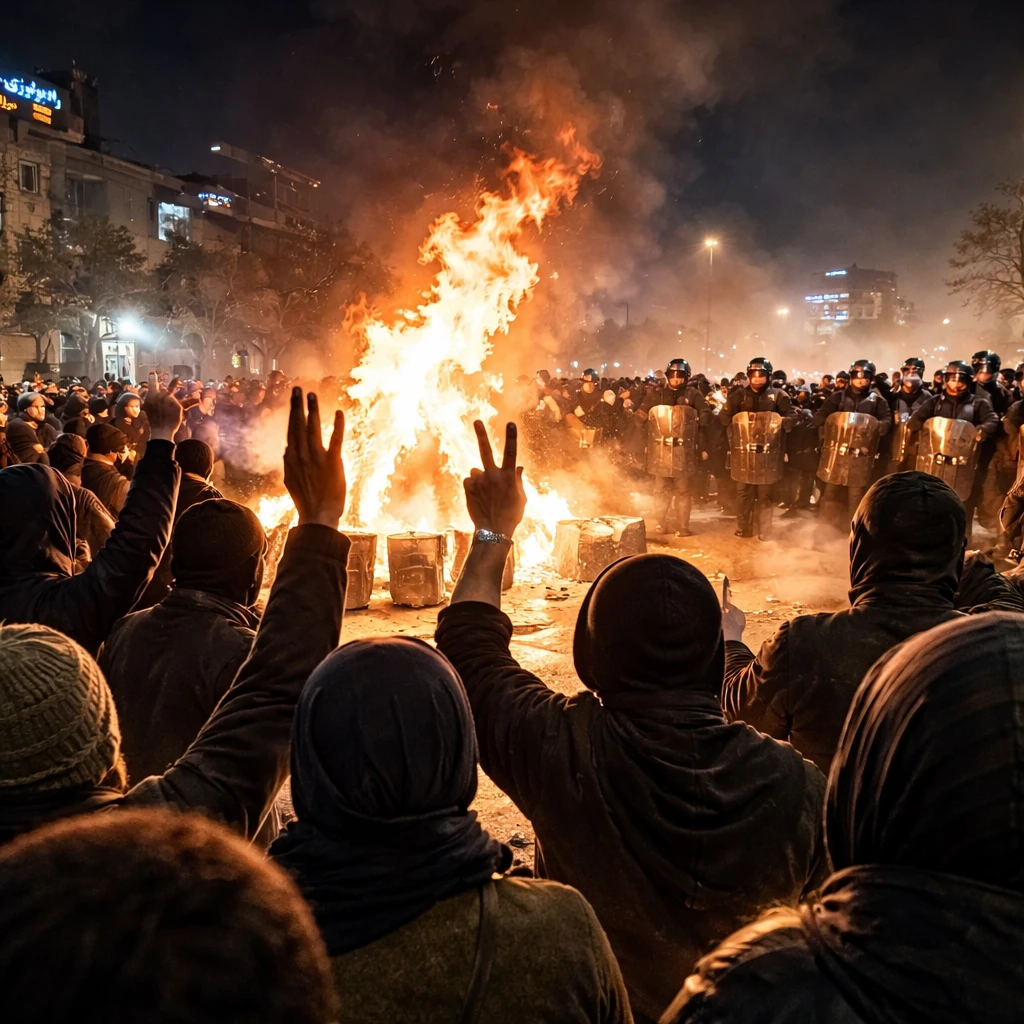
In the United Arab Emirates’ city of Dubai, analysts and observers are gaining a clearer understanding of the scale and severity of Iran's ongoing suppression of dissent—the most intense since the country's 1979 Islamic Revolution. Despite the Iranian government's extensive measures to isolate the nation from the global community by restricting internet access and severing communication lines, reports are surfacing that illustrate the extensive nature of the crackdown.
Urban centers across Iran bear the scars of recent violence. The distinct smell of smoke envelops cities and towns, a somber sign of the turmoil. Numerous mosques and government buildings have suffered extensive fire damage, their facades blackened and interiors gutted. Banks, integral to daily commercial transactions, have not been spared; many have been set ablaze and their automated teller machines vandalized. Official Iranian sources, as aggregated from state-affiliated IRNA news agency updates across more than twenty cities, estimate material damages exceeding $125 million.
Activists continue to report rising fatalities among demonstrators, suggesting these figures could be substantially underrepresented. According to human rights monitors, the Iranian government appears to have revived longstanding tactics of repression—albeit at a scale unmatched in recent decades—including the use of rooftop snipers targeting protestors, dispersing crowds with birdshot, and deploying Revolutionary Guard volunteers on motorcycles to brutally suppress those unable to flee.
From the perspective of Amnesty International representative Raha Bahreini, the majority of participants in the protests have demonstrated peacefully. Video evidence shows scenes of families, children among them, engaged in chants and celebrations around street bonfires, marching through neighborhoods. Bahreini emphasizes that the security forces’ response — involving unlawful firing upon the public — is deeply concerning.
The deaths of peaceful protesters and threats of large-scale executions have drawn international attention, in particular from the United States. President Donald Trump has previously stated that such developments represent a red line potentially justifying military action. Notably, an American aircraft carrier fleet is navigating towards Middle Eastern waters, raising concerns about the risk of confrontation following previous US strikes on Iran's nuclear sites.
The Iranian diplomatic mission to the United Nations has declined to provide detailed comments related to the ongoing demonstrations and the government’s efforts to quell them.
The origins of the unrest date back to December 28, escalating from the capital’s historic Grand Bazaar. Initially driven by frustrations over the exchange rate collapse of the Iranian rial, protests rapidly spread nationwide. January 8 marked a turning point, coinciding with calls to action by Reza Pahlavi, the country’s exiled crown prince, amplifying the scale of participation. Before communication channels were shut down, eyewitnesses estimated tens of thousands of people filled Tehran's streets.
Following the cut in telecommunications, gunfire echoed across the city’s districts. Bahar Saba of Human Rights Watch notes the unprecedented size of the crowds and criticizes the government’s reflexive reliance on lethal force and harsh repression as the sole responses to public demonstrations.
Deputy Interior Minister Ali Akbar Pourjamshidian confirmed publicly that over 400 cities have been involved in protests since violence intensified on January 8. On state television, Revolutionary Guard General Hossein Yekta issued warnings for families to keep children indoors and urged vigilance among regime loyalists to guard mosques and other strategic locations.
Experts attribute the authorities’ decision to escalate violence to the regime’s perception of an existential threat, further exacerbated by the repercussions of a brief conflict with Israel earlier in the year. Security forces appear to have implemented a calculated strategy to suppress protests forcibly, aiming to quell unrest rapidly through extensive force:
“The regime viewed this as a moment of existential threat and opted to apply lethal measures to prevent foreign influence and protest expansion, hoping to suppress the unrest conclusively,” stated Afshon Ostovar, a specialist in the Revolutionary Guard.
A critical component of Iran's repression apparatus is the Basij, an armed volunteer force integrated within mosques across the country. Semiofficial reports estimate nearly 80% of Basij bases are housed within mosques, consolidating their role in both community religious life and political enforcement. The connection between these religious sites and Basij presence is evident, yet remains underreported in state media, which focuses on mosque damage without contextualizing the dual role these venues serve.
Video footage has revealed Basij members armed with shotguns, batons, and pellet guns, alongside riot police outfitted with protective gear and firearms. Reports detail the intensive use of shotguns firing birdshot pellets into crowds, despite government denials, with numerous victims suffering severe eye injuries—a pattern resembling those observed in protests following Mahsa Amini’s death in 2022.
Tehran’s Farabi Eye Hospital, a specialist facility for ocular injuries, has reportedly activated all available medical personnel to address the influx of patients. Amnesty International's Bahreini notes a persistent and indiscriminate firing pattern aimed at large numbers of protestors, not isolated individuals, contributing to a climate of terror and physical harm.
Iranian authorities withheld consolidated casualty figures for several weeks but eventually provided an official total of 3,117 deaths, encompassing civilians, security personnel, and alleged terrorists. This contrasts with data from the Human Rights Activists News Agency, which estimates over 5,000 fatalities, including children and non-participants, verified through witness statements and official documentation.
The uncertainty surrounding the death toll highlights persistent challenges in verifying loss of life amid politically charged environments. Nonetheless, the government’s unprecedented acknowledgment of any fatality level underscores the intensity and scale of the unrest, and serves to justify ongoing mass arrests and communication blackouts.
State reports indicate daily detentions of dozens to hundreds of individuals and extensive property damage including hundreds of banks, government buildings, automated teller machines, and vehicles.
Looking ahead, there is growing concern regarding the potential for renewed demonstrations linked to cultural mourning periods occurring forty days following deaths. Tehran’s Behesht-e Zahra cemetery illustrates this trend, with large crowds attending funerals and chanting slogans against the governing leadership. Satellite imagery confirms persistent activity at burial sites of protest casualties.
Journalists working within Tehran report limitations imposed by the authorities, including closures restricting reporting on these memorial events. Elaheh Mohammadi, associated with a reformist publication, conveys a sense of widespread grief among the Iranian populace. She depicts a nation collectively mourning, stunned by losses and struggling to voice its sorrow amid restrictive conditions.