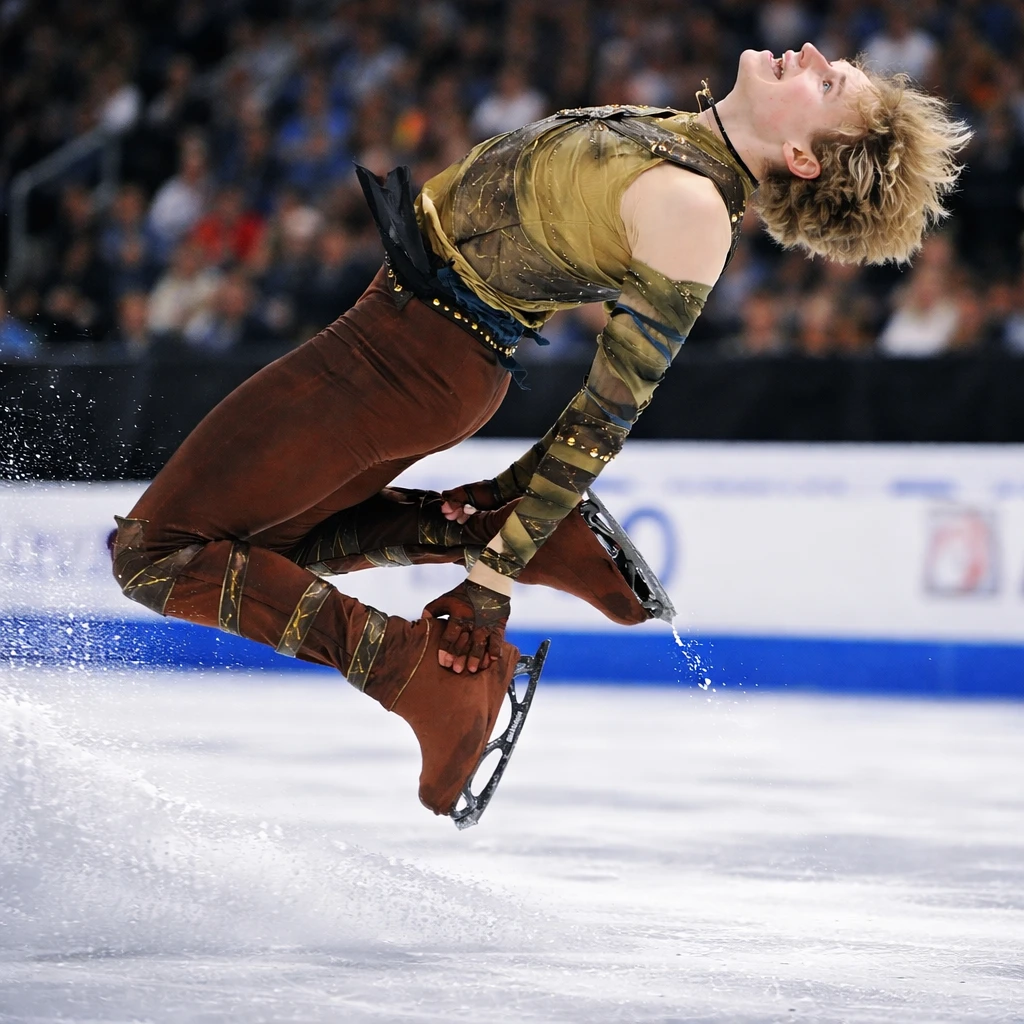

In a relatively under-the-radar competition held in upstate New York in September 2022, Ilia Malinin, dubbed the “Quad God” among figure skating aficionados, accomplished a historic milestone by successfully executing a quad axel jump. This jump, distinguished by its demanding forward-facing takeoff and requiring an additional 180 degrees of rotation beyond the standard quadruple jumps, had long been regarded as unattainable. Previous attempts by other skaters consistently ended in falls, affirming the jump’s formidable difficulty.
Malinin landed this groundbreaking maneuver at the iconic venue in Lake Placid, known for hosting the 1980 Winter Olympics where the U.S. hockey team famously triumphed over the Soviets, creating a resonating moment within both the skating community and the global sports audience. Two-time Olympian Jason Brown expressed his astonishment, remarking, “My mind was just blown.”
This achievement, while groundbreaking, has ushered in a pivotal question within the sport: what evolution follows such an unprecedented technical accomplishment?
Historically, figure skating’s core technical elements—the six primary jumps—have maintained consistency since the early 20th century, with the primary modifications relating only to the increased number of revolutions achieved. The progression from Dick Button’s pioneering double axel in 1948 and triple jumps in 1952, leading to Kurt Browning’s first quad toe loop in 1988, and subsequently Timothy Goebel executing the first quad salchow ten years later, illustrates the measured escalation of technical complexity within the sport.
Malinin’s successful quad axel may signify the ceiling of human biomechanical limits in figure skating, according to consensus among sports scientists. The rotational speed and height required to complete a five-revolution jump appear to exceed human physical capacity. This technical impasse places figure skating at a crossroads with a potential decline in technical innovation, threatening to diminish the sport’s appeal amidst broader challenges related to its popularity.
Nonetheless, Malinin remains optimistic about his progression. At 20 years old and favored to claim Olympic gold at the forthcoming Milan Cortina Games, he highlighted not only his ongoing development in jump and spin execution but also his pursuit of creative expression: “I haven’t reached my top, whether it’s in the technical and how much I can jump and spin, but also in the creativity.”
Malinin draws attention to his trademark “raspberry twist,” an original somersaulting spin distinct from traditional elements that consistently captivate audiences. However, this innovative move also underscores a structural challenge within the sport: the rigid scoring system seldom rewards creative deviations. Since the International Skating Union (ISU) mandates specific technical requirements for short and free skate programs, introducing unorthodox elements, such as the raspberry twist, carries disproportionate risks without corresponding scoring benefits.
Malinin commented on this conundrum, noting that despite his interest in integrating unique moves to enhance appeal, the scoring structure inhibits such innovation due to risk and marginal reward: “There are so many rules in your programs that you don’t have too much wiggle room.”
Reigning world champion Alysa Liu echoed this sentiment, emphasizing the restrictions imposed by technical regulations: “A lot of these rules really restrict us. Like, all of our spins look the same now, but they could look so different.”
American figure skating veteran Amber Glenn highlighted the disparity in how innovation is scored: “One of my training mates, Sonja Himler, does these incredible programs... spins the other way, jumps the other way — really cool things... But if I do the norm well, my scores will be better, even though what she does is way more impressive, in my opinion.”
Justin Dillon, high performance manager for U.S. Figure Skating, acknowledged the difficulty balancing individuality with scoring efficacy. Athletes often attempt unique routines but face decisions about whether the potential scoring penalties outweigh their creative ambitions. Dillon stated, “I encourage individuality... but if they do something so avant-garde that it doesn’t check those boxes, then it really doesn’t serve them.”
In recent years, the ISU has relaxed some restrictions, such as permitting the backflip—previously banned for safety concerns—though the move does not carry significant scoring value. This raises questions about whether reintroducing moves with greater risk and spectacle could rejuvenate interest and innovation in the sport.
Amber Glenn voiced both admiration and caution regarding the backflip, describing it as frightening yet exciting, and suggested she might pursue it post-retirement rather than as a competitive element.
Jason Brown, known for his artistry rather than quad jumps, tends to avoid the technical extremes but remains competitive through meticulous triple jump execution and exceptional artistic presentation. He proposed that future advancements in figure skating may be less about pushing technical boundaries and more about enriching artistic storytelling. Brown explained, “The more that people fixate on executing an element, the less risk people take artistically... maybe the next step for figure skating is to reward the story we’re trying to tell.”
As figure skating stands today, Malinin’s quad axel symbolizes the zenith of current human athletic possibilities within the sport. Meanwhile, the interplay between technical innovation, artistic expression, and stringent judging rules shapes a complex environment where the future direction of figure skating remains uncertain.