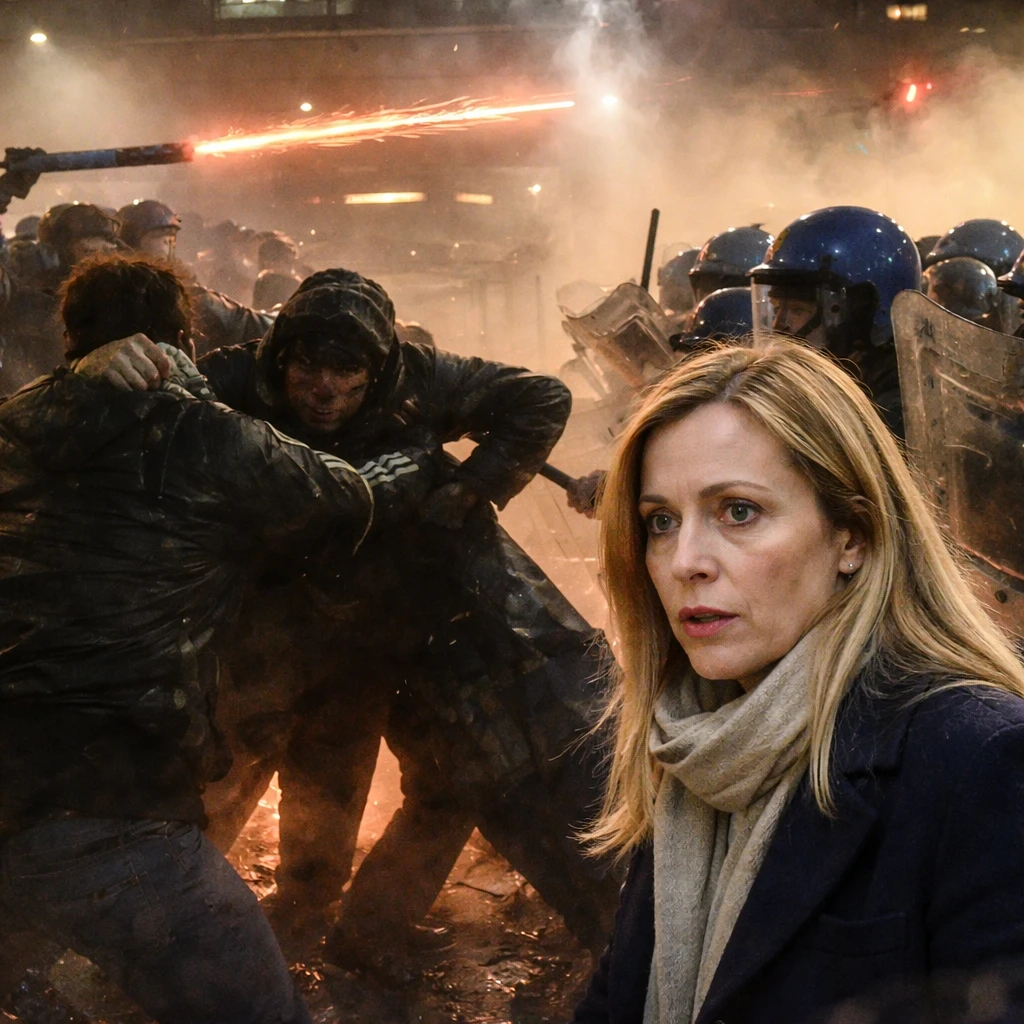

In Milan, Italian Prime Minister Giorgia Meloni issued strong rebukes early Sunday against a wave of protests and infrastructure sabotage targeting the ongoing Winter Olympics, labeling those involved as serious adversaries to the country. Speaking via a Facebook statement, Meloni criticized demonstrators opposing the Olympics and implicated them in deliberate actions that hindered the event’s logistics and international image.
"These individuals challenge the Olympic Games and intentionally create disruptions that are broadcasted worldwide. Additionally, there has been sabotage where railway cables have been severed to stall train departures," Meloni stated. She emphasized the commitment of thousands of Italians, many volunteers, who strive to ensure the smooth execution of the Winter Games. She also extended solidarity to law enforcement, Milan’s administration, and all those whose efforts are obstructed by what she described as criminal factions.
Responding to the sabotage suspicions, Italy’s transport ministry revealed a terrorism investigation into coordinated attacks on railway lines across northern Italy that occurred Saturday, coinciding with the tournament’s opening day. The initial damage was reported near the Bologna rail hub, a vital junction managing traffic between Italy’s north and south, where infrastructure was either burned or physically cut around 6 a.m. before sunrise. Subsequent incidents harmed rail lines near Pesaro along the Adriatic coast, resulting in widespread delays impacting thousands of passengers.
No group has publicly taken responsibility for these destructive acts, according to Italian news agency ANSA. The transport ministry indicated intentions to pursue substantial financial reparations from those responsible for the disruptions.
The unrest extended to city streets where, on Saturday evening, riot police deployed tear gas and water cannon against groups of protesters who threw firecrackers and attempted to access a highway adjacent to an Olympic venue in Milan. This violent episode followed a largely peaceful march involving thousands of participants expressing concerns over the environmental consequences of the Games as well as opposition to the deployment of U.S. security personnel in Italy. The violent elements were perceived as distinct from peaceful protesters, triggering a brief but intense confrontation.
This sequence of events transpired in the context of recently enacted Italian security legislation, approved by Meloni’s government, that grants authorities broader powers to detain individuals suspected of intending to provoke disruptions during protests, for up to 12 hours. Critics from opposition parties have raised alarms over potential infringements on freedom of expression stemming from this decree.
The International Olympic Committee (IOC) responded to the disturbances by reiterating that while peaceful demonstration is a legitimate right, violence has no place at the Olympic Games. "We draw a clear line at violence," IOC spokesperson Mark Adams declared during their daily media briefing. Law enforcement efforts succeeded in preventing violent protesters from advancing toward the SantaGiulia Olympic ice hockey rink, and by that point, the majority of the larger peaceful demonstration had concluded and dispersed.
The major peaceful gathering, estimated by police at around 10,000 attendees, featured symbolic actions such as the carrying of cardboard trees, representing those removed to construct the new bobsled track in Cortina. Participants engaged in cultural expressions, including drum-backed dance performances and loud music broadcast from a lead truck. An anthem with profane lyrics criticizing U.S. Immigration and Customs Enforcement (ICE) was notably part of the program.
Earlier in the day, some masked protesters ignited smoke bombs and firecrackers on a bridge overlooking an Olympic Village construction site housing approximately 1,500 athletes, located roughly 800 meters from the protest's main route.
The timing of the protests coincided with a visit by U.S. Vice President JD Vance, who was in Milan as head of the American delegation. Vance's official activities included a visit to Leonardo da Vinci’s “The Last Supper,” situated further from the protest zone. One central point of discontent was the presence of ICE personnel assigned to protect the U.S. delegation. However, official sources clarified that deployed officers are from Homeland Security Investigations, an ICE investigative division focusing on cross-border crimes, not the Enforcement and Removal Operations unit known for immigration enforcement on U.S. soil.
This demonstration followed a similar protest held the previous week against the deployment of ICE agents. Despite official reassurances that ICE operatives would operate strictly within U.S. diplomatic premises and refrain from street patrols in Italy, demonstrators voiced ongoing opposition to their presence during the Games.