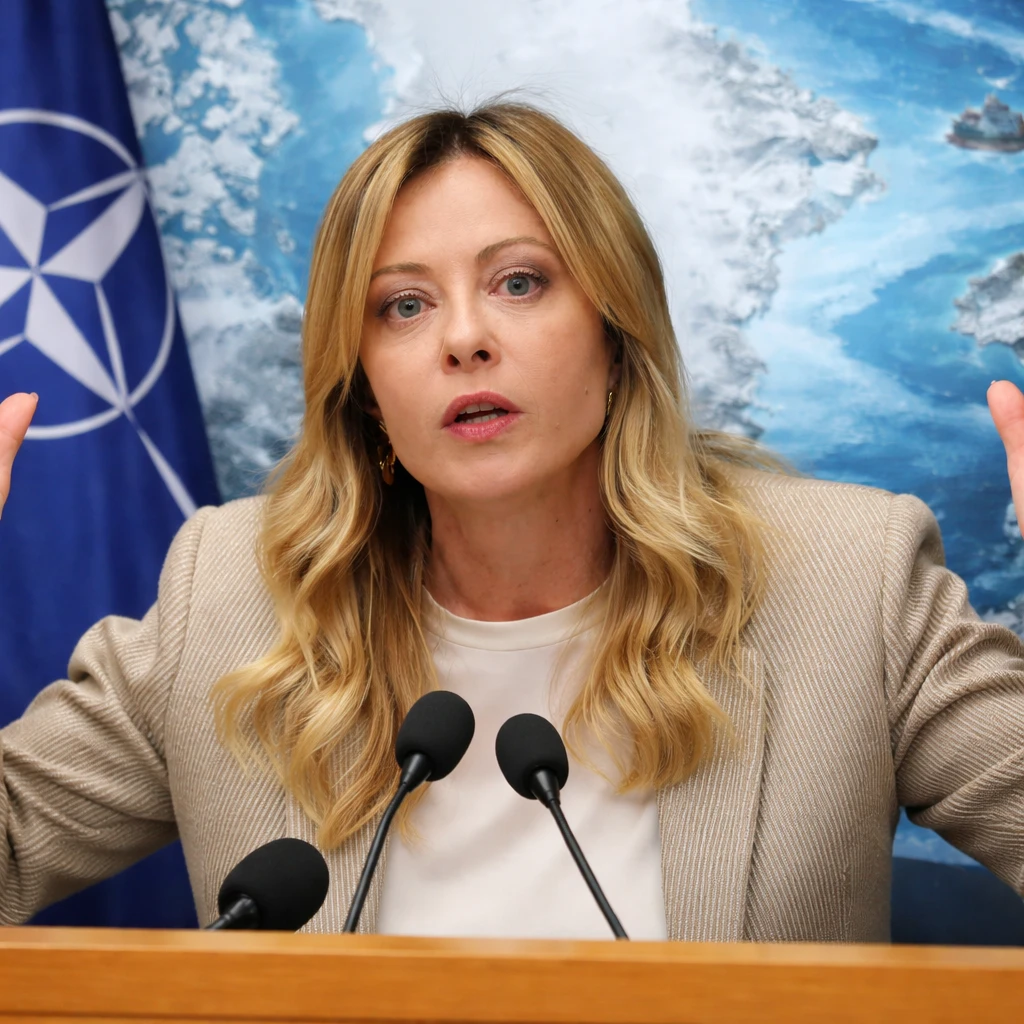

In a recent New Year press conference, Italian Prime Minister Giorgia Meloni addressed growing concerns regarding the strategic importance of Greenland and the Arctic region. She explicitly expressed her skepticism about the United States undertaking a military campaign to seize Greenland, a territory with significant mineral wealth and geopolitical significance. Greenland, while semi-autonomous, remains part of Denmark, a NATO member, complicating any unilateral military ambitions in the region.
Meloni underscored that resorting to military measures over Greenland would serve no one's interests and could result in serious ramifications for NATO's cohesion and operations. Highlighting Italy’s stance, she clearly stated that her country would not endorse any such military initiatives.
The backdrop to Meloni's remarks involves a statement from the White House indicating that the US administration is evaluating various options, including military action, to secure the strategically valuable island. This response prompted international dialogue over the appropriate approach to Arctic security and the role of existing alliances.
Drawing attention to previous US policy approaches, Meloni suggested that the prior administration under President Trump, known for its assertive strategies, had focused global attention on the Arctic's strategic relevance. She acknowledged that the region witnesses activity from multiple foreign actors, some potentially hostile, and noted the US's clear message opposing external moves destabilizing this area.
The Italian leader emphasized that reinforcing NATO's footprint in the Arctic could address American concerns about rival powers potentially expanding their influence in this vital region. This approach would provide a collective security framework rather than unilateral action.
Known for her alignment with President Trump’s policies in Europe, Meloni positioned herself as a mediator attempting to balance the diverse interests of the United States and the European Union. She emphasized that any American military move on Greenland would likely have extensive consequences for NATO, reflecting the alliance's collective nature and shared responsibilities.
President Trump has previously articulated ideas about buying Greenland from Denmark, a notion that has resurfaced following recent US military activities in Venezuela, accompanied by renewed calls for direct American control of the island citing strategic imperatives.
Leaders from several European NATO countries, including Britain, France, Germany, Italy, Poland, and Spain, have collectively defended Denmark's sovereignty over Greenland, a stance consistent with established international recognition dating back to early 20th century US policy.
Responding to queries intersecting US foreign policy and Italian diplomacy, Meloni affirmed the importance of respecting international law and noted that Italy’s foreign policy pillars remain rooted in its commitments to Europe and the Atlantic alliance. She acknowledged that absolute consensus among allies is rare, as national interests do not always align perfectly.
This position underscores Italy’s approach toward maintaining alliance solidarity while navigating complex geopolitical challenges presented by the Arctic’s increasing prominence on the international stage.