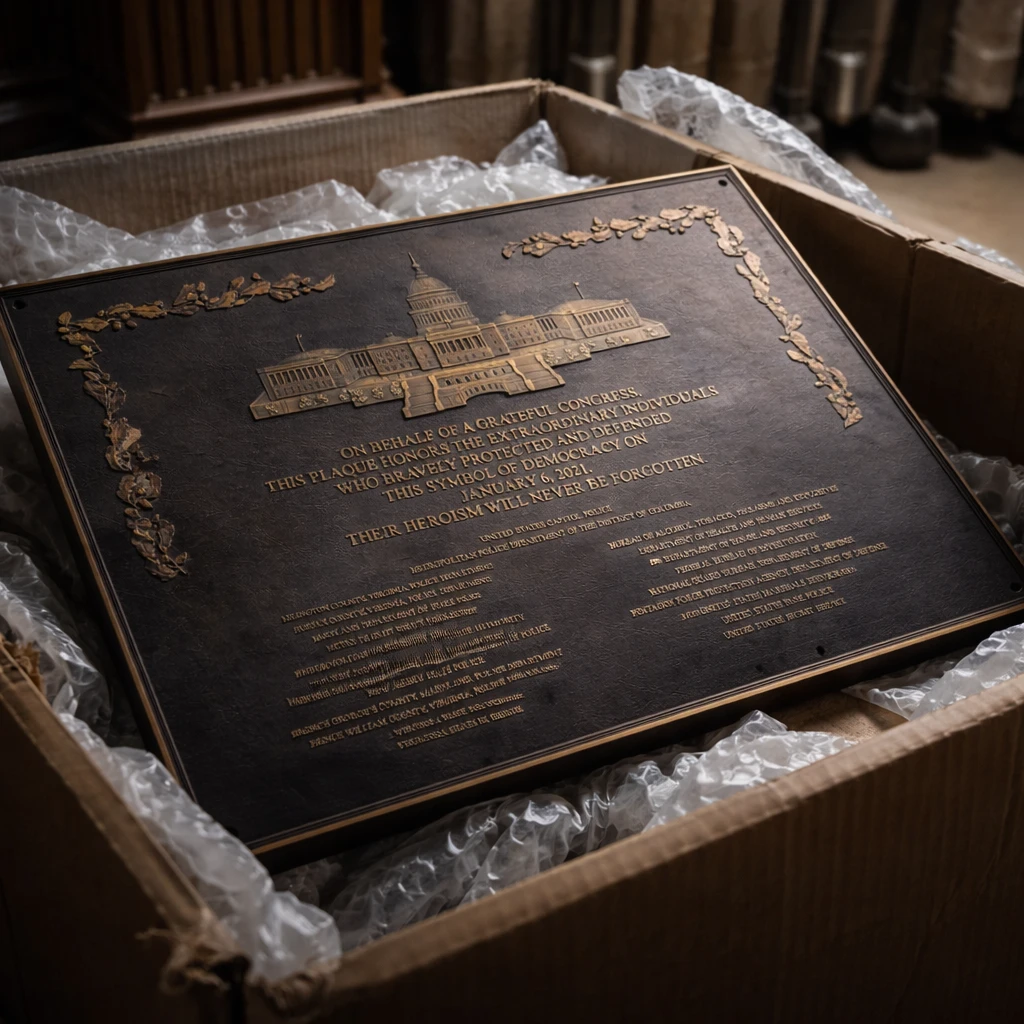

With the fifth anniversary of the January 6, 2021 assault on the U.S. Capitol approaching, a significant symbol honoring those who protected the seat of American democracy remains missing from public view. The official commemorative plaque, intended to pay tribute to the police officers defending the Capitol during the insurrection, is neither displayed as mandated by law nor is its exact location publicly acknowledged. Sources indicate that it is likely kept in storage.
House Speaker Mike Johnson of Louisiana has not yet carried out a formal unveiling of the plaque. Concurrently, the Department of Justice under the prior administration is actively seeking dismissal of a lawsuit brought forward by police officers demanding the plaque's public exhibition as legislatively intended. The Architect of the Capitol, entrusted with procuring and displaying this plaque, has declined comment due to ongoing federal litigation.
In a bid to safeguard the memory of this pivotal day, around 100 members of Congress, predominantly Democrats, have independently installed poster board replicas of the plaque outside their offices. This grassroots effort has resulted in a proliferation of unofficial tributes throughout the Capitol complex.
One such replication bears the inscription: "On behalf of a grateful Congress, this plaque honors the extraordinary individuals who bravely protected and defended this symbol of democracy on Jan. 6, 2021. Their heroism will never be forgotten."
Official Recognition Missing From Nation’s Capital
Washington, D.C., a city abundant with monuments commemorating the nation’s history, was to host this modest, permanent marker near the Capitol’s west front where some of the fiercest clashes occurred during the attack. However, with the absence of the plaque, the Capitol currently lacks an official reminder for visitors of the unprecedented violent breach carried out by supporters of then-President Donald Trump. The absence enables conflicting narratives to arise around the events of that day and potentially allows for historical revisionism.
Statements from officials during the immediate aftermath of January 6 made it clear that the attack was perceived as an "insurrection." Both Senate and House GOP leaders at that time condemned the violence, calling it a profoundly saddening moment. Yet, those denunciations have weakened as rhetoric around the event has evolved, with former President Trump referring to the day as a "day of love," and the current House Speaker Johnson—who questioned the 2020 election results—yet to advance formal recognition of the officers with the plaque.
Douglas Brinkley, a history professor at Rice University, reflected on the event’s historical significance, questioning whether January 6 will be remembered as a crucial moment when American democracy was threatened or regarded as an aberration. He notes the lack of widespread consensus even five years later.
Enduring Impact Despite Shifting Memory
The Capitol breach resulted in five fatalities, including Ashli Babbitt, a Trump supporter fatally shot while attempting to enter the House chamber. Over 140 officers were injured, some seriously, and several law enforcement personnel later died by suicide. Approximately 1,500 individuals have faced federal charges related to the events, constituting one of the largest prosecutions in modern U.S. history. Upon his return to office in January 2025, Trump pardoned all associated defendants within hours.
Unlike memorials marking prior tragedies such as the 9/11 attacks or the Oklahoma City bombing, January 6 lacks a dedicated physical tribute, creating a gap in remembrance and collective healing. Representative Mary Gay Scanlon emphasized the importance of the plaque as a gesture of respect for those who served courageously that day.
Legal Challenges Surrounding the Plaque
Although the Speaker's office has previously indicated efforts toward plaque installation, it declined further comment. The plaque was approved by Congress in March 2022 as part of a government funding bill, with a one-year deadline set for its installation. The legislation explicitly acknowledged the nation's debt to the officers and mandated the plaque to include the names of those who responded on January 6.
This summer, two officers who confronted the rioters filed a lawsuit citing the failure to display the plaque as an abandonment of their service and an encouragement of historical distortion. Officers Harry Dunn and Daniel Hodges argued that by not fulfilling legal requirements to honor the officers, Congress undermines their recognition.
In response, the Justice Department has moved to dismiss the lawsuit. The department contends that Congress has already publicly recognized law enforcement service through the plaque's approval, and that physically installing it would not protect the plaintiffs from alleged threats stemming from their law enforcement duties. The department further notes the complexity of including all roughly 3,600 officers involved in the response.
Grassroots Memorial Efforts and Polarized Remembrance
Members of Congress displaying replica plaques stress the significance of public awareness about January 6. Representative Jamie Raskin of Maryland, a member of the January 6 committee, underscores the educational value for newer generations unfamiliar with how close democracy came to being undermined that day. He anticipates the Capitol evolving into a site where visitors can learn about the event in depth.
Representative Zoe Lofgren of California, also part of the committee, highlighted the life-saving role the officers played and their rightful place for gratitude.
In contrast to initial bipartisan support for commemorations, current formal memorial events have become largely partisan affairs. The Democrats plan to convene members of the January 6 committee again to examine ongoing threats to electoral integrity, a session the Republican minority is expected to forgo participation in. Under Speaker Johnson’s direction, Republicans intend to establish their own committee to explore the "full truth" of the event, scheduling hearings in the near future.
Representative Joe Morelle of New York, who helped lead the efforts for the replica plaques, criticized attempts to "whitewash history" and highlighted the resolve among those who witnessed the day to maintain its memory. He pointed out the proliferation of unofficial plaques as emblematic of persistent remembrance despite the lack of formal acknowledgment—the hallways now host many such replicas, serving as a testament to collective memory within the Capitol walls.