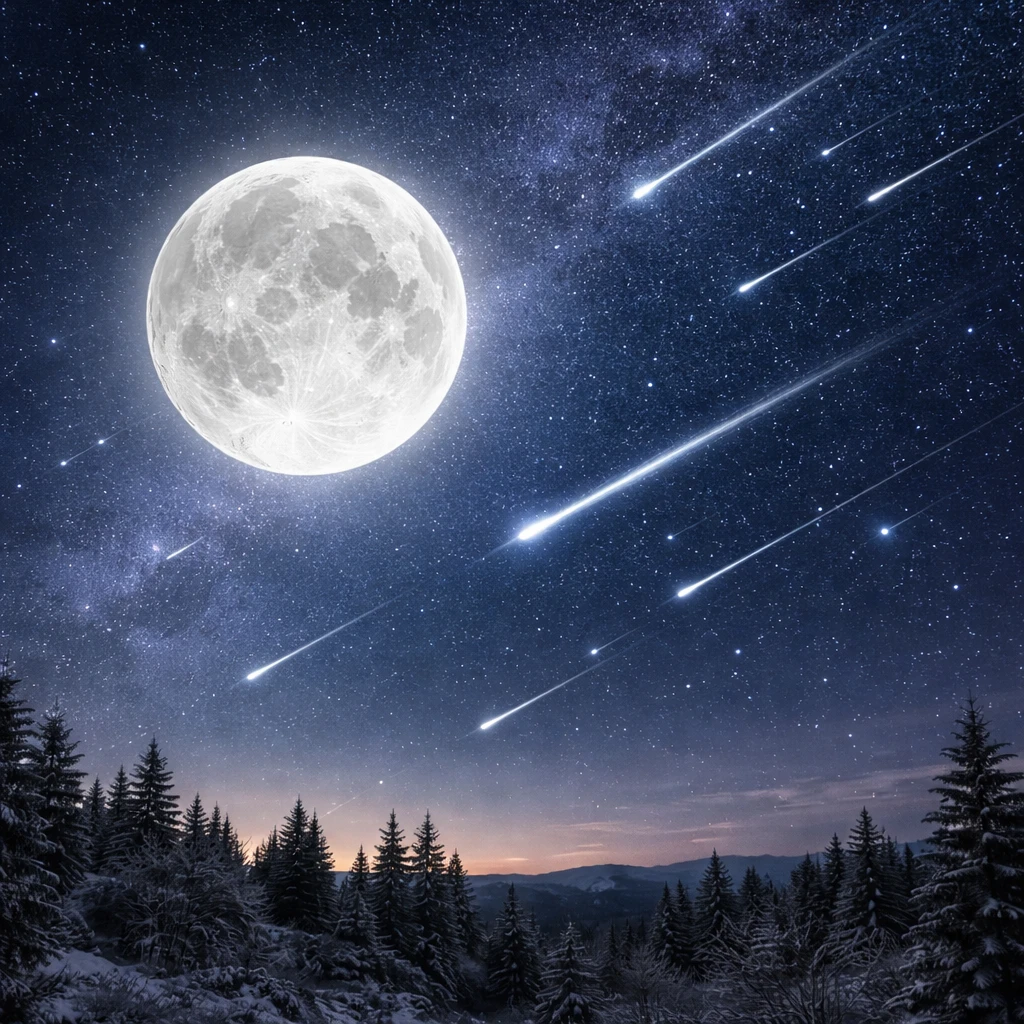

The start of the year brings a convergence of two significant astronomical events: the first supermoon of the year and the Quadrantid meteor shower. These events, both occurring in January, provide a spectacle in the sky. However, the luminous glow from the supermoon during Saturday night is expected to considerably reduce the number of meteors visible during the peak of the Quadrantids.
According to the American Meteor Society, the Quadrantid meteor shower reaches its peak from Friday night through early Saturday morning. In conditions free from light pollution, observers generally witness approximately 25 meteors per hour. Yet, due to the supermoon's brightness, this count will likely drop to fewer than 10 meteors per hour.
Mike Shanahan, who directs the planetarium at Liberty Science Center in New Jersey, explains, "The primary challenge in observing meteor showers is the presence of a full moon." The bright lunar light acts as a barrier, making it difficult to see the relatively faint meteor trails.
Meteor showers occur when swift meteoric particles enter Earth's atmosphere and combust, creating visible streaks of light commonly referred to as shooting stars. While individual meteors can be seen any night, annual showers like the Quadrantids are predictable because Earth crosses dense streams of space debris on a regular basis.
A supermoon happens when the full moon aligns closely with Earth in its elliptical orbit, appearing up to 14% larger and 30% more luminous compared to the year's least bright full moons, according to NASA data. This size and brightness difference may not be immediately striking to casual viewers but can significantly affect night sky observations.
These supermoons, much like standard full moons, can be observed from locations with clear skies during night hours worldwide. Conversely, the Quadrantid meteor shower is primarily visible from areas in the Northern Hemisphere. Importantly, viewing either event does not require any specialized astronomical equipment.
For those seeking to catch a glimpse of the Quadrantids, Jacque Benitez from the Morrison Planetarium at the California Academy of Sciences advises relocating away from urban light pollution and observing during the early evening before the moonrise impacts visibility. Alternatively, early dawn hours on Sunday could also offer viewing opportunities, albeit with similar lunar interference.
Observers should allow their eyes to adapt fully to the darkness and avoid using electronic devices that emit light, such as smartphones, to improve night vision. During peak times, meteors will present as swift, white points of light traversing the sky unpredictably.
Meteor showers derive their names from the constellations in whose direction the meteors seem to originate. The Quadrantids are associated with remnants of the asteroid 2003 EH1. Interestingly, the meteor shower’s name comes from a constellation called Quadrans Muralis, which is no longer officially recognized.
Looking ahead, the next substantial meteor shower, the Lyrids, is anticipated in April. Regarding supermoons, they occur several times each year and often appear in series. The upcoming supermoon on Saturday concludes a sequence that began four months prior, in October. Following this event, the next supermoon will not occur until late 2026.
Both the supermoon and meteor showers enrich the night sky and offer valuable opportunities for public engagement with astronomy, although the interplay of their timing requires adjustments in expectations for observation.