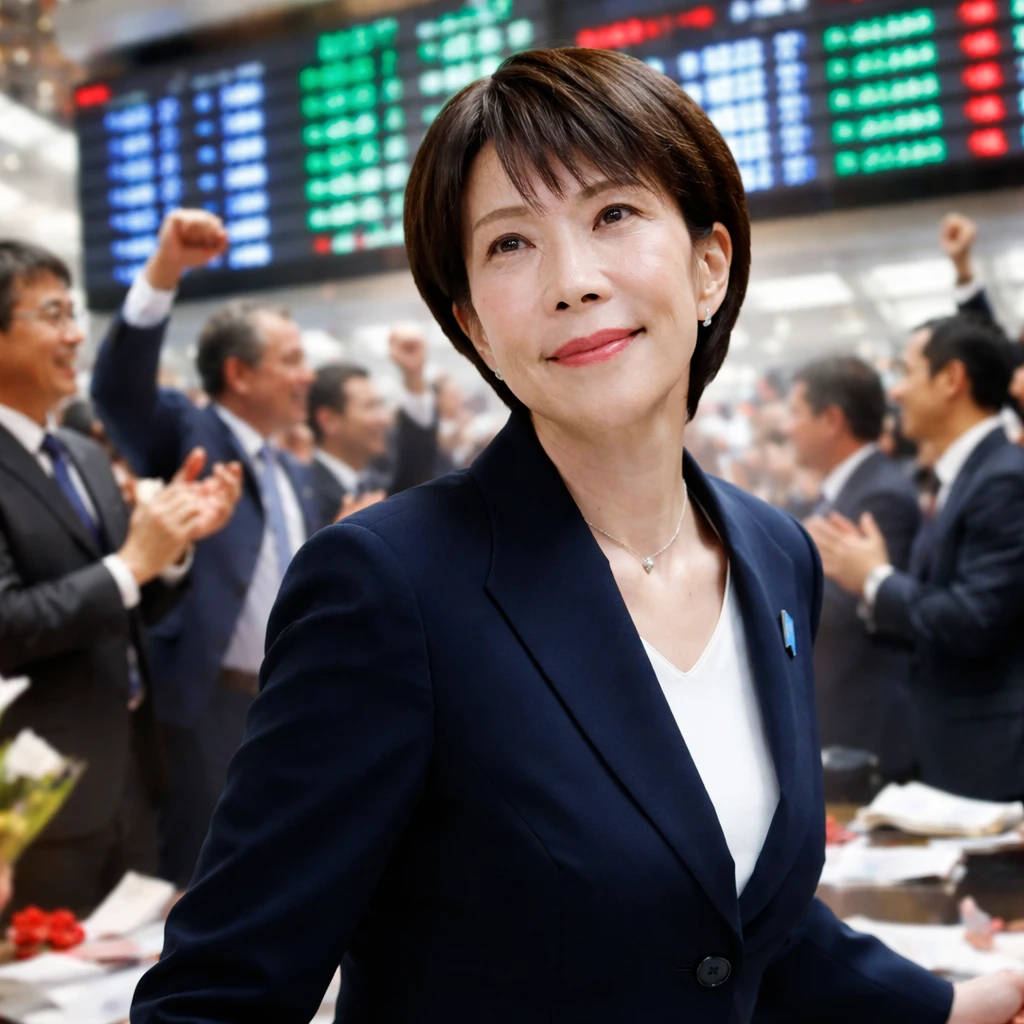

Tokyo's benchmark Nikkei 225 index experienced a substantial increase on Monday, rising as much as 5% to reach an unprecedented peak. This uptick followed a decisive victory by Prime Minister Sanae Takaichi's Liberal Democratic Party (LDP) in the recent parliamentary election, securing a supermajority with more than two-thirds of seats in the 465-member lower house. This commanding performance is historic, marking the LDP's largest turnout since its 1955 inception and surpassing the previous high of 300 seats achieved in 1986.
In response to this political development, markets throughout Asia also recorded gains. South Korea's Kospi surged by 4%, while indices in Hong Kong, Shanghai, Taiwan, and Australia posted advances ranging from 1.2% to 2.5%. These regional improvements coincided with a notable recovery on Wall Street the previous Friday, bolstered by strength in technology stocks and a pause in bitcoin's recent decline.
Specifically, the U.S. S&P 500 climbed 2%, marking its best daily performance since May. The Dow Jones Industrial Average jumped 1,206 points — a 2.5% gain — crossing the 50,000 threshold for the first time, while the Nasdaq composite rose 2.2%. These movements, including a rebound in chipmaker shares such as Nvidia and Broadcom, contributed to the positive global investor sentiment carrying into the start of the week.
Amid these market dynamics, political analysts observed that the electoral result eliminates a significant source of uncertainty. As noted by Stephen Innes of SPI Asset Management, the decisive LDP victory reduces political ambiguity that investors typically price in negatively. This clear majority provides Prime Minister Takaichi with increased latitude to pursue her agenda without the need for extensive compromise across factions.
Looking ahead, Takaichi’s immediate focus as the lower house reconvenes in mid-February will be advancing a budget bill delayed by the election. This legislation is intended to finance economic measures to address rising living costs and weak wage growth, signaling the government’s priority on stimulating Japan's economy.
By late morning, the Nikkei 225 maintained a 4.7% gain at 56,788.85 after briefly surpassing the 57,000 mark earlier in trading, setting a new record. The Kospi was up 4.3% at 5,308.84. The U.S. dollar experienced a slight decline against the Japanese yen, trading at 156.85 yen from 157.19 yen on Friday. Other regional indicators also reported gains: Hong Kong’s Hang Seng index increased 1.5% to 26,963.25; Shanghai Composite climbed 1.2% to 4,112.92; Taiwan’s Taiex added 2.5%; and Australia’s S&P/ASX 200 rose 1.9%, reaching 8,873.60.
Regarding commodities, gold showed renewed strength, climbing 1.8% to settle at $4,979.80 an ounce, with silver edging up 0.2%. Early Monday trading saw gold increase further by 0.7%, while silver rose 4.8%. Conversely, crude oil prices fell moderately, with U.S. benchmark crude retreating 55 cents to $63.00 per barrel and Brent crude dropping 66 cents to $67.39 per barrel.
Regarding cryptocurrencies, bitcoin stabilized after a prolonged decline, recovering above the $70,000 level following a dip near $60,000 late Thursday. Despite the recent volatility, the cryptocurrency's adjustment has provided some measure of relief to investors.
In the broader equity markets, although Friday's rally helped pare losses, the S&P 500 still faced its third weekly loss in four weeks. Market concerns centered on potential impacts from AI developments on software companies and reduced spending by major technology firms. The release of AI tools automating sectors like legal services compounded pressure on software stocks, underscoring uncertainties within specific industries despite the overall positive market tone.