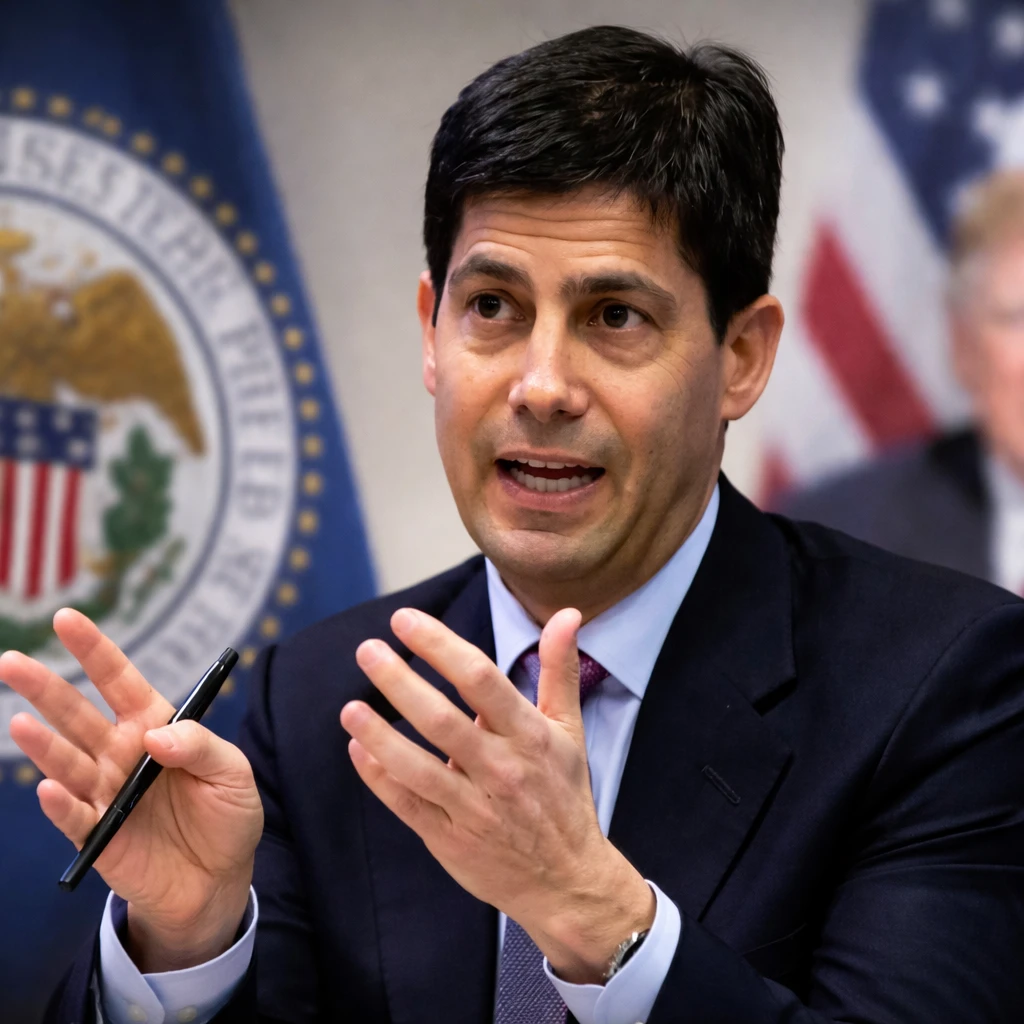
President Donald Trump has declared his plan to appoint Kevin Warsh, a former Federal Reserve governor, as the next chairman of the Federal Reserve, aiming to replace Jerome Powell in May. Trump expresses confidence that Warsh’s leadership will finally deliver the sustained economic growth he promised during his campaign.
When Trump described Warsh as coming from “central casting,” he indirectly revealed his perception of Warsh as embodying the conventional appearance and background expected of a Federal Reserve chief. Warsh, 55, notably fits many typical criteria for the position, yet the timing of his nomination is marked by a departure from traditional Fed policy, with Trump seeking significant interest rate reductions to meet his economic objectives.
While such cuts could spur short-term economic expansion, they carry the risk of overheating a currently robust economy where inflation remains elevated, and affordability continues to challenge many Americans.
Previously considered a strong candidate during the 2017 Fed chair selection, Warsh was ultimately passed over in favor of Powell—whom Trump later criticized as the result of poor counsel.
Warsh holds degrees from Stanford University and Harvard Law School and is married to Jane Lauder, daughter of billionaire Republican donor Ronald Lauder. At 35, he was the youngest member appointed to the Fed’s seven-person board, with service spanning from 2006 to 2011. His prior roles include economic advisory for the George W. Bush administration and a stint as an investment banker at Morgan Stanley.
During the 2008-2009 financial crisis, Warsh collaborated closely with then-Fed Chair Ben Bernanke as the central bank deployed aggressive measures to counter the Great Recession. Bernanke later praised Warsh as a trusted counselor, highlighting his valuable political insight, market expertise, and Wall Street connections.
Nonetheless, Warsh’s judgment during the crisis raised questions; he initially advocated for maintaining higher benchmark interest rates even as mortgage defaults and layoffs intensified. He expressed concerns that further rate reductions might trigger inflation, a concern that did not materialize as rates approached near zero and inflation remained subdued.
In 2011, Warsh opposed the Fed’s plan to purchase $600 billion in Treasury bonds aimed at lowering long-term interest rates, although he eventually supported the initiative under Bernanke’s influence.
Warsh’s economic philosophy has at times diverged from the current Republican stance. For example, in 2010 he criticized trade protectionism as contrary to growth policies, a position contrasting with Trump’s recent imposition of significant import tariffs under a declared economic emergency.
Currently, Warsh is a visiting economics fellow at Stanford University’s Hoover Institution and lectures at the Stanford Graduate School of Business. He is also a partner at the Duquesne Family Office, overseeing the wealth of investor Stanley Druckenmiller.
In recent months, Warsh has actively campaigned for the Fed chair role, undertaking media appearances and publishing articles sharply critical of the current Federal Reserve leadership. He has called for “regime change” in Fed policy, criticizing Powell for addressing issues like climate change and diversity—matters Warsh asserts lie outside the central bank’s mandate.
In a July interview with CNBC, Warsh characterized Fed policy as fundamentally flawed, highlighting a dramatic shift since his appointment in 2006. He blamed the Fed for permitting inflation to rise excessively in 2021 and 2022, labeling it the most significant macroeconomic policy error in 45 years that exacerbated national divisions.
Writing in The Wall Street Journal in November, Warsh argued against the conventional view that inflation stems from excessive economic growth and wages. Instead, he attributed inflation to government overspending and money creation.
He anticipates that advances in technology, particularly artificial intelligence, will enhance productivity and thus ease inflationary pressures. This perspective aligns closely with Trump’s optimism about suppressing inflation and leveraging AI to drive economic growth within the year.
Warsh’s assertion that AI represents a notable disinflationary force underscores his belief that technological innovation will boost U.S. competitiveness and productivity, contributing positively to economic dynamics.