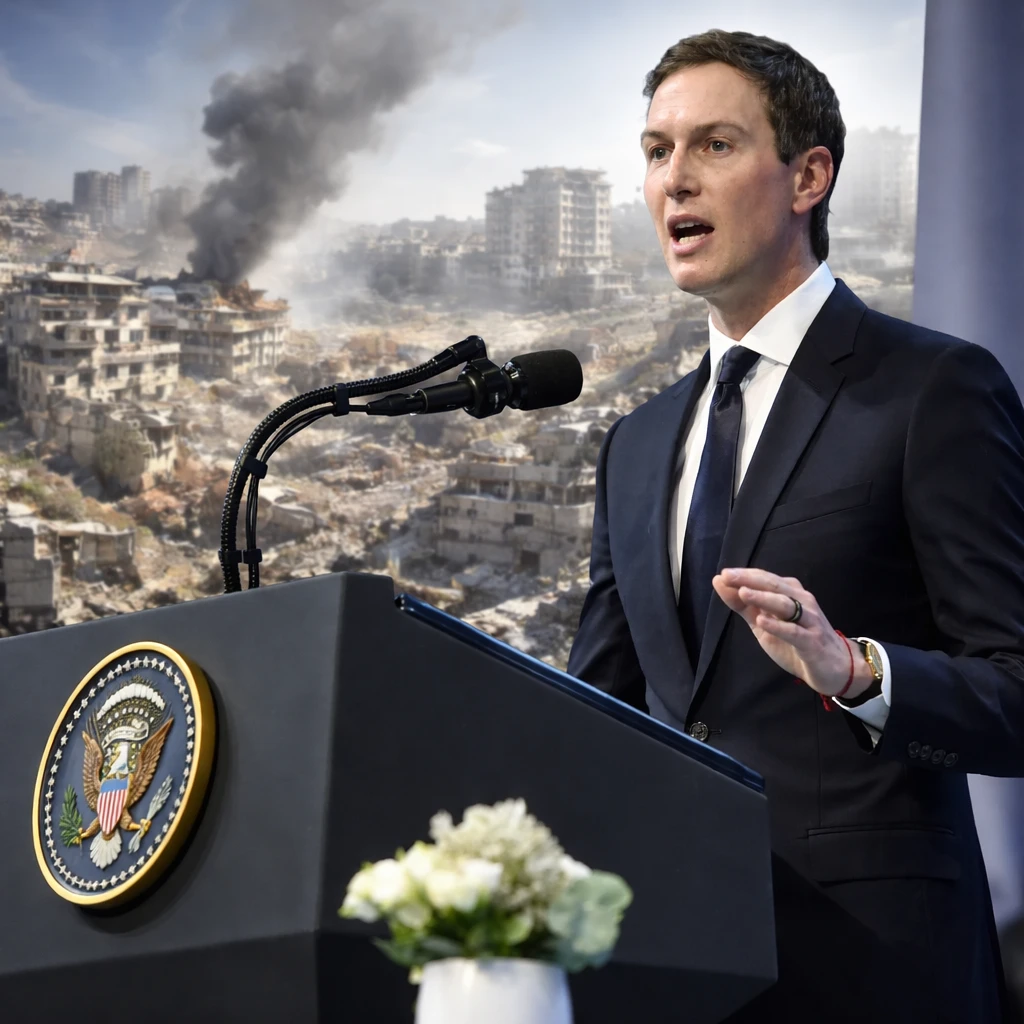

Jared Kushner, advisor to the U.S. President on Middle East affairs and son-in-law to Donald Trump, recently unveiled an ambitious blueprint for rebuilding Gaza into a contemporary metropolis. Speaking briefly at an economic forum in Davos, Switzerland, Kushner described plans for sleek high-rise buildings, a reclaimable coastline attractive to tourists, and a state-of-the-art port extending into the Mediterranean Sea.
His presentation proposed that Gaza's war-torn urban centers, devastated after over two years of conflict between Israeli forces and Hamas, could be reconstructed swiftly if adequate security conditions are met. "In the Middle East, they build cities like this ... in three years," Kushner asserted, emphasizing the feasibility of such rapid development if stakeholders cooperate to enable it.
This optimistic timeline sharply contrasts with projections from the United Nations and Palestinian authorities, who anticipate a prolonged restoration requiring extensive removal of rubble and demining operations. Currently, Gaza’s population, numbering near 2 million, resides amidst widespread devastation characterized by piles of concrete ruins, lurking unexploded ordnance, contaminated water spreading disease, and streets reduced to barren dirt pathways.
The United Nations Office for Project Services estimated that the territory has over 60 million tons of debris, filling approximately 3,000 container ships, a clearance effort expected to span more than seven years, followed by further time needed for disarming landmines.
At the same time Kushner spoke, world leaders gathered to formalize the establishment of the Board of Peace, an international entity assigned oversight of the ceasefire agreement and Gaza’s reconstruction process. The reconstruction endeavor's success is heavily dependent on establishing security within Gaza — a significant and uncertain condition.
Hamas’s position remains a pivotal factor; while the group holds to its claimed right to resist Israeli ground presence and maintains its armed capabilities, it has indicated openness to freezing weapons as a step toward Palestinian statehood. Yet, Israeli troops continue operations resulting in numerous casualties in Gaza, including civilians, despite the ceasefire that began in October.
The Board of Peace is engaged in de-escalation efforts and is spearheading initiatives aimed at Hamas’s demilitarization under the supervision of the U.S.-supported National Committee for the Assessment of Gaza (NCAG). This body is expected to gradually assume control and eventually transition governance from Hamas to a reformed Palestinian Authority. However, Hamas’s commitment to disarmament and the fate of its forces remains ambiguous since the group took control of Gaza in 2007.
Complicating the security landscape are other armed factions within Gaza, which Kushner’s presentation indicated would need to be dismantled or assimilated under NCAG’s authority. Israel has reportedly supported alternative armed groups and local gangs during the war to counterbalance Hamas’s influence. Kushner stressed that absent security guarantees, investor confidence and job market revitalization in Gaza would likely fail to materialize. Joint estimates from the United Nations, European Union, and World Bank calculate reconstruction costs at approximately $70 billion. Further, Kushner’s materials highlight that rebuilding will not commence in zones lacking full disarmament.
One notable omission from Kushner's framework is the interim arrangements for Gaza’s displaced residents during reconstruction. With wide areas contaminated by unexploded ordnance, clearance and rebuilding will displace many inhabitants. Currently, families shelter in densely populated areas near Gaza City and along the coast, which in the future are proposed as tourism zones with modern infrastructure. Residents express concern that the envisioned high-rises may replace traditional neighborhoods, potentially limiting their ability to return to former homes or rebuilding in their accustomed communities.
Individuals like Ahmed Awadallah, sheltering in displaced persons’ camps in Khan Younis, aim eventually to resume life near their original dwellings, an aspiration made uncertain by high-rise redevelopment plans. Another resident, Bassil Najjar, whose home lies in areas presently under Israeli control, expressed despair about ever returning.
Kushner’s plan proposes new thoroughfares, a revived airport (replacing one demolished over two decades ago), a new port, and diverse residential zones interspersed with parks, agricultural fields, and sports facilities. The vision also envisions spaces dedicated to advanced manufacturing, data centers, and an industrial complex, though details on the specific industries intended to occupy these zones are undeveloped.
The initial reconstruction phase prioritizes workforce housing in Rafah, a southern city heavily damaged in the conflict and currently under Israeli military oversight. According to Kushner, rubble clearance and demolition are already underway, yet he did not outline processes for demining or address ongoing restrictions affecting access to heavy machinery necessary for large scale clearance, as cited by the United Nations and other rights organizations.
Following Rafah, the effort would proceed to rebuild Gaza City, referred to in materials as "New Gaza," envisioned as a hub of employment opportunities and modern urban life.
However, critics including international legal experts view the redevelopment plans as overly optimistic and grounded more in commercial real estate perspectives than pragmatic peacebuilding. For instance, the extensive high-rise constructions pose strategic concerns for Israel, as they could afford lines of sight to sensitive military installations near the Gaza border.
Moreover, the transfer of authority from Hamas to the Palestinian Authority, as suggested by Kushner’s roadmap, faces strong opposition from Israeli Prime Minister Benjamin Netanyahu, who rejects proposals involving the Palestinian Authority's role in Gaza's postwar administration. The Palestinian Authority itself contends with low public trust and accusations of corruption in its current western territories governance, further complicating reconciliation prospects.