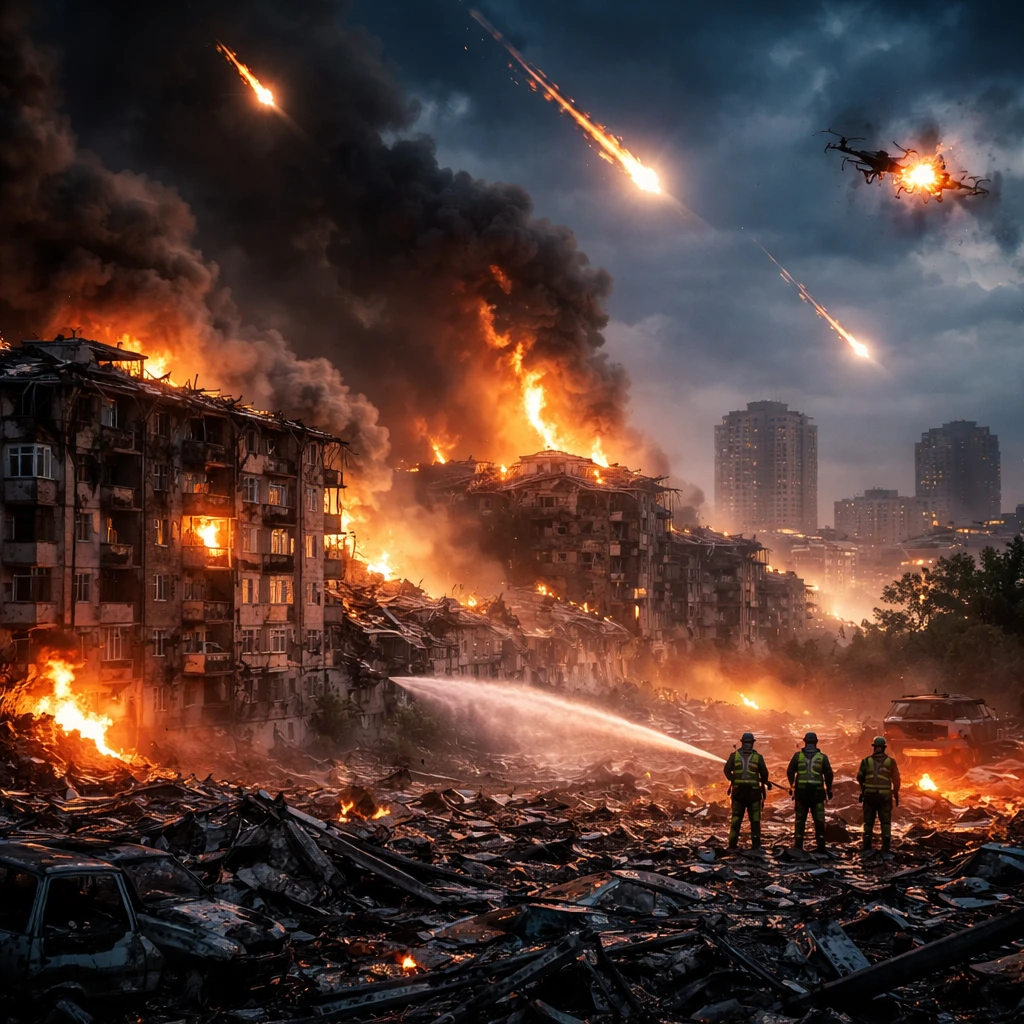

In the early hours of Saturday, Kyiv came under a coordinated attack involving ballistic missiles and drones launched by Russian forces, causing at least one confirmed death and injuring 27 individuals according to Ukrainian authorities.
The assaults continued intermittently throughout the morning, shaking the Ukrainian capital with multiple explosions, just one day before planned negotiations between Ukrainian President Volodymyr Zelenskyy and U.S. President Donald Trump in Florida. These talks are expected to focus on advancing peace efforts after nearly four years of conflict.
Zelenskyy indicated that discussions with Trump will cover security assurances and the situation concerning territorial disputes, specifically referencing the Donetsk and Zaporizhzhia regions. Following a stopover in Canada where he met with Prime Minister Mark Carney, Zelenskyy criticized the Russian offensive, interpreting the strike as a deliberate counteraction to Ukraine's peace initiatives.
Carney concurrently announced a $1.8 billion aid package designed to unlock broader international financing for Ukraine's reconstruction and development. He underscored the importance of solidarity with Ukraine amid what he termed acts of "barbarism," citing the recent attacks.
The Russian Defense Ministry described its overnight actions as a "massive strike" deploying sea, air, and land long-range precision-guided weapons, notably including Kinzhal hypersonic aeroballistic missiles, alongside drones. Official statements characterized the military objectives as targeting infrastructure leveraged by Ukrainian military forces and industrial enterprises. However, multiple residential structures sustained damage during these strikes.
Russia justified the attacks as retaliatory, responding to Ukrainian operations against civilian targets within Russian territory. Earlier that day, Russian air defenses reportedly intercepted seven Ukrainian drones near Krasnodar and Adygeya regions, and subsequently claimed the downing of 147 additional drones across various locations. Moscow's Mayor Sergei Sobyanin reported interception of over 20 drones approaching the capital, with no damage or casualties reported.
In a show of continued military engagement, the Kremlin released footage of President Vladimir Putin, clad in fatigues, receiving briefings from military leaders. Russian General Staff chief, General Valery Gerasimov, reported full Russian control over Myrnohrad (referred to by Russia as Dimitrov) in Donetsk, and the city of Huliaipole in Zaporizhzhia, among others. Putin asserted that if Ukrainian authorities refuse peaceful resolution, Russian forces would fulfill their objectives through military means.
Ukraine’s General Staff disputed these Russian claims, describing them as unfounded and emphasizing ongoing defensive operations in the contested cities. They highlighted challenges experienced by Ukrainian forces, yet maintained that sweeping Russian advances were unsubstantiated.
In response to the escalation and border tensions, Poland temporarily scrambled fighter jets and closed airports near the Ukrainian frontier, including Lublin and Rzeszow, though no incursions into Polish airspace were reported and airports later resumed operations. The cause of this heightened alertness remained unclear given the primary Russian attacks centered on Kyiv.
The Ukrainian air force reported that Russian forces deployed roughly 519 drones and 40 missiles, with Kyiv's energy facilities and civilian infrastructure enduring the brunt of the assault. The attacks resulted in widespread outages, with many Kyiv districts losing power and heating.
The human cost was significant. Interior Minister Ihor Klymenko confirmed damage to over ten residential buildings. Witnesses recounted harrowing scenes, including that of a man perishing in a fire ignited by the strikes. Residents described multiple explosions, including near a thermal power plant, followed by impacts damaging their homes. Among the injured were two children.
Multiple fires erupted in high-rise residential buildings in the Dnipro, Darnytsia, Obolonskyi, and Holosiivsky districts, with emergency services responding. In the surrounding Kyiv region, strikes also hit industrial and residential areas, with rescue teams locating at least one individual under demolished structures.
Ukraine's largest private energy company, DTEK, reported extensive power failures affecting hundreds of thousands of consumers in Kyiv following the attacks.
Looking ahead to the Zelenskyy-Trump discussions, the Ukrainian president emphasized his intention to minimize unresolved issues, especially concerning security guarantees, while maintaining Ukraine's firm position on critical matters. He noted that U.S. proposals for providing security guarantees would resemble NATO's Article 5 commitments, promising a collective military response to any attack on Ukraine, though specific bilateral terms remain to be finalized.
Territorial concerns remain highly sensitive topics on the agenda for the two leaders.