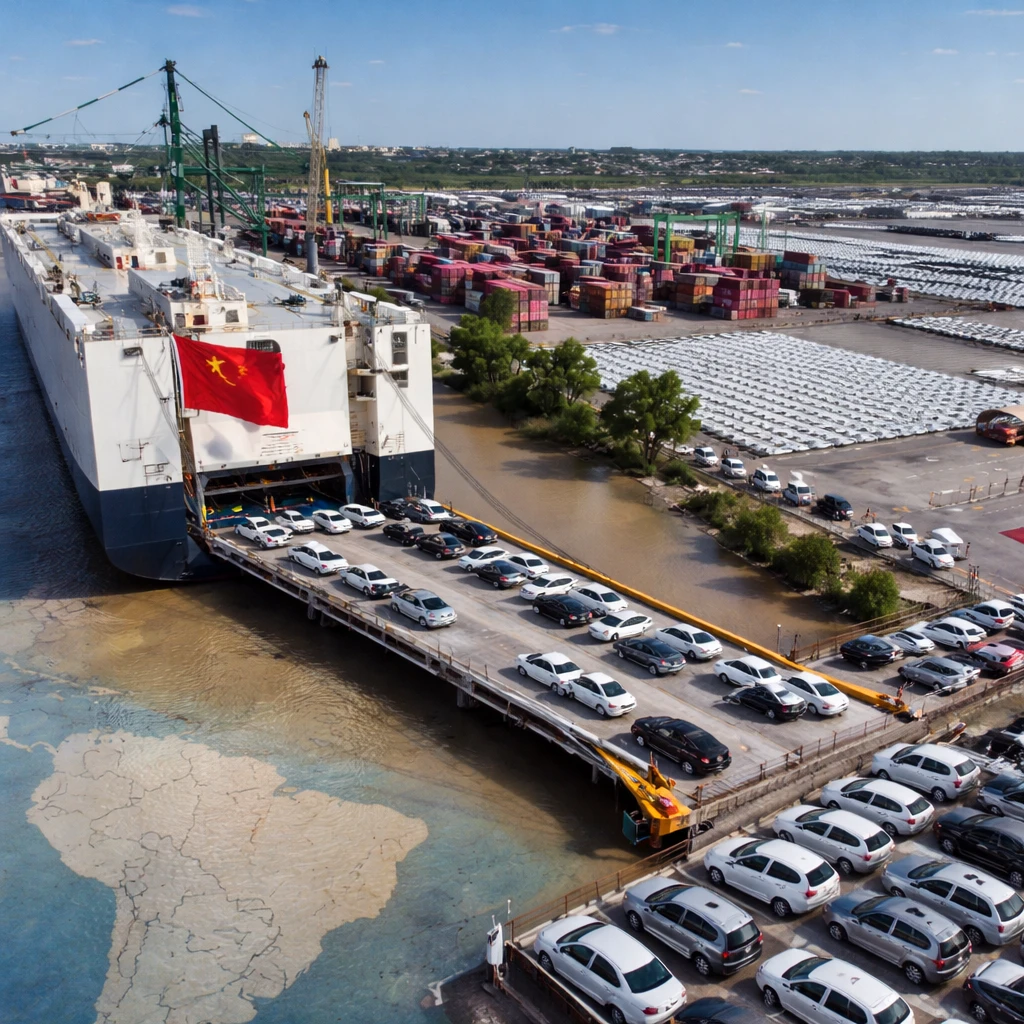

Chinese manufacturers have substantially increased their low-priced exports to Latin American markets, notably automotives and goods commonly sold through online platforms, as they adapt to reduced accessibility in the United States due to tariff policies and geopolitical tensions initiated under U.S. administration leadership. For many nations in Latin America, China stands as a key trade partner, attracted to the region's abundant natural resources and expanding consumer base, while simultaneously extending its geopolitical reach in what is considered an area of strategic interest by the United States.
Facing diminished domestic demand, Chinese businesses are compelled to identify new markets as production capacity intensifies across various sectors. The market of Latin America, with its population surpassing 600 million, presents a viable outlet for excess manufacturing output. Export volumes to this region and others have increased notably even as sales to the United States experienced a 20% reduction last year.
Margaret Myers, director of the Asia and Latin America program at Washington’s Inter-American Dialogue think tank, notes, “Latin America boasts a substantial middle class with relatively strong purchasing power and genuine demand for goods—conditions that make it an attractive region for China to channel its surplus industrial production.”
The wave of Chinese automobiles, apparel, consumer electronics, and household furnishings has elicited concern among Latin American governments as they endeavor to develop competitive domestic industries. Nations such as Mexico, Chile, and Brazil have responded by implementing tariff increases and other protective measures intended to shield local manufacturers from foreign competition.
Popularity of Inexpensive E-commerce Imports
While affordable Chinese products are favored by many consumers across Latin America, they simultaneously present substantial challenges to local businesses. Online retail giants originating from China, including platforms like Temu and Shein, have accelerated the penetration of Chinese goods. For example, Lady Mogollon, a Chilean restaurant manager, remarked on her frequent use of Temu for purchasing clothes and household items at prices significantly lower than those found in local brand-name stores.
Market analytics firm Sensor Tower reports that Temu achieved an average of 114 million monthly active users in Latin America during the first half of 2025, reflecting a 165% year-over-year increase from 2024. Shein’s monthly active users in the region also expanded by 18% within the same timeframe.
Beyond digital sales, Chinese-made shirts, outerwear, toys, watches, furniture, and other consumer items occupy vendor stalls in central areas such as Mexico City. Ángel Ramírez, manager of a lamp shop in downtown Mexico City, expressed difficulties in maintaining business due to the influx of Chinese merchandise. He stated that the number of stores selling Chinese products has more than tripled in recent years, resulting in closures of long-established local outlets and job losses.
Impact on Manufacturing Employment and Capacity
Argentina is experiencing significant repercussions from rising Chinese imports, which have contributed to factory closures and layoffs within its manufacturing sector, a segment employing nearly 20% of the workforce. Government data reveals a 237% surge in e-commerce imports, predominantly from China, in October compared with the same month the previous year.
Luciano Galfione, president of the Pro Tejer Foundation representing textile manufacturers, described the industry as operating at historically low capacity, attributing this to record-high import volumes. The president of the chamber of industry, Claudio Drescher, who oversees the Buenos Aires-based Jazmín Chebar clothing brand, voiced concern over the rapid increase of ultra-fast fashion imports from China and described the phenomenon as assuming significant economic importance locally.
A spokesperson from Temu indicated that the company was enhancing opportunities for local Latin American businesses by offering a scalable, affordable online sales channel previously inaccessible to many sellers, including opening its marketplace to domestic vendors in Mexico and Brazil in 2025. Shein affirmed its commitment to respecting local industries and fair competition but refrained from commenting on trade policy matters.
Chinese Automobiles Expand Market Share in Latin America
In the automotive sector, Mexico and Brazil—two prominent Latin American automotive manufacturing hubs—are witnessing escalating imports of competitively priced Chinese vehicles. Brands such as BYD and Great Wall Motors (GWM) perceive substantial growth prospects within the region. Data from the Brazilian Association of Electric Vehicles indicates that over 80% of the 61,615 electric vehicles sold in Brazil in 2024 were Chinese brands.
Mexico emerged as the largest importer of Chinese automobiles last year, receiving 625,187 vehicles and overtaking Russia in this regard, according to the China Passenger Car Association. Mexico houses a significant automotive industry, ranking as the seventh-largest global vehicle producer, with an estimated 3.4 million out of approximately 4 million manufactured vehicles annually exported. Brazil produced about 2.6 million vehicles, including numerous electric and hybrid models, compared with China's output of 34.5 million vehicles, over 7 million of which are exported.
Jorge Guajardo, a partner at consultancy DGA Group and former Mexican ambassador to China, acknowledged China's comparative advantage in electric vehicles due to cost efficiencies and considerable government backing. Affordable pricing of Chinese vehicles appeals to consumers and supports their growing presence in Latin America, according to Paul Gong, head of China Autos Research at UBS.
Chinese automakers are also making infrastructure investments through construction of manufacturing facilities within the region. BYD and GWM have initiated factory projects in Brazil aimed at boosting regional production capacity, potentially generating hundreds to thousands of jobs. Nevertheless, last year Brazilian prosecutors filed a lawsuit against BYD alleging substandard labor conditions, claims that the company has denied.
China’s Economic Footprint and Trade Imbalances
Latin America’s wealth of natural resources, including lithium in Brazil, copper in Chile, and fishmeal in Peru, remains a vital component of China's expanding industrial demands. Nonetheless, the region is experiencing growing trade deficits with China. In some countries, the trade relationship skews heavily toward Chinese exports with limited reciprocal imports.
Mexico, China's second-largest trading partner after the U.S., reported a trade deficit of $120 billion in 2024. Mexican exports to China primarily consist of raw materials such as copper and electrical equipment, totaling approximately $9 billion. Argentina’s trade deficit with China escalated to about $8.2 billion in 2025, with imports of electrical machinery and manufactured goods outweighing exports of commodities like soybeans and meat. Conversely, Brazil maintained a trade surplus of around $29 billion, attributed in part to increased soybean exports compensating for halted U.S. purchases. Chile also holds a surplus due to copper, lithium, fruit, and wine exports.
Generally, China exports predominantly manufactured products while importing raw materials from Latin America. Yet China's involvement in the region surpasses trade alone. Between 2014 and 2023, China extended loans and grants exceeding $153 billion to Latin American and Caribbean countries, constituting the largest share of official sector financing for the region, compared to U.S. assistance of around $50.7 billion in the same period. This equates to China providing three dollars for each dollar offered by the United States.
The deepening economic engagement positions Latin America as a strategic pillar in China’s “Global South” initiative aimed at balancing Western influence. Infrastructure projects exemplify this approach, such as the $1.3 billion megaport in Peru’s Chancay inaugurated in 2024, with plans to connect via railway to Brazil’s Atlantic coast. State-backed Chinese entities also invest heavily in dams, mines, and other critical infrastructure throughout Latin America.
Despite concerns over domestic industry competitiveness, many Latin American countries find it challenging to resist the expansion of Chinese exports due to the extensive economic integration and financial dependence involved. Myers from the Inter-American Dialogue remarked, “Although the growth of Chinese imports provokes competitiveness worries, the economic ties have become too crucial for many nations to openly oppose China’s export surge.”
Protective Trade Measures and Political Considerations
In response to the impact of Chinese imports, Mexico has historically imposed tariffs up to 50% on various Chinese goods, including automotive products, appliances, and apparel, to support local production. Brazil is removing or limiting ‘‘de minimis’’ tax exemptions on small-value shipments under $50, targeting the prevalence of low-cost Chinese imports, and has also increased tariffs on electric vehicle imports. Similarly, Chile has elevated tariffs and introduced a 19% value-added tax on low-value parcels.
Further protective measures could emerge throughout Latin America, as some analysts anticipate more restrictive tariffs and tightened regulatory environments aimed at controlling imports. Nonetheless, balancing economic interests with political realities remains delicate. Leland Lazarus of Lazarus Consulting, specializing in China-Latin America relations, pointed out, “Countries face a complex balancing act; overly aggressive protectionist policies risk prompting retaliatory actions from China, limiting their effective leverage.”
Overall, Latin American nations are navigating a challenging environment where expanding Chinese trade and investment opportunities coexist with increasing pressure on local industries and employment. The long-term impact on regional economies and industrial sectors remains subject to the evolving interplay of trade policies, investment strategies, and geopolitical considerations.