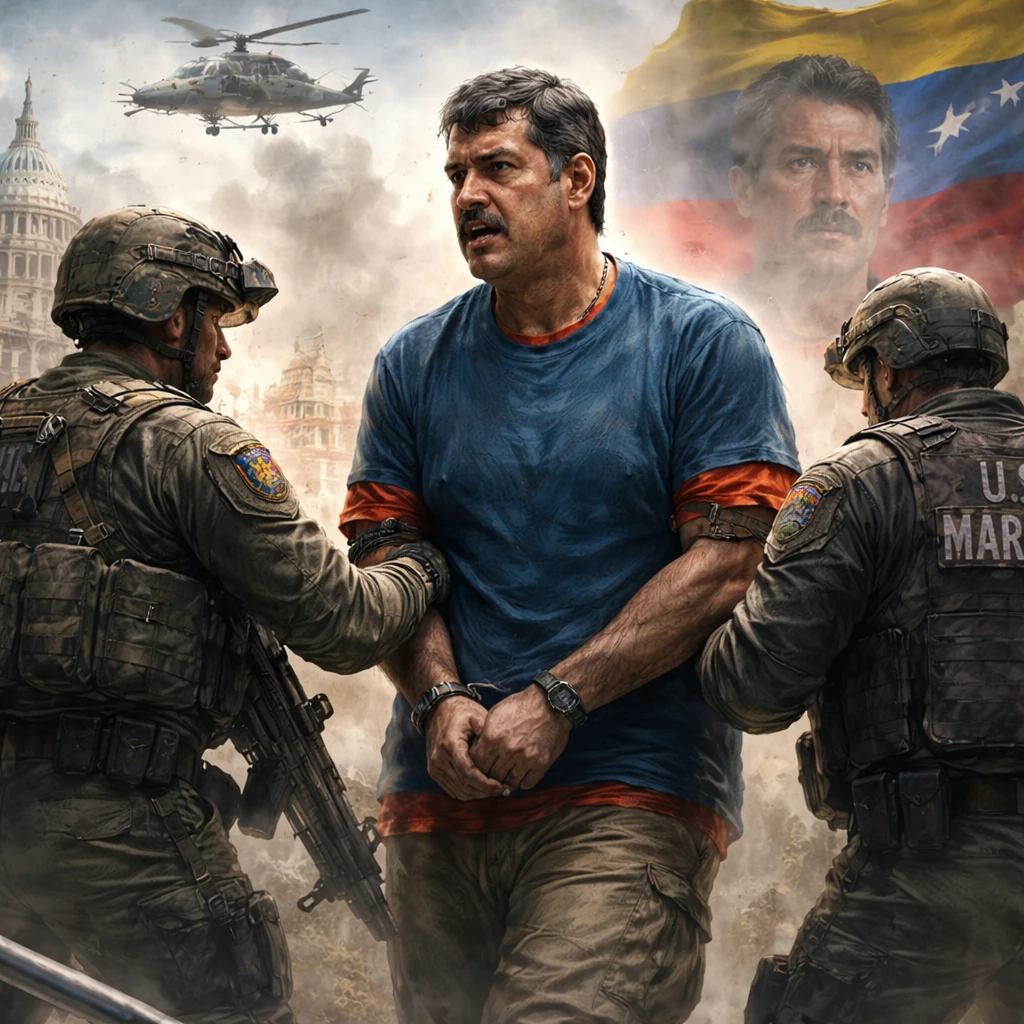

In the aftermath of the devastating global conflicts of the twentieth century, nations committed to building a comprehensive framework of laws to curb future large-scale wars. This international order centers at the United Nations headquarters in New York, a stone's throw from the courtroom where Nicolás Maduro was processed after his overthrow in Venezuela.
Today, this framework appears imperiled as the principle that power through force dictates outcomes is resurfacing on the international stage. Rosemary A. DiCarlo, the UN Under-Secretary-General, emphasized before the Security Council that maintaining global peace hinges on all member states continuously upholding the United Nations Charter provisions.
From Washington, the U.S. administration led by President Donald Trump defends Maduro's capture as a lawful military operation. According to a White House memorandum obtained in October by a news agency, the Venezuelan drug cartels are viewed as unlawful belligerents. The U.S. thus claims to be engaged in an armed conflict with these groups.
The operation involved apprehending Maduro and his wife, Cilia Flores, at a military base residence in Caracas. Following these events, they face allegations including participation in a narcoterrorism conspiracy. Mike Waltz, U.S. Ambassador to the UN, characterized the mission as a surgical law enforcement action with full justification.
This initiative aligns with Trump's recently unveiled National Security Strategy, prioritizing the restoration of U.S. preeminence throughout the Western Hemisphere as a key objective for his second term. However, this military action raises questions about whether it may establish a precedent for similar interventions in the future.
Concerns about subsequent resulting actions surfaced when President Trump cautioned Colombia and its left-leaning President Gustavo Petro, labeling Petro as a troubled figure involved with cocaine trafficking to the United States. The White House already sanctioned Petro and his close associates in October, citing allegations related to involvement in the global narcotics trade. Colombia remains a central hub in the international cocaine market.
This mission's reception has drawn criticism worldwide, spanning from China to Mexico, with many leaders and analysts deploring the operation and expressing alarm it could normalize foreign military interventions and further deteriorate established international legal norms. The French Foreign Minister, Jean-Noël Barrot, condemned the capture for violating the non-use-of-force principle fundamental to international law and cautioned that violations by permanent Security Council members imperil global security.
Several geopolitical flashpoints now appear vulnerable to shifts due to this changing stance on force and sovereignty.
In Ukraine, the prolonged Russian military aggression, widely perceived as undermining international law, has relied heavily on U.S. backing within Europe. Russia's UN envoy, Vasily Nebenzya, condemned the U.S. operation against Maduro as a regression to a lawless era, urging the Security Council to oppose militarized foreign policies.
Experts such as Volodymyr Fesenko from Kyiv highlight that Russia has long worked to erode the global order and that Trump's actions have continued this disintegration trend.
Northward in the Arctic, President Trump intensified European anxieties by publicly speculating on Greenland's status, a Danish territory. Describing it as a strategic asset heavily frequented by Russian and Chinese vessels, Trump asserted U.S. national security interests necessitate control, a stance Denmark explicitly rejected, reaffirming the existing NATO-based security cooperation ensuring U.S. access.
Across the Pacific, the Maduro seizure prompted speculation about China potentially adopting a similar approach toward Taiwan's leadership amid escalating military maneuvers and U.S. arms sales to the island. Nevertheless, Beijing's current strategy employs gradual coercion rather than direct confrontation. China criticized the U.S. action as a blatant violation of Venezuela's sovereignty, underscoring what it perceives as Washington's self-appointed role as a global adjudicator.
In the Middle East, the intense Israeli military response in Gaza following Hamas's attacks exposes the insufficiency of international mechanisms to quell destructive conflict. U.S. support for Israel manifests through vetoes of UN ceasefire resolutions. Additionally, Washington confronts nearby Iran over its nuclear ambitions and domestic unrest, indicating a readiness to respond militarily if circumstances necessitate, a posture Tehran condemns in light of U.S. actions in Venezuela.
Within Europe, the EU grapples with responding to these developments amid a strained transatlantic alliance. Although EU statements acknowledge Maduro's political illegitimacy, they emphasize adherence to international legal principles and the UN Charter, calling on Security Council members to uphold these responsibilities. Contrarily, Hungary's Prime Minister Viktor Orbán disparages the applicability of international law in practice, reflecting deep divisions within traditional alliances.
Overall, the recent developments including Maduro’s capture illustrate accelerating tensions between established international law and unilateral power assertions, with potentially profound implications for global political stability and legal order.