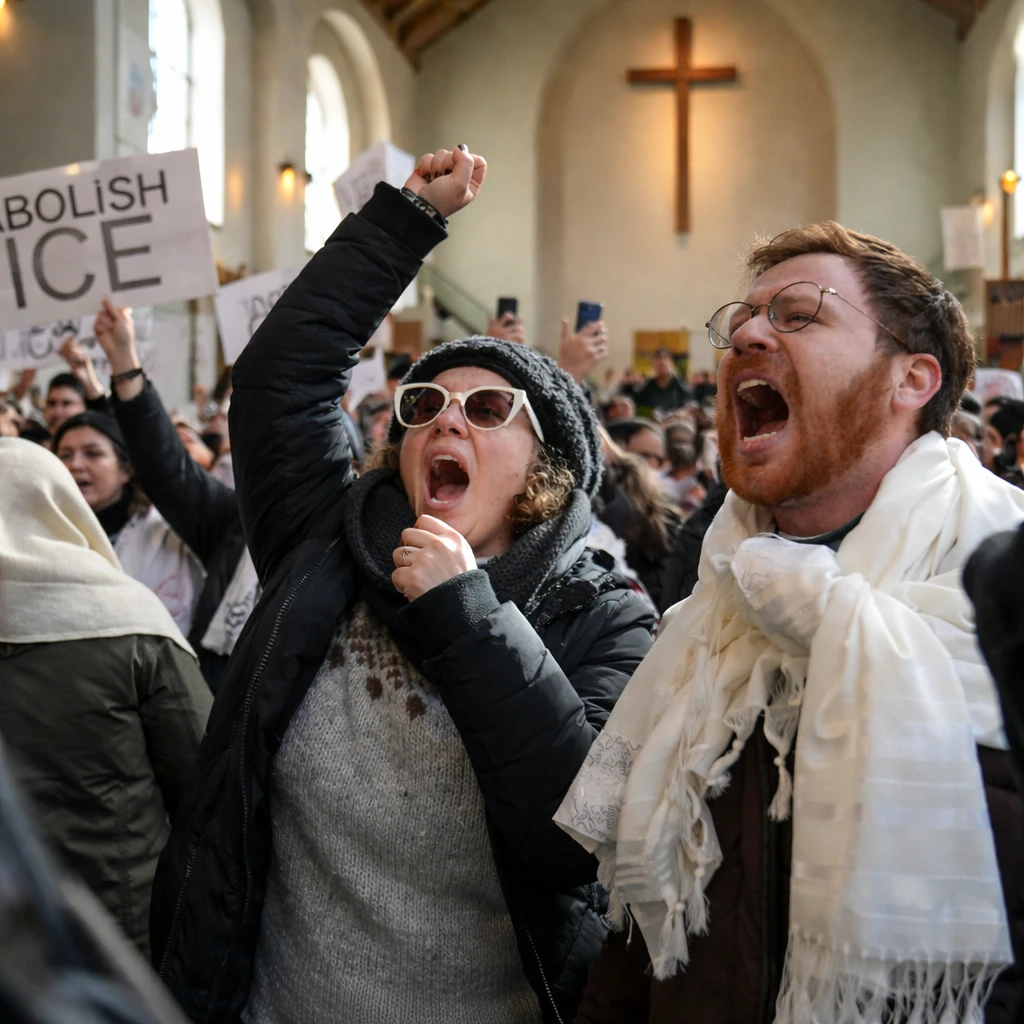
In the United States, protest and civil disobedience have long been intertwined with religious history. Despite this, direct political protests inside places of worship remain uncommon events. A recent case at Cities Church, a Southern Baptist congregation in St. Paul, Minnesota, has revived discussion about the legality and appropriateness of such actions. On a recent Sunday service, a group of anti-ICE protesters interrupted the gathering, drawing attention to a pastor affiliated with U.S. Immigration and Customs Enforcement (ICE). Three individuals involved in the protest were subsequently arrested on federal charges.
Charles C. Haynes, a senior fellow at the Freedom Forum, a nonprofit dedicated to First Amendment rights, emphasized that disrupting a worship service contravenes the law. He noted that this infringement is often deliberate in acts of civil disobedience, where breaking the law serves to raise awareness for a cause. Historic examples include the civil rights demonstrations led by figures such as the Rev. Martin Luther King Jr., underscoring how legal transgressions have been used to effect change.
Prior to her arrest, civil rights lawyer Nekima Levy Armstrong, who identifies as Christian, framed the protest in spiritual terms on social media, suggesting that judgment would commence within the "House of God."
Haynes underscored the importance of protecting religious freedom in houses of worship, suggesting that civil rights law should be upheld when religious practice is interfered with. Nevertheless, he acknowledged that protesters often feel compelled to undertake extreme measures driven by urgency surrounding their causes.
Traditionally, protests are more frequently held outside places of worship rather than within. Instances include anti-Israel demonstrations outside New York City synagogues and picketing of military funerals by a Kansas church. Legal and political entities face ongoing challenges in balancing the rights of protesters with the rights of worshippers. The exact implementation of protest-free buffer zones around religious sites continues to present complex legal questions, as detailed by legal scholars Vikram Amar and Alan Brownstein.
While interruptions inside worship services are infrequent, they have historical precedence. Radical Quakers in colonial America challenged established churches through service disruptions. Similarly, the African Methodist Episcopal Church's origins trace back to African American worshippers departing segregated white congregations in the 18th century. The civil rights era saw "kneel-ins" at segregated churches aiming to confront racial injustice.
One notable example in recent history was the 1989 "Stop the Church" demonstration by the AIDS advocacy group ACT UP at St. Patrick’s Cathedral in New York, where protesters disrupted Mass by vocal outbursts and lying in aisles to protest inadequate responses to the AIDS crisis. Although these actions met with criticism and minor legal consequences, activists at the time viewed the protests as matters of life and death.
Earlier in 1984, protests at affluent Pittsburgh churches, aimed at drawing attention to unemployed steelworkers, elicited mixed reactions. Some praised the courage of the activists, while others questioned the effectiveness of such tactics.
Certain protest groups elect to operate within legal boundaries, utilizing provocative messaging while refraining from entering sanctuaries. The Westboro Baptist Church, for example, has publicly protested against homosexuality and at military funerals, actions that have been upheld by the Supreme Court within defined parameters limiting proximity to funerals.
More recent protests targeting synagogues in New York City have sparked proposed legislation to establish 25-foot buffer zones to safeguard houses of worship, reflecting ongoing efforts to delineate appropriate protest boundaries.
Unlike many religious organizations that have condemned ICE’s enforcement actions in Minnesota, the incident inside Cities Church has garnered limited support across faith communities. The Minnesota Council of Churches, which has advocated for boycotts in response to immigration issues, did not comment on the arrests related to the church protest.
During the protest at Cities Church, approximately three dozen individuals entered the service, with some approaching the pulpit and chanting demands such as "ICE out" and referencing a recent fatal shooting of a woman by an ICE officer. The church’s pastor David Easterwood is an ICE employee.
Kevin Ezell, president of the Southern Baptists’ North American Mission Board, condemned the protest as an unjustified desecration of sacred space and a source of distress for families peacefully gathered. Even clergy critical of current immigration policies expressed unease regarding the tactic. Brian Kaylor, a minister affiliated with the Cooperative Baptist Fellowship, acknowledged his opposition to immigration enforcement but described the church protest as troubling and warned against normalizing such methods across political divides.
Bishop Mariann Budde of the Episcopal Diocese of Washington, D.C.—who has protested ICE practices and privately lobbied for immigrant rights—responded cautiously to the arrests, emphasizing the imperative to protect the safety and sanctity of houses of worship for all individuals.
Heightened security measures in many religious institutions reflect growing concerns over attacks and safety risks. The federal government’s 2023 decision to permit immigration arrests in sensitive locations such as churches and schools has prompted some churches to publicize that no federal immigration officers are permitted within, and there have been reports of decreased attendance correlated with enforcement intensifications.
The protesters arrested in St. Paul face significant legal consequences. They have been charged under a federal civil rights statute initially established post-Civil War to combat vigilante actions by groups like the Ku Klux Klan against freed slaves. This statute has since broadened in scope, enforcing constitutional rights protections. Convictions may result in sentences up to 10 years in prison or longer if the offense includes bodily harm or property damage.
The developments in Minnesota underscore the enduring tension between activism, religious freedom, and the rule of law—complex issues that continue to evoke strong sentiments from multiple sectors of society.