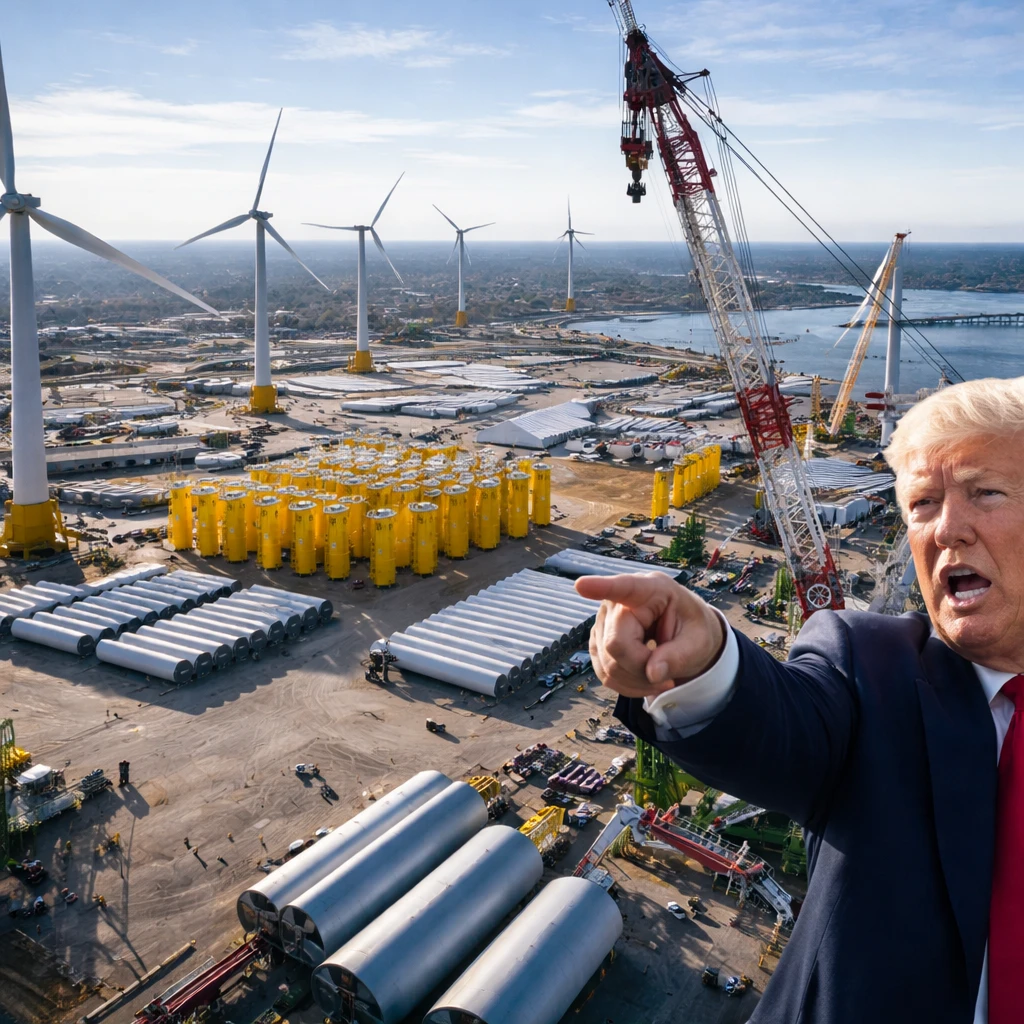

Several offshore wind developers engaged in legal proceedings this week to challenge the Trump administration’s recent order halting their projects, which are under construction along the East Coast. The freeze issued on December 22 has placed a temporary ban on five major offshore wind initiatives due to alleged national security issues, though details of these concerns have not been publicly disclosed.
Danish energy giant Orsted, Norwegian firm Equinor, and Dominion Energy Virginia have each filed lawsuits requesting courts to nullify the federal freeze. The earliest hearing took place Monday concerning Orsted’s Revolution Wind project, developed jointly with Skyborn Renewables, intended to supply power to Rhode Island and Connecticut.
President Trump has consistently opposed the development of wind energy projects, expressing his intent not to authorize the construction of any 'windmills.' During a recent meeting with oil industry leaders focused on investments in Venezuela, he criticized wind farms as financially unprofitable, harmful to the landscape, and threats to wildlife. Trump declared, 'I’ve told my people we will not approve windmills. Maybe we get forced to do something because some stupid person in the Biden administration agreed to do something years ago. We will not approve any windmills in this country.'
The Biden administration has taken an opposite approach, aiming to expand offshore wind power as part of broader climate change initiatives. Nevertheless, the Trump administration reversed previous energy policies on its first day in office through executive orders favoring fossil fuels such as oil, gas, and coal.
The freeze impacts the Vineyard Wind project, currently under construction in Massachusetts; Revolution Wind; Virginia’s Coastal Virginia Offshore Wind; and two New York State projects—Sunrise Wind and Empire Wind. On Friday, New York’s attorney general initiated legal action against the Trump administration over the suspension of Empire Wind and Sunrise Wind. Similarly, the states of Rhode Island and Connecticut sought judicial relief to continue Revolution Wind.
At a hearing before the U.S. District Court for the District of Columbia on Monday, Janice Schneider, attorney for Revolution Wind, emphasized that the project is nearly 90% complete and merely weeks from delivering electricity. She highlighted substantial financial consequences, estimating losses exceeding $1.4 million per day due to the halt. A specialized installation vessel faces a narrow window—ending in February—to complete turbine placement, and the order jeopardizes this schedule. Schneider acknowledged sensitivity to national security issues but noted that neither classified summaries nor detailed concerns have been conveyed to their security-cleared experts. She urged the court to critically evaluate the administration’s motives.
Pursuing the government’s stance, Department of Justice lawyer Peter Torstensen argued the primacy of national security and defended the suspension as necessary to mitigate newly identified security risks described in classified information, which supersedes the developers’ claims of irreparable harm.
Equinor’s Empire Wind LLC faces a Wednesday hearing. The company warns that the project could be terminated if construction does not resume by Friday due to a complex build schedule reliant on vessels with limited availability. Molly Morris, Equinor’s senior vice president responsible for Empire Wind, stated the company remains committed to the project, noting its advanced construction status and the vital new power capacity it promises for New York. Like Orsted, Equinor has received no clarification on specific national security objections or corrective measures from federal officials. Morris expressed hope that offshore wind remains integral to a comprehensive energy approach essential for the country.
Dominion Energy Virginia, overseeing Coastal Virginia Offshore Wind, was the first to file suit. Their petition requests an injunction against the freeze, branding it as arbitrary, capricious, and unconstitutional. This case is scheduled for a Friday hearing.
Overall, the ongoing legal confrontations underscore a high-stakes conflict between federal agencies’ security assessments and the offshore wind sector’s push to advance renewable energy infrastructure critical for regional power supplies.