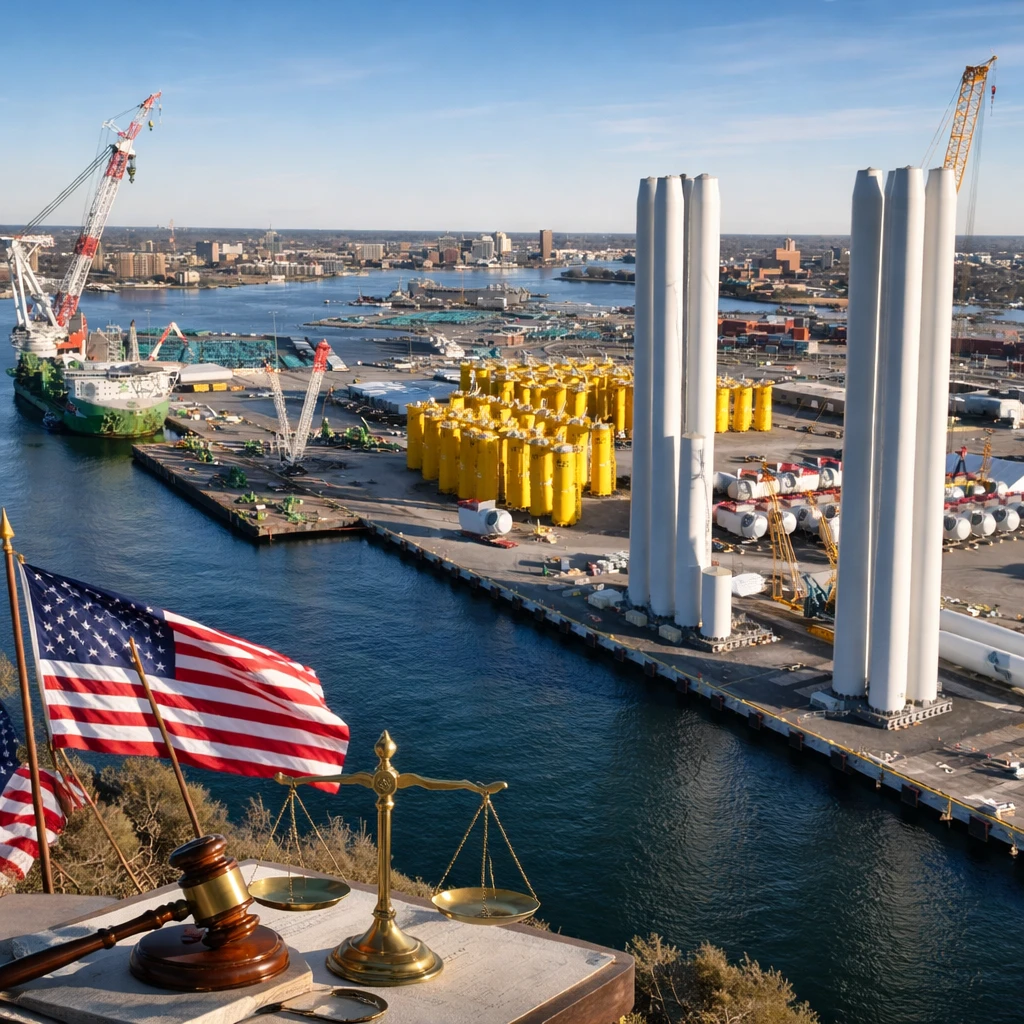

The suspension of leases for five significant offshore wind developments along the United States' East Coast, imposed by the Trump administration due to purported national security issues, has sparked a series of legal actions from the affected developers and state entities. This includes civil lawsuits filed late Tuesday by the limited liability companies affiliated with Norwegian company Equinor’s and Danish energy firm Orsted’s projects. Connecticut and Rhode Island have also jointly petitioned for a preliminary injunction on another project, with filings submitted earlier Monday.
On December 22, the administration announced a halt to these projects’ leases, effective for a minimum of 90 days, citing national security concerns without providing detailed explanations. The president's stance has consistently favored traditional fossil fuels—such as oil, coal, and natural gas—over renewable energy technologies that generate electricity without carbon emissions, like offshore wind.
Matt Middleton, a spokesperson for the Interior Department, elaborated Wednesday that President Trump has instructed the department to manage public lands and waters for multiple uses—including energy development, conservation, and national defense. Middleton described the pause on large offshore wind projects as a "decisive step to protect America’s security, prevent conflicts with military readiness and maritime operations, and ensure responsible stewardship of our oceans."
Middleton further stated, "We will not sacrifice national security or economic stability for projects that make no sense for America’s future."
Equinor owns the Empire Wind project, while Orsted controls Sunrise Wind; both are key offshore wind initiatives based in New York. Empire Wind LLC has formally requested expedited court review, warning it faces likely termination if construction activities do not resume by January 16. The project’s timeline depends heavily on specialized vessels with limited availability, making delays costly and threatening the underlying project financing.
Orsted has also petitioned a judge to nullify the suspension order, highlighting that it has invested billions in the Sunrise Wind project. The company underscored that its team maintained weekly consultations during 2025 with the U.S. Coast Guard and other agency representatives, who raised no national security concerns until the recent order. The lease suspensions also affect other projects, including Vineyard Wind in Massachusetts, Revolution Wind in Rhode Island and Connecticut, and Coastal Virginia Offshore Wind in Virginia.
Dominion Energy Virginia, responsible for Coastal Virginia Offshore Wind, was first to initiate legal action. It seeks to halt the administration’s suspension, labeling it as "arbitrary and capricious" and in violation of constitutional principles.
Orsted, partnering with Skyborn Renewables on Revolution Wind, has filed a complaint challenging the suspension on behalf of that joint venture.
The lawsuit filed by Connecticut and Rhode Island calls for the continuation of work on Revolution Wind. Connecticut Attorney General William Tong remarked, "Every day this project is stalled costs us hundreds of thousands of dollars in inflated energy bills when families are in dire need of relief. Revolution Wind was vetted and approved, and the Trump administration has yet to disclose a shred of evidence to counter that thorough and careful process."
Avangrid, co-owner with Copenhagen Infrastructure Partners of the Vineyard Wind project, has not publicly disclosed whether it will join the legal confrontation against the administration.
The Trump administration has a history of intervening in offshore wind projects. In April, it paused work on Empire Wind, accusing the Biden administration of rushing permits, but permitted construction to resume a month later. Equinor secured the federal lease for Empire Wind in March 2017, early in Trump's first term, with final federal approval occurring in February 2024.
Construction of the almost completed Revolution Wind project was halted on August 22 after a declaration of national security concerns by the Bureau of Ocean Energy Management. However, a federal judge reversed the suspension a month later, permitting project work to continue while recognizing the significant harm caused to developers and the likelihood of their claims’ success.