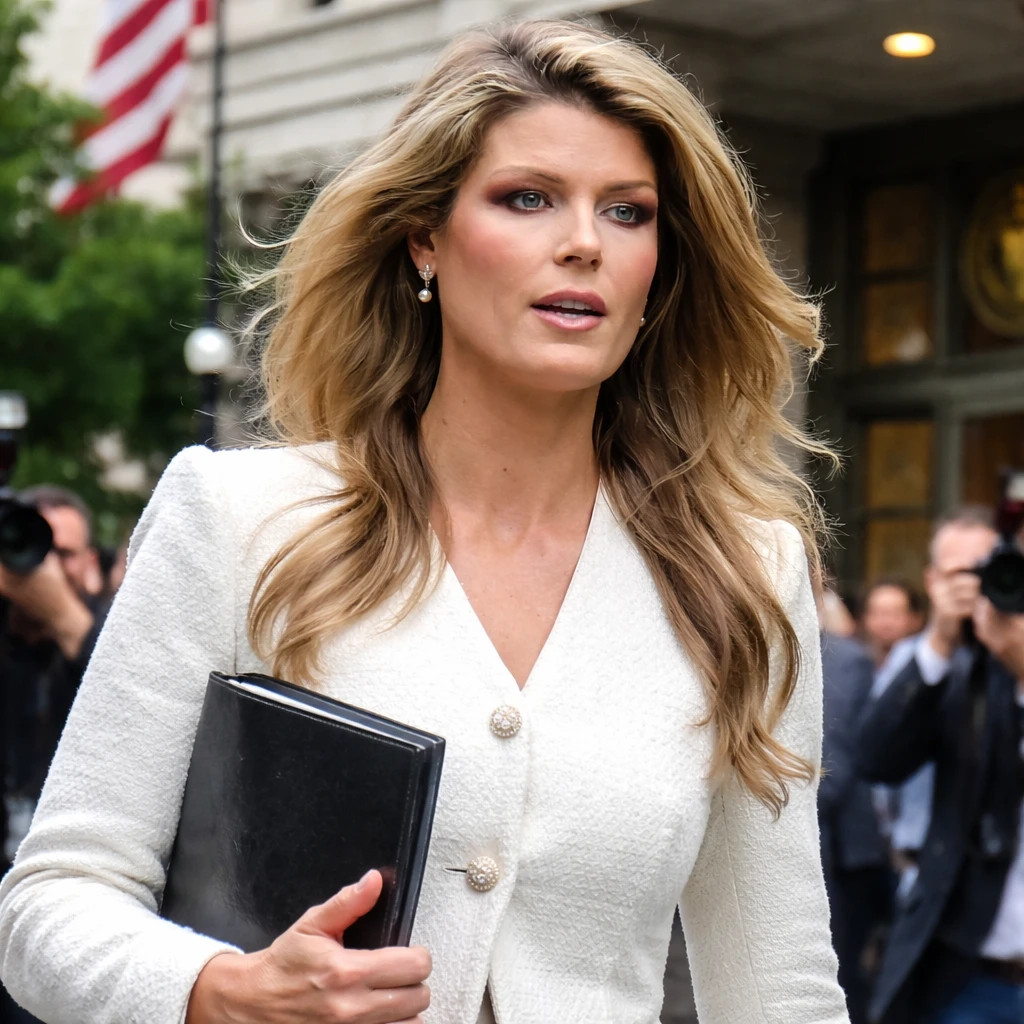
Lindsey Halligan, who was rapidly installed by the Trump administration as the interim United States attorney for the Eastern District of Virginia, has stepped down from her position following the conclusion of her 120-day appointment, Attorney General Pam Bondi announced on Tuesday evening. Halligan's tenure was marked by considerable controversy as multiple federal judges questioned the legality of her appointment after a court ruled it unlawful two months prior.
Bondi publicly expressed dissatisfaction with the situation, stating through a social media post on X that the circumstances leading to Halligan's departure were "deeply misguided." She emphasized that obstacles have hindered the ability of a democratically elected president to fill crucial law enforcement roles, and affirmed the Department of Justice's intention to continue challenging such judicial decisions to maintain public safety.
Halligan’s appointment took place in September and was intended to last 120 days, officially concluding on Tuesday. Despite holding no prior experience as a federal prosecutor, she was selected by President Trump, who sought her to helm one of the Justice Department's most significant offices. During her brief incumbency, Halligan successfully pursued indictments against two of Trump's longstanding opponents—former FBI Director James Comey and New York Attorney General Letitia James—actions carried out in response to Trump's requests.
However, in November a federal judge ruled that Halligan’s appointment violated legal standards, rendering her indictments invalid and requiring their dismissal. The Justice Department has since appealed this ruling but maintained Halligan in her role until recent judicial interventions made clear her tenure should end.
On Tuesday, two judges issued orders that effectively marked the conclusion of Halligan's term. Chief Judge M. Hannah Lauck, appointed by President Barack Obama, directed the publication of a vacancy announcement for the United States attorney position on the court’s website, actively seeking candidates interested in the appointment. Concurrently, U.S. District Judge David Novak removed Halligan’s official title from active court documents and prohibited her from identifying herself as United States attorney, warning of disciplinary actions should she continue to do so. Novak, a Trump appointee himself, criticized the Department of Justice’s earlier aggressive defense of Halligan, describing their rhetoric as more suited to a cable news debate than formal court proceedings.
Judge Novak condemned Halligan’s continued representation of herself as the U.S. attorney despite clear court orders stating otherwise, characterizing such actions as false statements and a "charade" that had to end. He underscored that any violation of his directive would warrant disciplinary proceedings against Halligan and potentially others who support her improper representation.
Halligan’s ascent to the position followed the departure of previous veteran U.S. Attorney Erik Siebert in September, amidst an administration-led reshuffle. Since then, the Eastern District of Virginia office has experienced notable leadership instability and a wave of resignations. It remains unclear who will assume leadership following Halligan's exit.
Throughout her appointment, Halligan pursued indictments aimed at two figures President Trump viewed as adversaries, acting reportedly in accordance with Trump's explicit demands disseminated via social media. Despite initial prosecutorial successes, these cases rapidly unraveled after judicial review deemed her appointment improper.
In response to the rulings and her enforced departure, Halligan expressed frustration over the legal ambiguity she faced. She noted that although multiple judges treated her appointment as disqualifying and excluded her name from filings, no replacement had been officially appointed as required by the previous court orders. This situation left her in a professional limbo she described in her statement.
The controversy surrounding Halligan’s appointment adds to a broader pattern of legal challenges confronting Trump-appointed figures, including the recent resignation of Alina Habba, another former Trump personal attorney whose role was similarly invalidated by appellate courts.