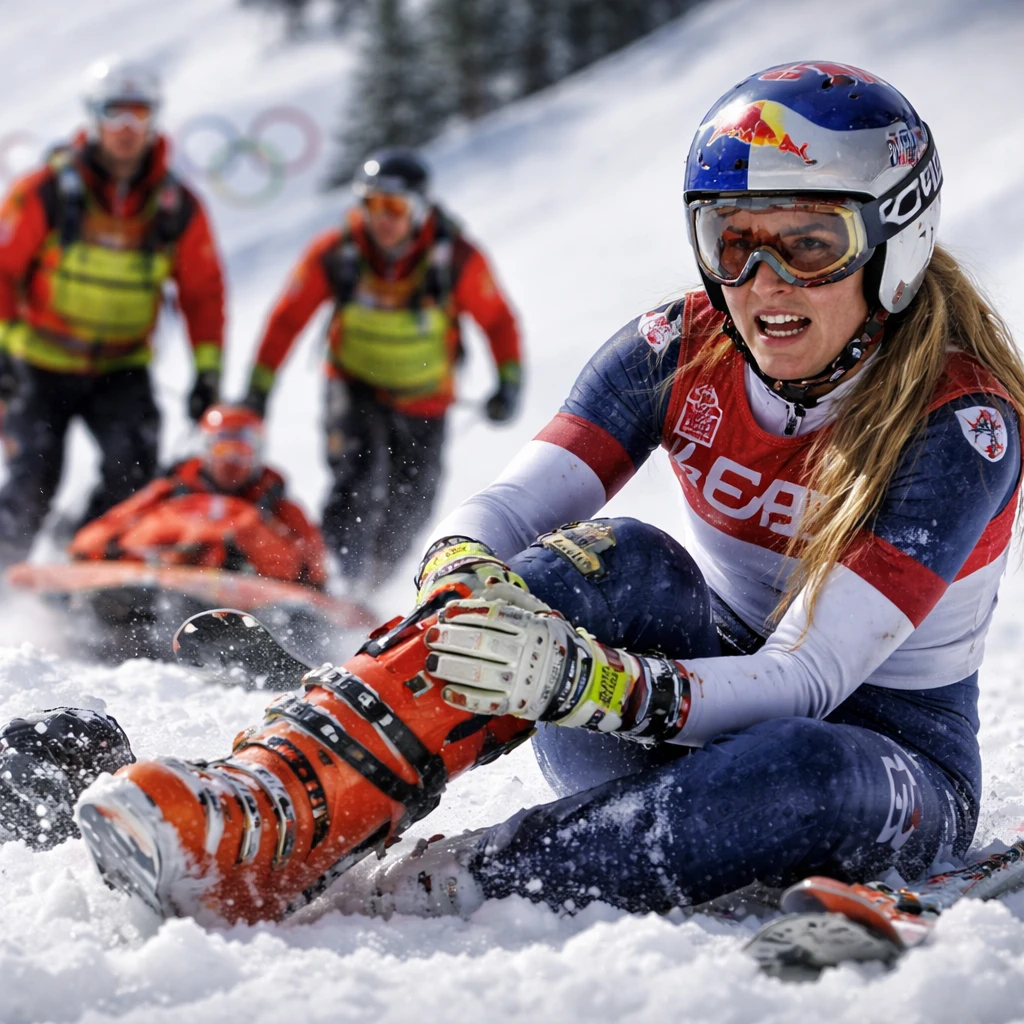

At the Winter Olympics in Cortina d'Ampezzo, Italy, Lindsey Vonn revealed on social media that she sustained a complex fracture to her left tibia after a high-speed crash during the downhill competition. The injury has been described as stable for now but necessitates several surgical procedures for proper treatment.
The 41-year-old American skier shared her experience and feelings about the incident in an Instagram post, stating that although the outcome was not what she envisioned and inflicted significant physical pain, she holds no regrets about competing. This resilience was underscored by her continued involvement despite recently suffering a ruptured anterior cruciate ligament (ACL) in the same knee less than two weeks prior. Recovering from an ACL rupture typically sidelines professional athletes for extended periods, yet Vonn had participated in training runs before the event.
Observers speculated whether her previous ACL injury contributed to her crash, particularly when she clipped a gate near the summit of the Olympia delle Tofana course, a venue where she holds a record 12 World Cup victories. Vonn dismissed these suggestions, emphasizing that the crash was unrelated to her earlier injury, attributing it instead to the challenging dynamics of downhill skiing where precision within inches can determine the difference between success and injury.
"Yesterday my Olympic dream did not finish the way I dreamt it would," she said. "It wasn’t a storybook ending or a fairytale, it was just life. I dared to dream and had worked so hard to achieve it. Because in downhill ski racing the difference between a strategic line and a catastrophic injury can be as small as 5 inches."
She further explained, "I was simply 5 inches too tight on my line when my right arm hooked inside of the gate, twisting me and resulting in my crash. My ACL and past injuries had nothing to do with my crash whatsoever."
Vonn's father, Alan Kildow, expressed that this accident likely signifies the conclusion of her competitive skiing career. In an interview, he stated that, from his perspective, no further races will occur as Vonn nears the culmination of her time in the sport at age 41.
Upon arriving at the Olympic venue, Vonn consulted extensively with her medical team before deciding to participate. The International Ski and Snowboard Federation (FIS) does not conduct injury status assessments, placing the responsibility on athletes themselves to judge their fitness for competition.
The FIS president, Johan Eliasch, remarked on Vonn's situation, indicating that her decision was a personal one and reflective of her knowledge of her own body. Eliasch also pointed out the inherent risks in ski racing, highlighting the rarity and bad luck involved in Vonn's accident, where contact with a gate during an aerial maneuver caused a loss of control from which recovery was impossible.
Medical facilities in Treviso, Italy, where Vonn was treated, confirmed she underwent surgery on her left leg following the crash. The U.S. Ski Team acknowledged her condition as stable and emphasized the joint efforts of American and Italian doctors in her care.
Officials from the International Olympic Committee noted Vonn’s capability to train and the professional guidance she received regarding competitive readiness. The sports director of the IOC, Pierre Ducrey, commented that the choice to compete remains with the athlete and their support system and cannot be easily judged from the outside.
Support from teammates also emerged, with Keely Cashman clarifying that the ACL injury was unrelated to the crash's mechanics. Cashman stressed that the twisting motion caused by Vonn's arm hooking on a gate at high velocity was the critical factor, dismissing misconceptions about the prior knee injury.
The aftermath of the crash generated various opinions about the appropriateness of Vonn's participation, but prominent skiers like Italy's Federica Brignone affirmed the primacy of athlete autonomy in such decisions. Brignone herself has returned from serious leg fractures to compete at high levels, demonstrating the demanding nature and risks of alpine skiing.
Kyle Negomir, an American downhiller, underscored Vonn’s stature and judgment as a seasoned athlete capable of making informed choices about competing despite injury. His comments highlighted the calculated risks inherent to top-tier ski racing and the difficult balance athletes maintain between ambition and safety.