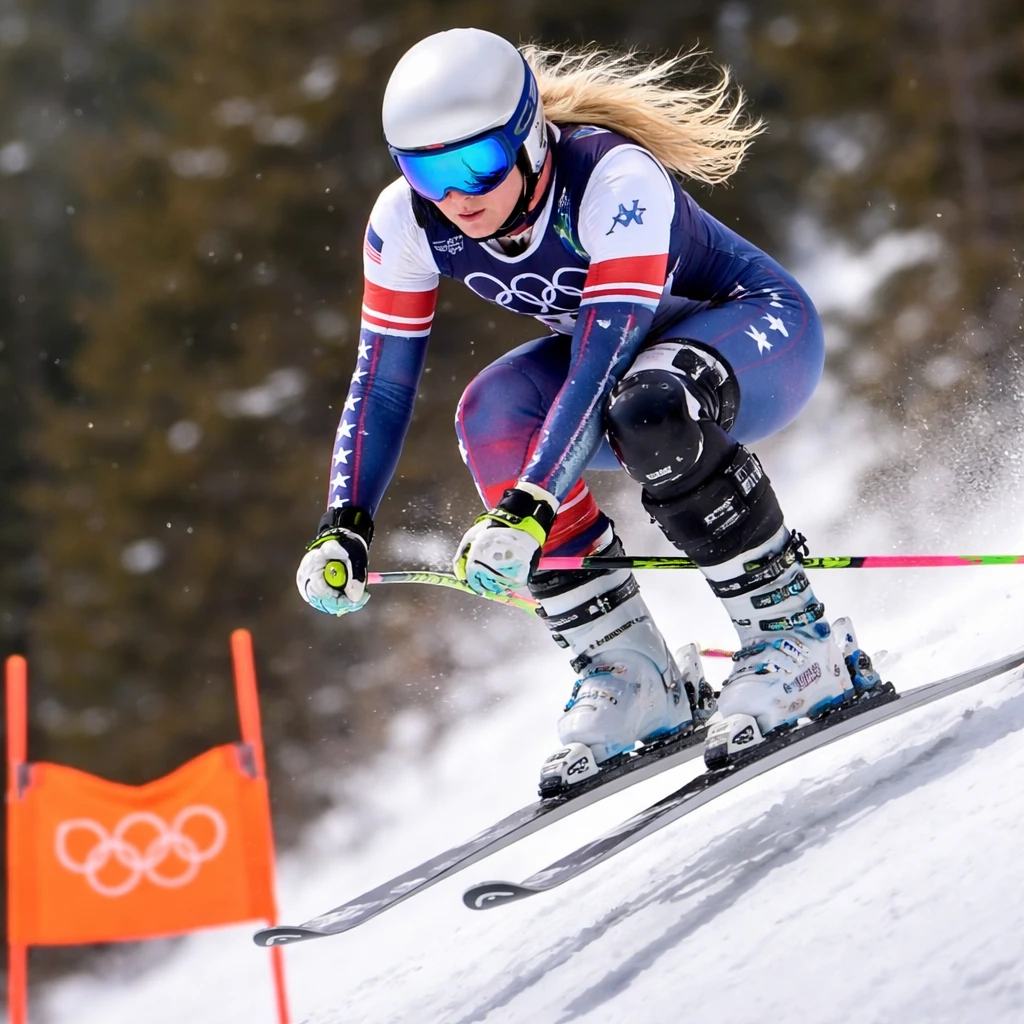

Lindsey Vonn’s participation in the Olympic downhill at age 41 is already an inspirational narrative, given her right knee titanium replacement after nearly six years of retirement. However, this comeback has taken an unprecedented turn as she prepares to race with a fully ruptured anterior cruciate ligament (ACL), bone bruises, and meniscal injury in her left knee.
Vonn described this comeback as her “most dramatic” yet, acknowledging the severity of her condition and her determination to compete under such circumstances. Speculation about her motivations has surfaced, with some critics suggesting it is nearly incredible or a pursuit of attention. Vonn responded firmly on social media, underscoring that skiing is not her sole identity and that she pursues the sport out of passion, not necessity.
She stated, “My life does not revolve around ski racing. I am a woman that loves to ski. I don’t have an identity issue, I know exactly who I am. I was retired for 6 years and I have an amazing life. I don’t need to ski, but I love to ski. I came all this way for one final Olympics and I’m going to go and do my best, ACL or no. It’s as simple as that.”
Her closest peer and competitor, Sofia Goggia—the gold medalist from the 2022 Beijing Olympics who also suffered significant knee injury—highlighted the magnitude of Vonn’s challenge. Goggia recalled her own recovery from partial ACL tear, fibula fracture, and tendon damage over several weeks and noted that Vonn is attempting to compete just nine days after her crash.
Goggia invoked the words of Milanese poet Alessandro Manzoni, “Ai posteri l’ardua sentenza,” implying that Vonn’s performance should be judged by future generations rather than immediate critics.
Another Olympic skiing luminary, Mikaela Shiffrin—who surpassed Vonn’s record for all-time women’s World Cup wins—expressed excitement about watching Vonn compete. Shiffrin praised Vonn’s determination and resilience, signaling strong camaraderie within the U.S. ski team. She anticipates possible collaboration with Vonn in upcoming team combined events at these Games.
The level of attention Vonn’s race commandingly attracts has prompted the International Olympic Committee to move its media briefing timing to avoid overlap. Shiffrin also cited promising performances from fellow American teammates Jacqueline Wiles and Breezy Johnson, underscoring the competitive depth of their squad.
Historically, Vonn holds a record 12 World Cup wins in Cortina, while Goggia boasts four, backed by fervent home crowd support. Other leading contenders include Germany’s Emma Aicher and Kira Weidle-Winkelmann, as well as Norway’s Kajsa Vickhoff Lie, who carried her country’s flag during the opening ceremony.
The Olympia delle Tofane downhill course presents formidable challenges, notably the Tofana schuss, a narrow high-speed chute framed by Dolomite rock walls where athletes can reach speeds of 80 mph (130 kph). Above this stretch, a critical right turn with an uphill segment demands precise trajectory to maintain momentum, as explained by former Olympian Kristian Ghedina.
The course also features the sharp left turn named Delta, known as the takeoff point for summer hang gliders, adding technical complexity immediately after the schuss.
Vonn’s coach and 2018 Olympic downhill champion Aksel Lund Svindal acknowledged that the substantial brace she must wear over her injured left knee compromises her aerodynamics. However, he emphasized the necessity of the brace for protection, cautioning against questioning her choice to wear it due to medical concerns.
Having previously competed through adversity—including securing a bronze medal at the 2019 World Championships with multiple knee injuries—Vonn conveys confidence in managing the physical and mental challenges. She underscored her improved current condition compared to that period and reaffirmed her experience in coping with high-pressure situations.
On the eve of the race, Vonn conveyed on social media her commitment to give her utmost effort, despite accepting uncertainty in results. She expressed strength in self-belief amid unfavorable odds presented by her age, knee injuries, and mechanical support needs.
Her closing remarks encapsulated the spirit underpinning her endeavor: “Usually, when the odds are stacked against me the most, I pull the best of what’s inside me out.”