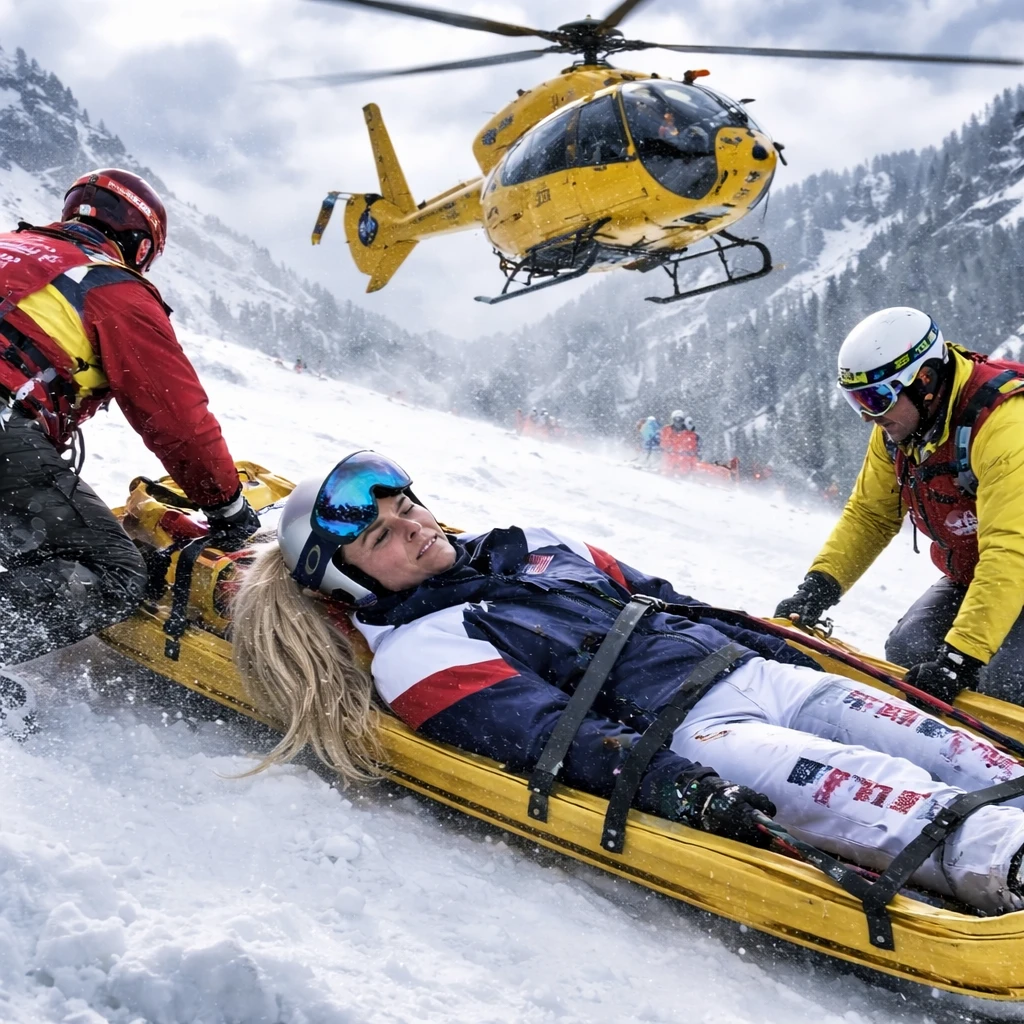

In a dramatic and unsettling moment during the women's downhill skiing competition at the 2026 Winter Olympics held in Cortina d’Ampezzo, Italy, Lindsey Vonn, the 41-year-old American alpine skiing icon, suffered a severe crash moments after beginning her run. Known for her resilience and formidable career, Vonn’s attempt to capture Olympic gold again on a repaired right knee and a severely injured left knee was abruptly halted when she lost control immediately after leaving the starting gate.
Observers saw Vonn clip a gate with her right shoulder before she flailed uncontrollably down the slope, ultimately landing awkwardly on her back with her skis tangled beneath her. The intense crash was accompanied by her audible cries as medical teams quickly rushed to her aid. Silence descended over the crowd gathered at the finish line, watching anxiously as Vonn underwent several minutes of medical attention on the snow.
For the second time in nine days, a rescue helicopter was summoned to extract her from the mountain. Vonn was stabilized on a stretcher and airlifted to receive further medical evaluation. The United States Ski Team has not released detailed information regarding her condition, stating only that she would be thoroughly assessed.
Anouk Patty, chief of sport for U.S. Ski and Snowboard, commented on the severity of the sport's risks, saying, “She’ll be OK, but it’s going to be a bit of a process. This sport’s brutal and people need to remember when they’re watching that these athletes are throwing themselves down a mountain and going really, really fast.”
The competition itself produced a significant milestone, as Breezy Johnson, Vonn’s teammate, secured the Olympic downhill gold, becoming only the second American woman to do so, following in Vonn’s footsteps 16 years prior. Johnson, a 30-year-old athlete, fended off strong challenges from Germany’s Emma Aicher and Italy’s Sofia Goggia, though her victory was tempered by the day’s events concerning Vonn.
Reflecting on the emotional challenges, Johnson expressed empathy for Vonn’s ordeal: “I don’t claim to know what she’s going through, but I do know what it is to be here, to be fighting for the Olympics, and to have this course burn you and to watch those dreams die. I can’t imagine the pain that she’s going through and it’s not the physical pain—we can deal with physical pain—but the emotional pain is something else.”
Vonn’s father, Alan Kildow, was among the spectators and was visibly shaken during the incident. Notable figures including rapper Snoop Dogg observed the proceedings quietly, while fellow American ski star Mikaela Shiffrin expressed her sorrow through social media with a broken heart emoji.
Johan Eliasch, president of the International Ski and Snowboard Federation, characterized the crash as “tragic, but it’s ski racing,” and extended gratitude for Vonn’s contributions to the sport, noting that her presence has cast alpine skiing in a favorable spotlight during the Games.
Heading into the Olympics, Vonn was widely celebrated as an inspiring narrative given her age and the significant reconstruction done on her knees, including a partial titanium knee replacement in the right knee. She had returned to World Cup competition after nearly six years and was leading the downhill standings, making her a favorite for gold. However, just nine days before the Olympic downhill, she suffered another severe knee injury in Switzerland—including a ruptured ACL, bone bruise, and meniscus damage—yet she continued to compete.
Her history is punctuated by persistent comebacks. Notably, during the 2006 Turin Olympics, she endured a serious fall in training and was hospitalized, but still competed in all planned events less than 48 hours later.
Cortina d’Ampezzo holds a special place in Vonn’s racing legacy. Dubbed the queen of Cortina, she had secured a record 12 World Cup victories on the Olympia delle Tofana course and had tested her repaired knees during downhill training runs before Sunday’s accident, which occurred under clear, sunny skies. Vonn had described this comeback as "the best" and "most dramatic" of her career.
News of her crash quickly spread throughout the fan zones and spectators voiced their concerns and disappointment. American spectator Megan Gunyou remarked, “It’s such a huge loss and bummer. I feel like hearing her story and just like the redemption of her first fall and like fighting to come back to the Olympics this year, I mean, I feel so sad for her.”