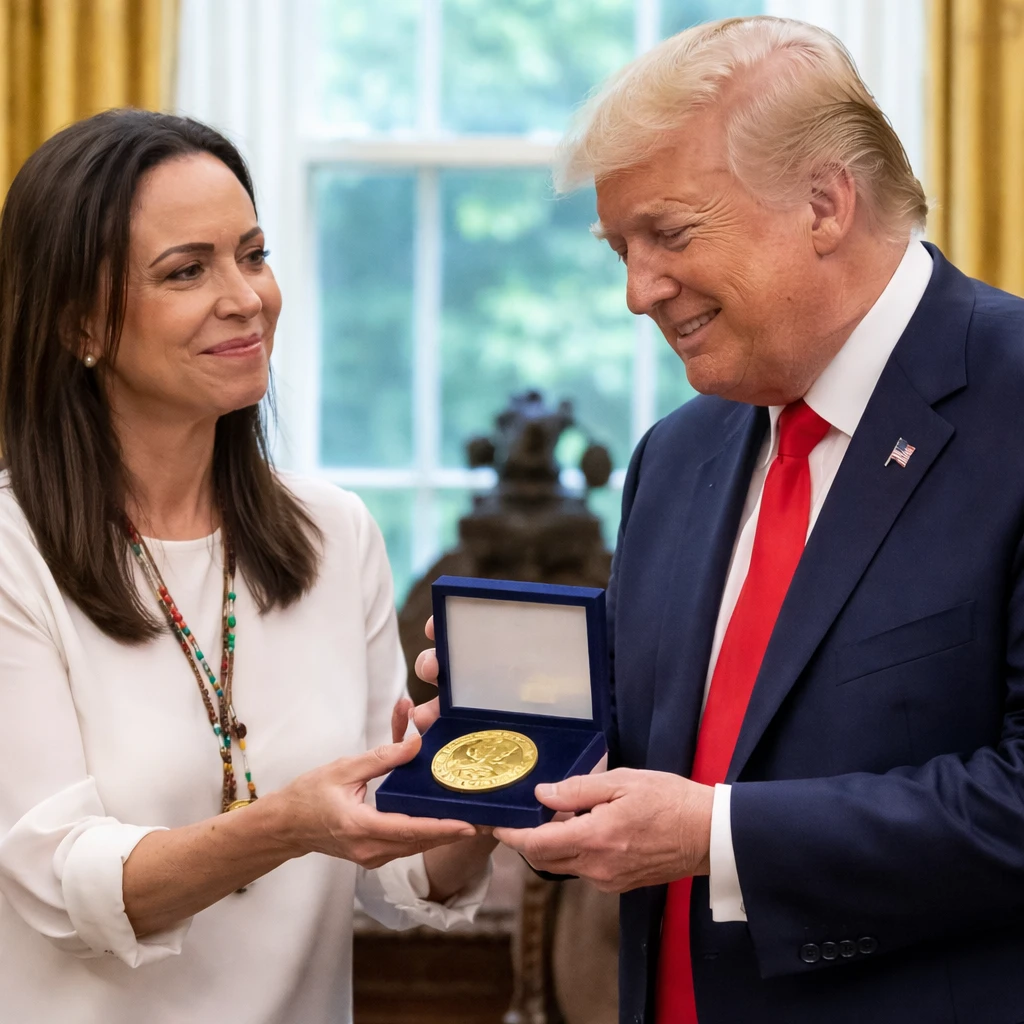

In a rare and symbolic act, Venezuelan opposition leader María Corina Machado handed over her Nobel Peace Prize medal to President Donald Trump during a visit to the White House on Thursday. Machado, a prominent figure opposing the Maduro regime, conveyed this gesture as a token of recognition for Trump’s commitment to Venezuelan freedom despite ongoing political complexities.
After meeting with Trump at the White House, Machado told reporters that she presented the medal "as a recognition for his unique commitment with our freedom." She departed the executive mansion heading to Capitol Hill for a session with U.S. lawmakers. Later, Trump confirmed via social media that Machado had entrusted him with the medal, expressing honor in receiving it and praising Machado's resilience. His message highlighted mutual respect between the two leaders.
The White House shared an official photo showing Trump and Machado in the Oval Office, featuring the framed medal with an inscription acknowledging Trump’s decisive actions in support of Venezuelan liberation. However, despite the symbolic presentation, the Nobel Institute clarified that Machado was not entitled to transfer the Peace Prize to the president. The exchange remains purely honorary rather than formal.
Trump's stance on Venezuela has shown signs of inconsistency. While he proclaimed strong support for democratic transition, he has not specified timelines for elections or details on future political arrangements. Machado herself mentioned that concrete information on election scheduling was not conveyed during their discussion. She also refrained from disclosing the meeting's substance beyond expressing optimism about Trump's dedication.
Following a private meeting lasting approximately two and a half hours, Machado briefly addressed her supporters gathered near the White House fence. She affirmed, "We can count on President Trump," which was met with chants of gratitude directed at the former president. This public display contrasted with the ongoing fragile political situation in Venezuela, where acting President Delcy Rodríguez administers government affairs and remains closely tied to Maduro’s regime.
Rodríguez recently advocated renewing diplomatic links with the United States and encouraged increased foreign investment in Venezuela’s nationalized oil sector, even as Trump’s administration has sought control over the country’s crude exports amid sanctions and legal actions.
Trump has publicly expressed skepticism regarding Machado’s capability to govern Venezuela, citing a perceived lack of internal support and respect across the country. Despite some opposition to Maduro's rule, electoral processes have affirmed Maduro’s continued control amid accusations of irregularities and suppression of dissent.
White House Press Secretary Karoline Leavitt characterized Machado as "a remarkable and brave voice" but emphasized that the meeting did not alter Trump’s views on her political viability. Leavitt reiterated Trump’s stance supporting new Venezuelan elections "when the time is right," without offering specific timelines.
Leavitt described the encounter as a candid and constructive exchange focused on Venezuela’s current affairs rather than a platform for new policy proposals. Machado reportedly initiated the meeting independently and appeared to have approached it without rigid expectations.
After departing the White House, Machado met privately with a bipartisan group of U.S. senators. Senator Chris Murphy shared that Machado warned of concern if significant progress towards a political transition or elections did not materialize within a few months. Murphy highlighted Machado’s critical assessment of Delcy Rodríguez, labeling her as potentially more detrimental than Maduro himself.
Despite the meeting, Machado reportedly received no firm U.S. commitment on election timelines. Senator Bernie Moreno praised Machado’s message, framing the ousting of Maduro as a crucial achievement for Latin America and underscoring the importance of Trump’s role.
The timing of Machado's Washington visit coincided with U.S. naval forces intercepting a sanctioned oil tanker linked to Venezuela, part of broader efforts to control the country's oil imports. These events followed the high-profile capture of Maduro and his wife in Caracas, their subsequent extradition to New York, and pending drug trafficking trials.
Leavitt noted cooperative efforts between Venezuelan interim authorities and the Trump administration, including plans to release political prisoners previously detained under Maduro’s government. Recently, five Americans were freed. Trump cited a "great conversation" with Rodríguez, marking their first dialogue post-Maduro's removal.
The political outlook for Machado remains uncertain. Following Maduro’s arrest, Trump publicly stated doubts about Machado’s leadership prospects. Historically, Machado has navigated political pressures carefully, seeking alliances within the U.S. administration and garnering international accolades like the Nobel Peace Prize awarded to her daughter in Norway due to Machado’s prolonged absence from public life amid security concerns in Venezuela.
Machado's initial political engagements date back to 2004, involving challenges to the Chávez government through initiatives like the Súmate referendum. Her activism led to legal confrontations and international opposition to successive Venezuelan administrations. In recent elections, despite indications of support, Maduro’s party secured victory amid contested results, sparking widespread protests and crackdowns.
Authoritative coverage gathered from multiple correspondents and sources familiar with the evolving political scenario.