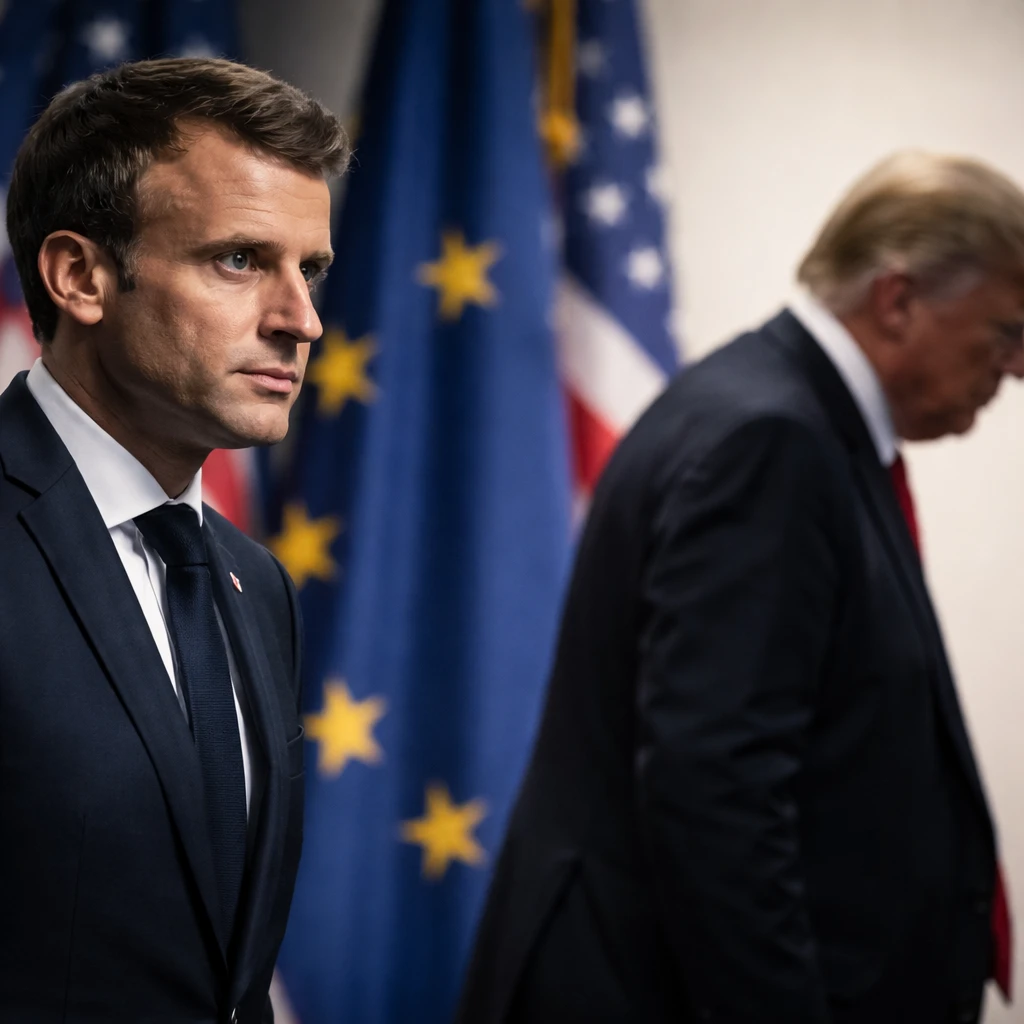
In the ongoing geopolitical developments surrounding U.S. President Donald Trump's proposal related to Greenland, Europe's outward resistance contrasts with behind-the-scenes diplomacy. On a recent Tuesday, Trump shared a text message he received from French President Emmanuel Macron, which Macron’s office verified as authentic. The French leader’s message, which opened with the friendlier address "My friend," conveyed a softened discourse compared to the more critical public comments from France and some of its European allies about Trump’s efforts to assert U.S. interest in Greenland, a semi-autonomous territory of NATO member Denmark.
Before addressing the contentious Greenland matter, Macron’s message underscored areas where he and Trump hold convergent views. "We are totally in line on Syria. We can do great things on Iran," Macron wrote in English, signalling alignment on key foreign policy concerns.
Regarding Greenland, Macron expressed confusion, stating, "I do not understand what you are doing on Greenland," then quickly pivoted to a more cooperative note: "Let us try to build great things." This reference was the sole mention of Greenland in the text segments shared by Trump, though the timing of the message's receipt was not made clear in the public release.
In an unusual break from diplomatic convention, Trump has frequently divulged private exchanges with world leaders. This week also saw the publication of a message Trump sent to Norway’s prime minister, verifying the message’s legitimacy both through Norway’s government and the White House itself. Within it, Trump connected a tough stance on Greenland with Norway’s decision the previous year not to award him the Nobel Peace Prize, stating, "Considering your Country decided not to give me the Nobel Peace Prize for having stopped 8 Wars PLUS, I no longer feel an obligation to think purely of Peace." The note ended emphatically, "The World is not secure unless we have Complete and Total Control of Greenland."
Additionally, Trump shared a positive message from NATO Secretary General Mark Rutte, who affirmed a commitment to "finding a way forward on Greenland" and expressed eagerness to meet. Rutte, however, has refrained from publicly discussing Greenland, particularly amid rising uncertainties over U.S. intentions and warnings from Denmark that any militarized U.S. action could challenge NATO stability. Responding to inquiries about these issues, Rutte stated, "I can never comment on that. That’s impossible in public."
Macron’s relationship with Trump is characterized by accessible but cautious communication. Demonstrated last September when Macron filmed a phone call to Trump on a New York street—highlighting diplomatic channels remain open even if formal meetings are challenging—the French president appears prepared for the potential public nature of private communications with the American leader.
When asked about the publicity surrounding his message to Trump, Macron expressed no surprise and took responsibility for the content. "It’s my habit to be coherent between what I say on the outside and what I do in a private manner," he remarked, showing an openness to transparency, even as the tone of his private outreach diverges from public criticism.
Perhaps most notably, Macron proposed in his message the idea of convening representatives from both Ukraine and Russia at a Paris meeting scheduled for the week, a suggestion not made public before. He suggested hosting Russian officials in the margins of the meeting, acknowledging the diplomatic sensitivities involved given France's simultaneous military and political support for Ukraine against Russian aggression. The invitation supposedly also encompassed Danish and Syrian representatives, as well as members of the G7, including the United States, culminating in an offer to share a dinner in Paris before Trump’s return to the U.S.
Despite Macron’s steady diplomatic efforts, his attempts to maintain cordial ties with Trump have seen mixed reactions. For example, Trump reacted sharply when informed that Macron declined to join his newly formed Board of Peace to oversee the next phase of the Gaza peace process—an institution Trump recently proposed. Trump threatened to impose hefty tariffs on French wines and champagnes, explicitly framing the potential tariff as a punitive measure aimed at pressuring Macron into participation, despite the French president remaining in office until 2027. This episode highlights the underlying tensions that persist beneath the veneer of diplomatic engagement.
Contributors to this analysis included correspondents from Brussels, Paris, and Davos, reflecting the widespread international attention this issue commands.