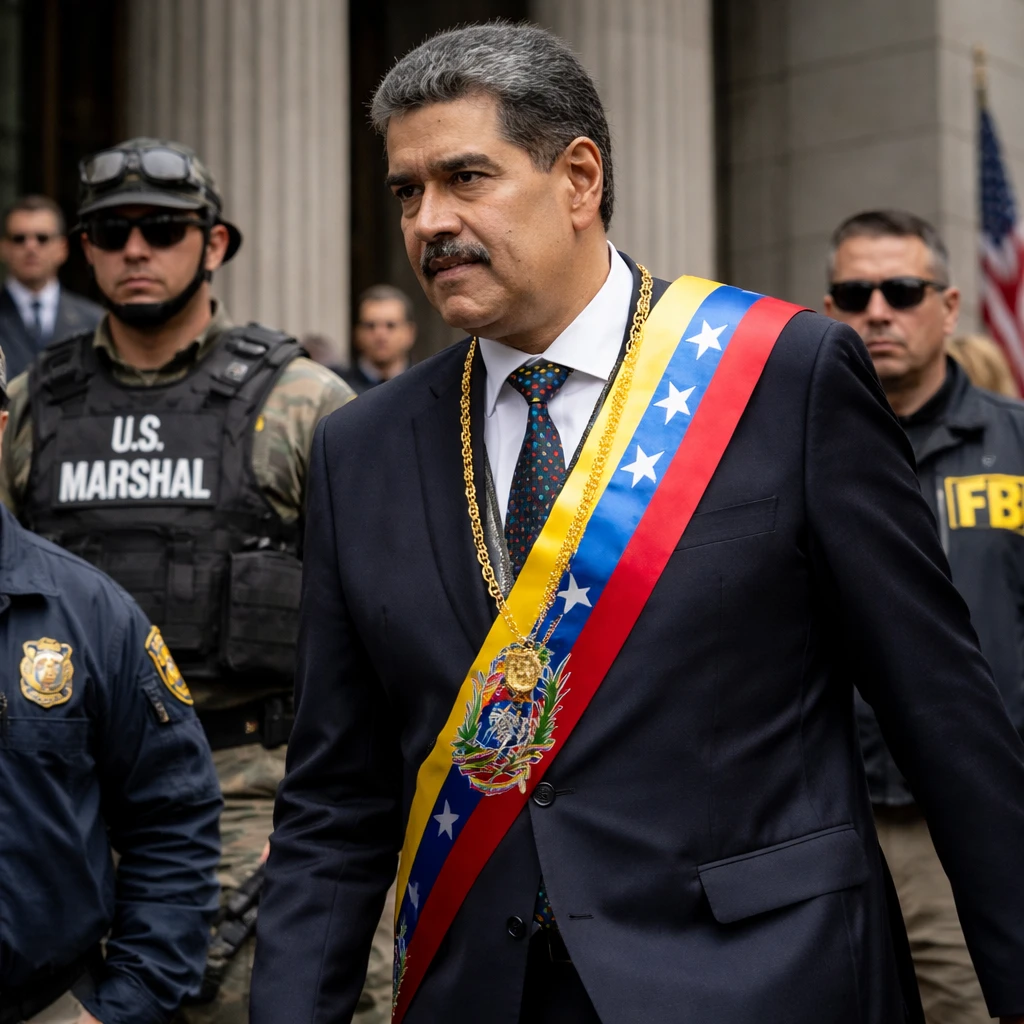

Deposed Venezuelan leader Nicolás Maduro is scheduled to appear for his initial court session in New York on Monday to answer to drug trafficking allegations levied by U.S. authorities. His situation parallels that of former Panamanian strongman Manuel Noriega, who faced U.S. legal proceedings following his ouster by American military forces.
Maduro's capture occurred on the 36th anniversary of Noriega's removal, drawing striking parallels between the two leaders’ legal ordeals. Similar to Noriega, Maduro’s legal team is anticipated to dispute the conditions of his apprehension and assert claims of sovereign immunity, charging that as a ruling head of state he is protected from prosecution. Such claims form a central principle in international and U.S. law but are expected to be rejected based on precedents established during Noriega’s trial.
Legal experts note that, because the U.S. does not recognize Maduro as Venezuela’s legitimate president, these immunity arguments lack sufficient standing. "There’s no claim to sovereign immunity if we don’t recognize him as head of state," explained Dick Gregorie, a retired federal prosecutor involved in both Noriega’s indictment and investigations into Maduro's government corruption. Multiple U.S. administrations across political parties have labeled Maduro’s election results as fraudulent and refused to acknowledge his legitimacy, thereby diminishing his protections under law.
Unlike Noriega, who governed Panama without ever holding a presidential title during his regime, Maduro holds the distinction of claiming electoral victories on three occasions. Certain nations including China, Russia, and Egypt recognize Maduro’s 2024 reelection despite its contentious nature. This discrepancy creates distinct legal questions, though for U.S. courts, the State Department’s position—classifying Maduro as a fugitive—is determinative. This designation accompanies a $50 million reward for his capture.
Following Maduro’s contested 2019 reelection, the first Trump administration closed the U.S. Embassy in Caracas, severed diplomatic relations with Maduro's government, and extended recognition to Venezuela's opposition leader as the legitimate head of state. The Biden administration has largely maintained this policy framework, allowing opposition-appointed leadership of Venezuelan assets such as Citgo while concurrently engaging in dialogues aimed at facilitating free elections.
Maduro's legal defense is further complicated by U.S. sanctions targeting him and his wife, Cilia Flores, who were both apprehended concurrently. These sanctions prohibit American persons from financial dealings with them unless authorized by the Treasury Department. With Maduro’s successor Delcy Rodríguez similarly constrained under sanctions, financing legal defense poses significant challenges.
Historically, the U.S. Justice Department's policy demands that the attorney general personally approve indictments of sitting foreign presidents due to the foreign policy implications. Former Trump administration Attorney General Bill Barr, who authorized Noriega’s removal under a 1989 legal opinion legitimizing forcible extraterritorial abductions for enforcing domestic law, also oversaw Maduro’s indictment during his tenure. Barr stated that the operations against Maduro and his associates inherently involve regime change, emphasizing dismantling criminal networks tied to the Venezuelan leadership.
Experts caution that although Maduro may argue a narrower form of immunity for official acts as a de facto leader, such claims are fragile. The indictment accuses Maduro and other co-conspirators of operating a large-scale cocaine trafficking enterprise with protection and logistical support extended to violent drug traffickers and narcoterrorists. This criminal characterization undermines any defense that such conduct could be considered legitimate official acts.
In contrast to Noriega, whose arraignment was marred by contentious issues around the legality of his arrest amid a U.S. invasion deemed "shocking to the conscience," Maduro’s prosecution rests on the premise that he lacks recognized sovereign immunity. Supreme Court rulings from the 19th century uphold that U.S. courts can try foreign nationals regardless of how they are brought into the country.
As this high-profile legal battle unfolds, questions remain on the constitutional grounds of the U.S. operation that led to Maduro's capture given the lack of Congressional authorization. Nonetheless, judicial deference to executive foreign policy decisions is expected to allow the prosecution to proceed without significant judicial obstacles.