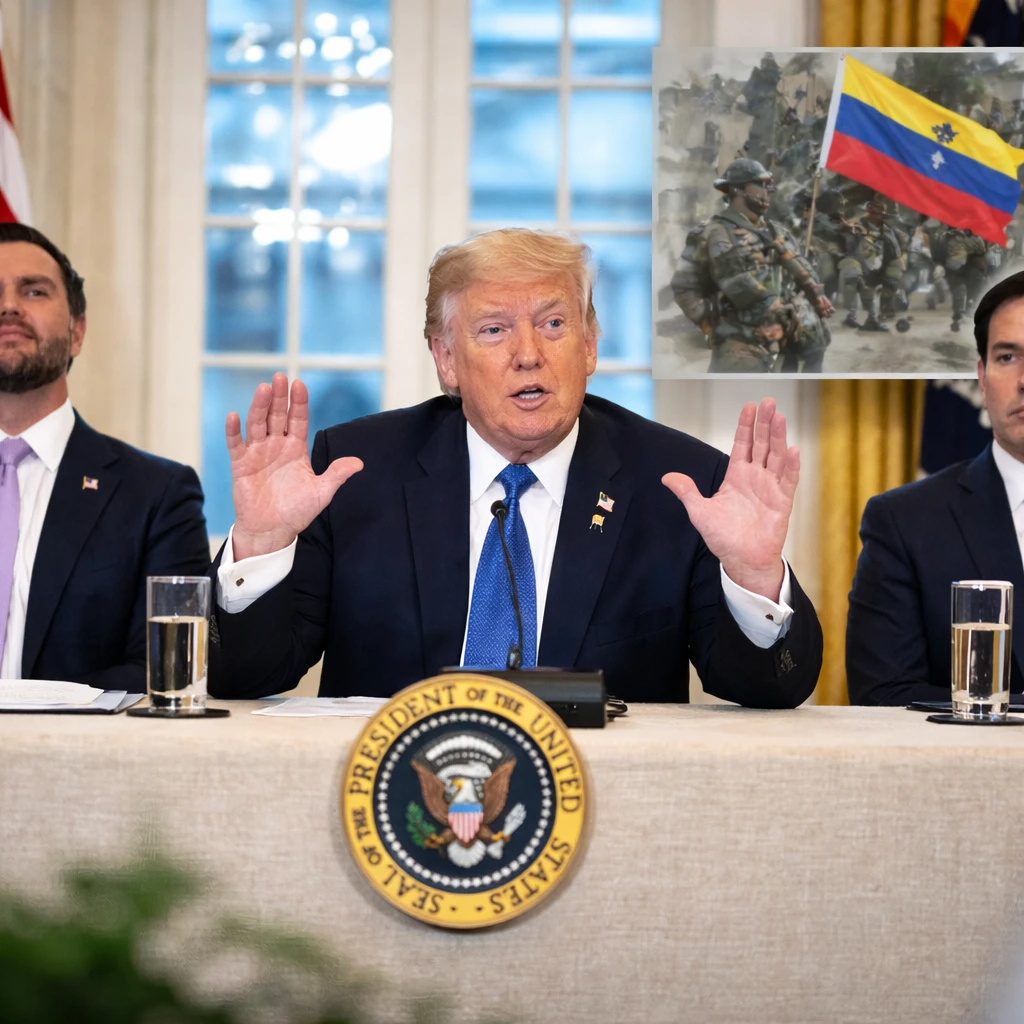

A recent survey by the AP-NORC Center for Public Affairs Research reveals that the majority of American adults believe President Donald Trump has overextended the use of U.S. military forces in foreign affairs. Conducted shortly after the January 3 apprehension of former Venezuelan leader Nicolás Maduro, the poll shows that 56% of Americans feel Trump has gone too far with overseas military interventions. This sentiment is coupled with broad disapproval of the president's overall management of foreign policy, particularly his handling of the situation in Venezuela.
The findings stand in contrast to the administration's assertive foreign policy stance, which includes efforts to assert control over Venezuelan oil resources, proposals for the United States to acquire Greenland, and commitments to support protesters in Iran. While some Americans perceive the recent actions targeting Venezuela as positive steps toward curbing illegal drug trafficking into the U.S. and aiding the Venezuelan people, fewer view these moves as beneficial for U.S. national security or the economy.
Among partisan groups, Republicans mostly align with Trump's approach, despite it differing from his earlier "America First" campaign platform. Nevertheless, only a minority of Republicans advocate for an even more aggressive military posture abroad, reflecting concerns about the risks of continued foreign engagement.
The survey highlights that while the U.S. undertook military action to capture Nicolás Maduro in Venezuela, President Trump has also suggested the possibility of seizing Greenland unilaterally if negotiations with Denmark fail. Additionally, he has asserted that the U.S. would support peaceful protesters in Iran. These foreign policy moves have generated differing perspectives across political affiliations.
The majority of Democrats and independents express the belief that Trump has exceeded appropriate limits in foreign interventions, with nearly 90% of Democrats and 60% of independents sharing this view. In contrast, only about 20% of Republicans agree that the president has overreached. A significant 71% of Republicans consider Trump's actions adequate, and only 10% desire further escalation in military involvement.
Public approval of Trump's handling of Venezuela is relatively low, with 57% expressing disapproval, slightly better than the 61% who disapprove of his overall foreign policy approach. These figures mirror the relatively stable overall approval ratings for the president during his second term.
Many Americans recognize certain benefits arising from the U.S. intervention in Venezuela. Approximately half view the efforts as mostly beneficial in stopping the flow of illegal drugs into the United States. Meanwhile, 44% believe the intervention will largely help the Venezuelan people who suffered under Maduro's regime for over a decade. However, Americans remain divided on whether the intervention will positively or negatively affect U.S. economic interests and national security, or whether it will have no significant impact.
Republican respondents tend to perceive greater benefits from the U.S. actions, particularly concerning drug trafficking. Eight in ten Republicans believe the intervention will be mainly positive for reducing illegal drug inflow, whereas only six in ten think it will benefit the U.S. economy.
Among Democrats and independents, the preference leans toward the United States playing a less active role internationally. Nearly half of all Americans want a reduced American presence in global affairs, while about one-third see the current level of involvement as appropriate. Only 20% of adults favor increased U.S. engagement worldwide, including just 10% of Republicans.
Notably, more than half of Democrats and independents have shifted toward wanting less U.S. intervention compared to earlier this year. Conversely, a majority of Republicans—64%—now regard the existing foreign role as suitable, an increase since September. The proportion of Republicans desiring a smaller international role has fallen to around 25%, down from 34% several months ago.
The AP-NORC survey was conducted with a sample of 1,203 adults from the AmeriSpeak Panel, which is designed to be representative of the U.S. population. The margin of error for the overall adult sample is plus or minus 3.9 percentage points.