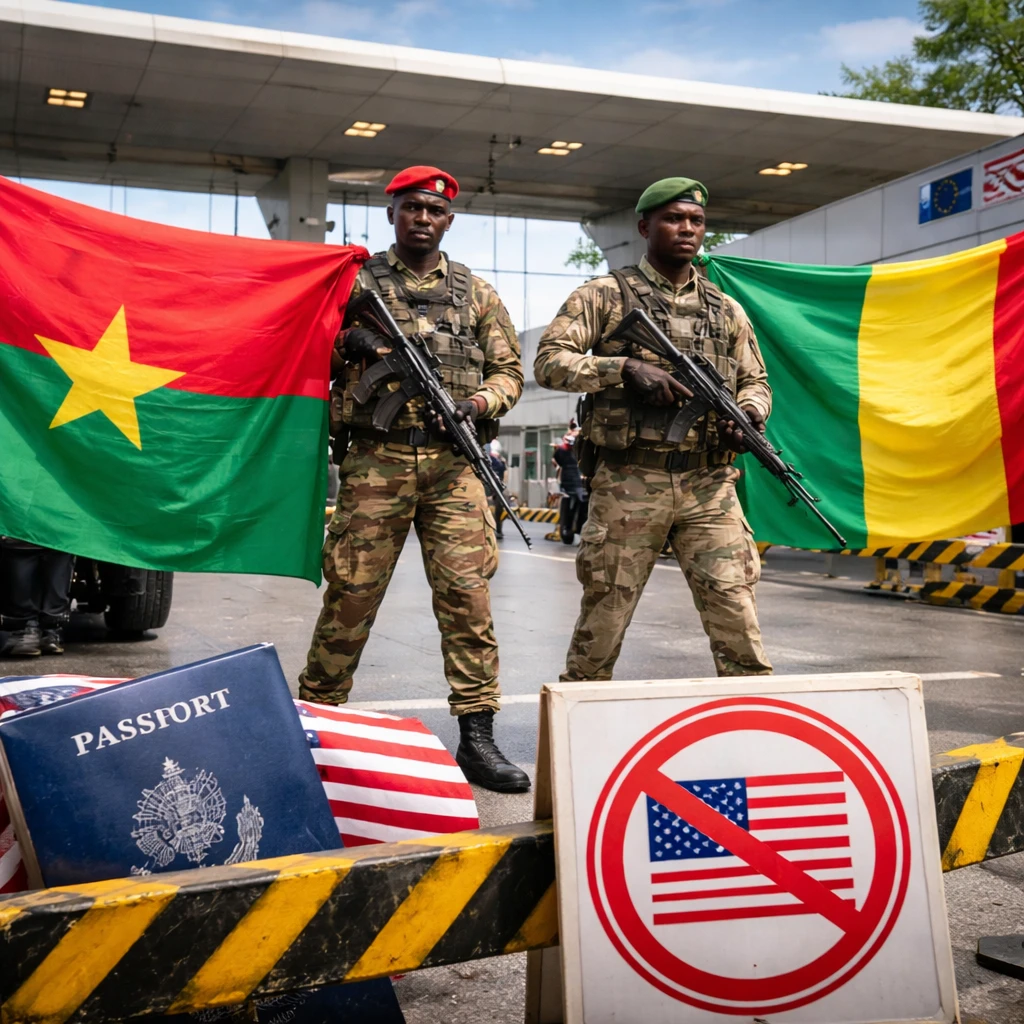

Authorities in Mali and Burkina Faso have declared prohibitions on the entry of United States nationals into their territories, instituting these measures as direct retaliation against recent U.S. immigration policies. Both governments issued formal declarations on Tuesday, asserting that these steps follow the principle of reciprocity in response to the U.S. government's decision to restrict travel from their countries.
The U.S., under President Donald Trump's administration, expanded travel bans on December 16 to include 20 additional nations. Among them were Mali, Burkina Faso, and Niger—countries currently governed by military juntas that have distanced themselves from the Economic Community of West African States (ECOWAS), the regional governmental association.
In its official communication, Mali's Ministry of Foreign Affairs and International Cooperation stated, "In accordance with the principle of reciprocity, the Ministry informs both national and international audiences that, immediately, the Government of the Republic of Mali will implement identical conditions and requirements to those placed upon Malian citizens towards U.S. nationals." This indicates an immediate enforcement of equal travel restrictions targeting Americans.
Concurrently, Burkina Faso's Minister of Foreign Affairs, Karamoko Jean-Marie Traoré, issued a parallel statement. He justified the ban on U.S. nationals traveling to Burkina Faso on similar grounds, signaling a congruent policy stance between the two neighboring West African nations.
According to details provided by the White House, the rationale behind the U.S. travel ban includes the prevalence of consistent attacks by armed groups operating within these countries. Mali and Burkina Faso have experienced significant challenges in curbing the rapid rise and operational expansion of various militant organizations. These security concerns have catalyzed the military juntas, which seized control from previous civilian administrations, to commit firmly to combating these threats amid regional instability.
These reciprocal travel restrictions contribute further to the complex and strained relations between the affected West African military governments and the U.S. administration, particularly in the context of ongoing security struggles and shifting regional alliances.