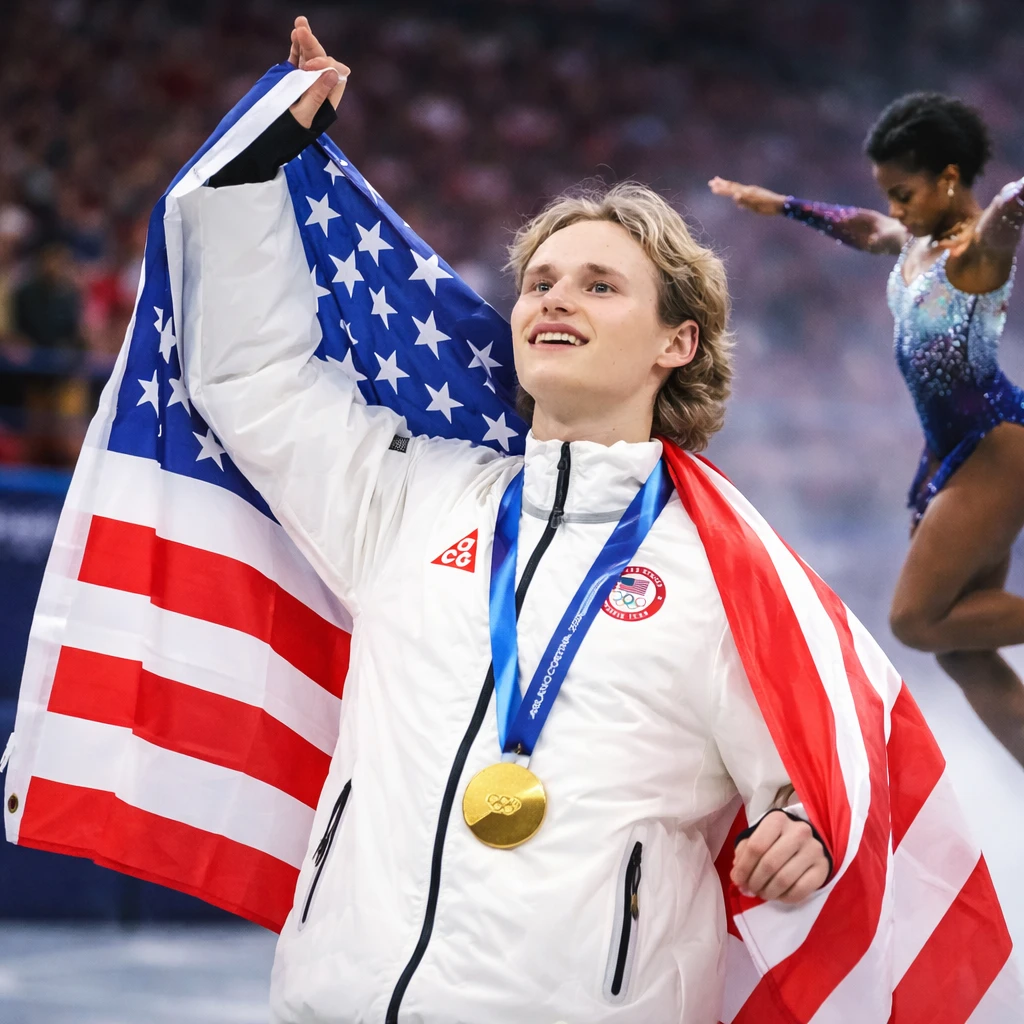

During the 2026 Winter Olympics in Milan, Ilia Malinin, a figure skater from the United States known for his multiple quadruple jumps, succeeded in legally landing a backflip on a single skate for the first time in Olympic history. The Virginia-born 21-year-old contributed a vital performance to the American team’s gold medal win by incorporating this move, which has since become known as the "Bonaly flip" after Surya Bonaly, a French skater who had performed the maneuver under very different circumstances.
Despite Malinin’s achievement attracting widespread acclaim, many observers on social media have expressed concern that this recognition overshadows Bonaly’s precedent-setting work, suggesting racial dynamics may be at play. Ari Lu, a 49-year-old Black TikTok user, noted that while Malinin is celebrated for his athletic skill, Bonaly, who is Black, was often subjected to criticism and negative judgments during her competitive years—frequently focusing on her appearance rather than her abilities.
Historically, backflips in figure skating were rare and officially forbidden. Terry Kubicka, a former U.S. champion, successfully executed a backflip at the 1976 Olympics but landed on two skates before the International Skating Union banned the move citing safety concerns. More than two decades later, during the 1998 Nagano Games, Bonaly defied this prohibition by performing a backflip landing on a single blade, an act of rebellion that marked her final professional routine amidst a cheering crowd. However, the judges penalized her for the move, reflecting the enduring controversy surrounding it.
For years, this thrilling element was confined to exhibition performances until the International Skating Union lifted its ban roughly two years ago to refresh the sport’s appeal among younger audiences. Malinin incorporated the backflip into competition choreography, bringing it to the Olympic stage and contributing to his team’s triumph.
Bonaly herself ended her Olympic career with a tenth-place finish and has acknowledged a double standard in the sport’s reception of her move compared to Malinin’s recent success. In a phone interview from Minnesota, she expressed pride in seeing the maneuver performed legally on Olympic ice and remarked that her career's timing worked against her, as audiences were less accustomed to diversity and unconventional performances during her era. "I broke ice for other skaters," she said. "Now everything is different. People welcome anyone as long as they are good and that is what life is about."
Bonaly’s legacy is part of a broader narrative contextualizing racial barriers in figure skating. Before her, athletes such as Mabel Fairbanks faced exclusion owing to racist policies, and Debi Thomas became the first African American Winter Olympic medalist in figure skating. While representation has improved incrementally, the presence of Black skaters at a professional level remains limited. In fact, no Black skaters competed for the U.S. team this year, with notable skater Starr Andrews finishing seventh at nationals. Conversely, the team includes five Asian American athletes and Amber Glenn, a vocal supporter of LGBTQ+ causes.
Regarding the backflip, Amber Glenn, Malinin’s teammate and three-time U.S. champion, noted that while she finds backflips entertaining and aspires to learn one after her competitive career ends, she currently has reservations about training the maneuver due to its difficulty.
Social media posts from both the International Skating Union and the International Olympic Committee have increasingly celebrated Bonaly’s backflip, acknowledging its lasting influence and symbolic significance in the sport. These endorsements highlight the move’s journey from being forbidden to becoming an inspirational emblem.