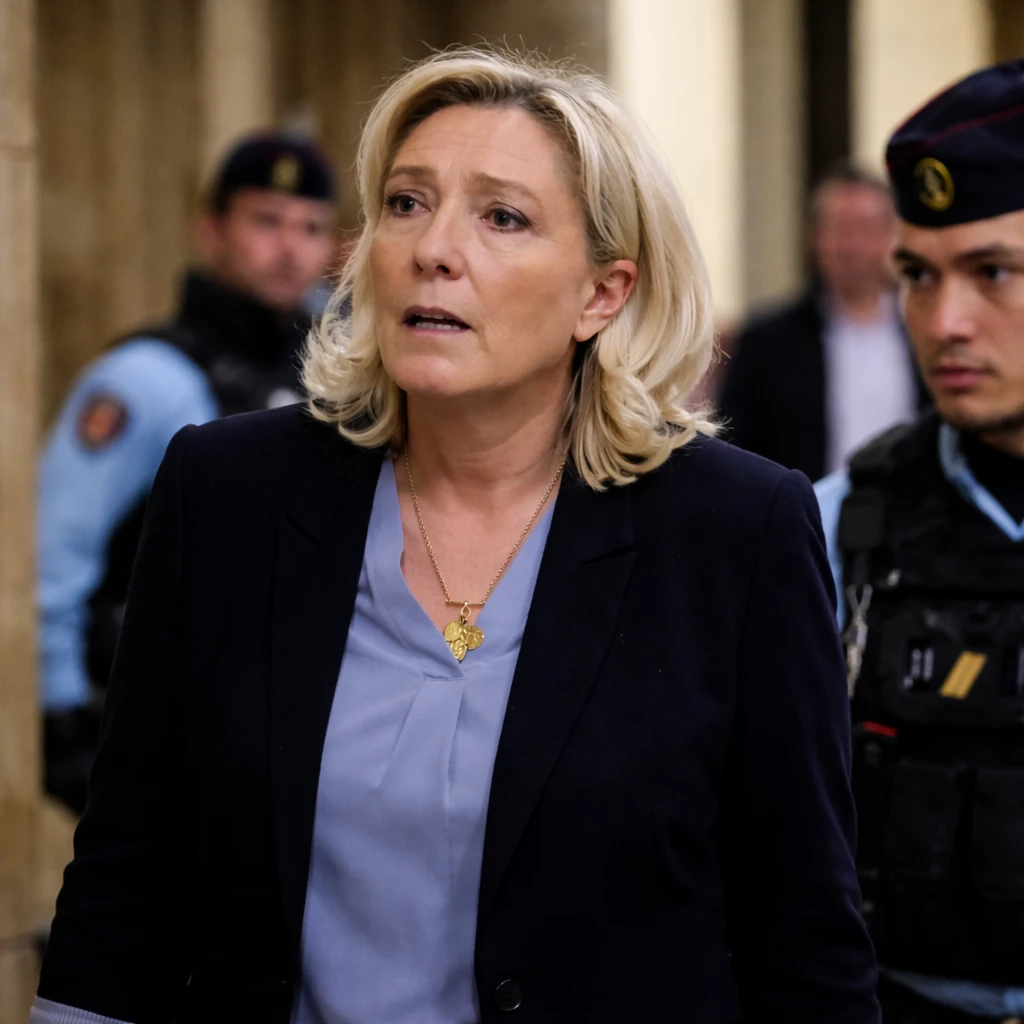

Marine Le Pen, head of the French far-right party, acknowledged on Wednesday during an appeals hearing in Paris that she had made "a mistake" related to the deployment of funds from the European Parliament. Despite this admission, she categorically refuted claims that she was the architect of a fraudulent scheme aimed at diverting European Union (EU) money. The ongoing legal proceedings cast a shadow over her ambitions as a potential presidential candidate.
Le Pen, aged 57, is seeking to reverse a March 2025 ruling which found her guilty of embezzlement connected to the payment of parliamentary assistants from 2004 through 2016. She conceded that some individuals paid as EU parliamentary aides had performed work for her political party, formerly known as the National Front, during that time period. "The mistake lies here: certainly some assistants, case by case, should have worked marginally, more substantially, or entirely... for the benefit of the party. And that's that," Le Pen stated before a panel of three judges.
The five-week trial which commenced last week may have profound consequences for the French political environment. A decision from the appeals court is anticipated before the summer months.
In the original verdict, Le Pen was barred from occupying elected office for five years and sentenced to two years of electronically monitored home detention plus an additional two years suspended sentence. The Parisian court held that she was at the core of "a fraudulent system" her party employed to misappropriate approximately €2.9 million (about $3.4 million) from EU parliamentary funds allocated for hiring assistants. The ruling condemned this diversion of resources as "an undemocratic shortcut" disadvantaging political opponents.
If her candidacy is reinstated, Le Pen is expected to be a leading contender in France's 2027 presidential election. If disqualified, she has named her 30-year-old protégé, Jordan Bardella, as the alternative presidential candidate representing her political movement.
Throughout a rigorous interrogation on Wednesday, Le Pen strongly denied the existence of a "system" designed to use EU funding to pay party workers. She argued that her party did not intentionally violate any laws. "I wouldn't say we did everything perfectly. We can be criticized in certain respects," Le Pen said. "But we acted in full good faith." When asked about the decision-making process behind each hiring, she admitted to some "ambiguity" in assistant assignments. She notably acknowledged that her personal assistant, who held a contract as a parliamentary aide, "may have bought some plane tickets for me as party president, I admit, yes."
Presiding Judge Michèle Agi reminded Le Pen that as a Member of the European Parliament since 2004 and party president since 2011, she had approved these hires. "You are a lawyer; you know the law. Inevitably, signing a contract has meaning for you," Agi stated to Le Pen. In response, Le Pen shifted responsibility to the European Parliament, claiming it never informed her party at the time that their hiring practices might have contravened the rules.
Regarding her bodyguard's contract as a parliamentary assistant, Le Pen maintained that the European Parliament considered the situation "a bit special" given the security needs involved. "Not many MEPs require protection... and one can also think the European Parliament takes that exceptional situation into account. I believe we did not commit any irregularities," she added.