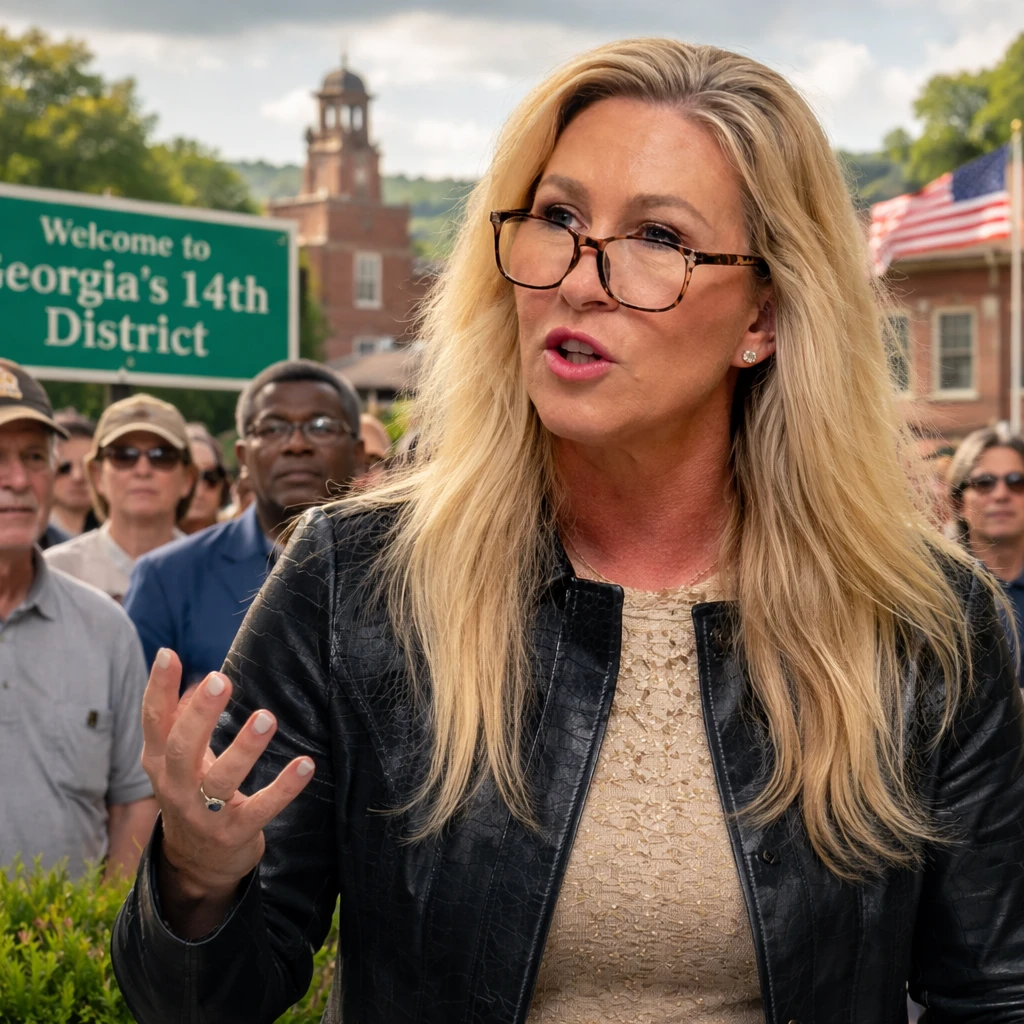

In the northwestern corner of Georgia, where Representative Marjorie Taylor Greene's 14th Congressional District resides, her political journey is viewed through varied lenses as she steps down before completing her third term in office. The dialogue surrounding her legacy is marked by strong admiration from certain Republicans who regard her as a "mama bear," articulating sentiments they felt but found seldom expressed in Washington, contrasting with more critical perspectives of independents residing within the district.
Jackie Harling, chair of the local Republican Party, emphasized Greene's role in giving voice to Conservative constituents. Harling conveyed, "Every thought that we had in our minds, she seemed to be very good at verbalizing," underscoring Greene's reputation as a public fighter who spoke out on hot-button issues with few reservations. This vocal approach, marked by a willingness to address controversial topics and embrace conspiracy narratives, contributed significantly to her national recognition and emblematic status within segments of the political right.
However, such notoriety was not uniformly viewed as beneficial by the district’s population. Heath Patterson, an independent voter, expressed skepticism regarding the tangible impacts of Greene’s tenure. He acknowledged her capacity to make her voice heard but questioned the direct advantages accrued to the constituents. "I don’t think we did," he stated, reflecting a sentiment among those who viewed her congressional effectiveness with some reservation.
Greene's political alignment underwent a notable shift during her time in office. Initially a fervent supporter of former President Donald Trump, she vocally defended his contested claims about election integrity following the 2020 presidential election. Over time, disagreements surfaced, particularly over Trump's foreign policy priorities and handling of sensitive investigations such as those related to Jeffrey Epstein. This divergence culminated in Trump publicly labeling her a traitor and endorsing a primary challenger against her. Shortly thereafter, Greene announced her resignation.
Despite her departure, Greene has maintained a stance critical of Trump’s recent decisions, including his proposed military actions in Venezuela. On social media, she articulated that many within the MAGA movement felt betrayed by actions she believed conflicted with their initial goals.
Her ascendancy within Georgia politics mirrored Trump's rise. Greene embarked on her political journey during Trump's 2016 campaign, eventually choosing to represent the 14th District, a deeply Republican stronghold, after initially contemplating a run in the more suburban 6th District. Historically, this region supported Democratic leaders, including former Governor and Senator Zell Miller, noted for initiatives like Georgia’s lottery-funded education programs. However, demographic and cultural shifts have influenced the district's political realignment through the years.
Jan Pourquoi, an immigrant and local officeholder from Whitfield County, highlighted the district’s sense of cultural displacement amid rapid growth that trails the broader state's increase. He remarked on the residents’ perception of being "culturally oppressed," feeling marginalized as the national narrative evolves to become more urban, secular, and diverse. For many, Greene symbolized a political reaction to these changes, reflecting a desire to "stick it to them" in defense of their identity and values.
Electoral district boundaries drawn by state leaders have consolidated like-minded voters, often diminishing the competitiveness of general elections and amplifying the importance of primary contests. This structural dynamic encourages candidates with hardline positions, such as Greene, making moderate or centrist alternatives less viable. Consequently, voters like Patterson find themselves politically isolated in a region dominated by entrenched partisan loyalties.
Within local Republican circles, Greene’s resignation prompted both nostalgic support and calls for evolution. At a recent Whitfield County GOP Christmas gathering, attendees adorned in patriotic and MAGA-themed apparel voiced appreciation for her uncompromising "America First" stance and readiness to challenge established party figures. Supporters praised her advocacy on cultural issues including transgender policies and abortion, viewing these as central to her appeal.
Greene's legislative record contained several contradictions, including supporting local Korean-owned solar factories while voting against federal policies designed to expand domestic renewable energy production. She also broke ranks with Republicans on healthcare subsidy extensions favored by Democrats. Nonetheless, her base appeared untroubled by these discrepancies, focusing instead on her role as an outspoken firebrand.
Discussion regarding the impact of a more conventional legislator who might prioritize bipartisan collaboration and securing federal funding for the district was met with indifference by some supporters. Gavin Swafford, an associate from her initial campaign, suggested that Greene's major contributions lay beyond legislative achievements, emphasizing her role as a political voice rather than a policy builder.
Looking ahead, the contest to replace Greene has already gained momentum internally. Star Black, a Republican candidate who had planned to challenge Greene before her resignation, advocates for a representative who combines toughness with attentiveness to constituents' needs. Black stressed the necessity of not only fighting for district interests but also listening and representing the community effectively.