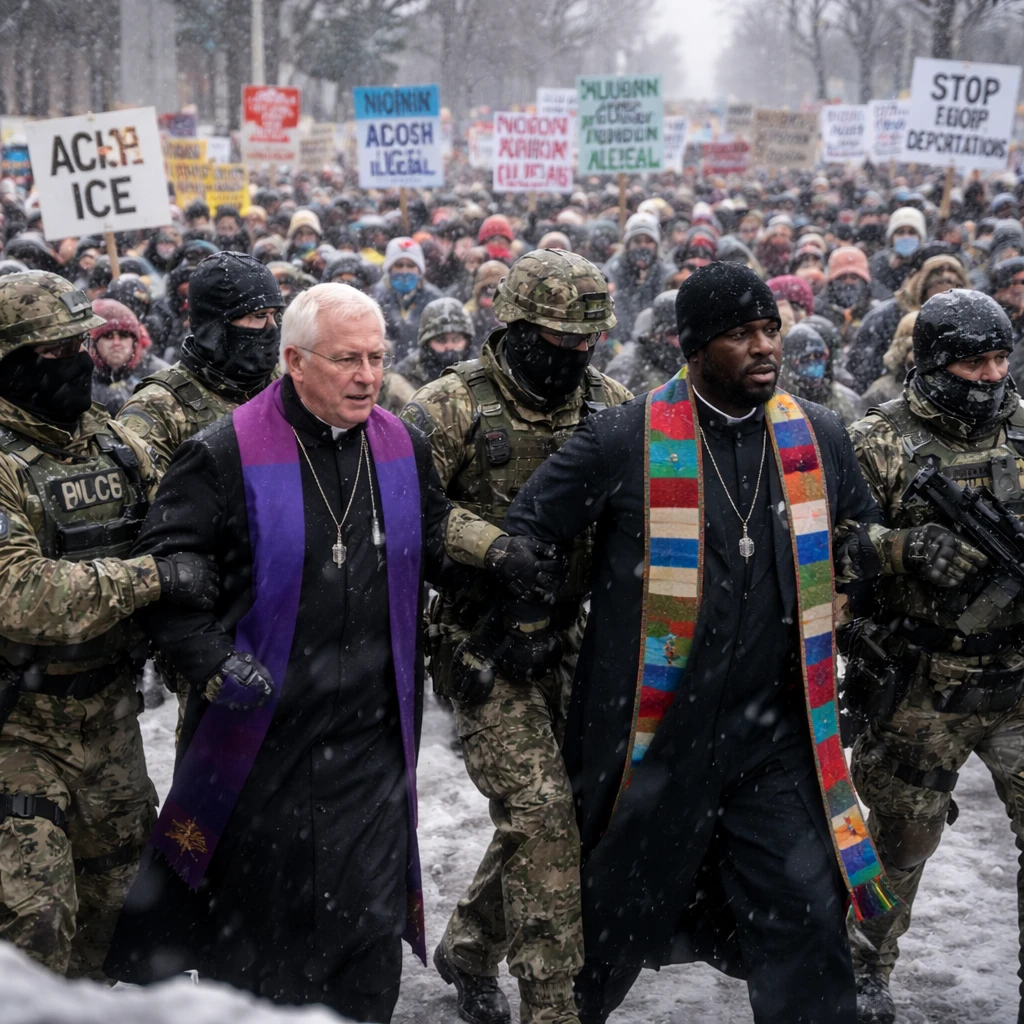
On a frigid Friday in Minnesota, with temperatures plunging to minus 9 degrees Fahrenheit (minus 23 Celsius), thousands of demonstrators assembled in downtown Minneapolis to protest the intensified immigration enforcement directed by the federal government. This surge of activism amid severe cold is part of a growing state-wide resistance against President Donald Trump's aggressive immigration policies. Participants include a broad coalition of labor unions, progressive groups, and clergy members who are encouraging Minnesotans to disengage from work, educational activities, and commercial patronage as acts of solidarity.
A pivotal moment of the day occurred at Minneapolis-St. Paul International Airport, the state's major air travel hub, where about 100 clergy were detained by police. These religious leaders were protesting deportation flights and urging airlines to halt participation in what the Department of Homeland Security has characterized as its largest immigration enforcement sweep ever. The Metropolitan Airports Commission spokesman, Jeff Lea, explained that the clergy were issued misdemeanor trespassing citations and cited for failing to comply with peace officer instructions. Their demonstration reportedly exceeded permitted boundaries near the main terminal and disrupted airline operations, prompting their arrest and subsequent release.
Reverend Mariah Furness Tollgaard from Hamline Church in St. Paul detailed her experience, noting that despite police orders to disperse, she and her fellow demonstrators chose to remain, accepting arrest to closely support migrants, including some from her congregation fearful of leaving their homes. Tollgaard indicated plans to return to her church to conduct a prayer vigil, framing the federal presence in Minnesota as an occupation that the community cannot tolerate.
Also present was Reverend Elizabeth Barish Browne from Cheyenne, Wyoming, who traveled to join the Minneapolis rally despite the harsh temperatures. Speaking from the protest, she condemned the current immigration enforcement as "clearly immoral." The protest movement in the Twin Cities has been ongoing, with daily gatherings since early January, triggered by the fatal shooting of Renee Good, a 37-year-old mother of three, by an ICE officer. This incident, alongside frequent confrontations between federal agents and community members who monitor their movements, has galvanized public outrage.
Among the protesters was Sam Nelson, a local who skipped work to support the demonstration. A former student at a Minneapolis high school where federal agents recently detained someone post-class, Nelson expressed his objection to ICE's presence on local streets, emphasizing communal solidarity against such enforcement tactics.
The protest movement has seen widespread participation beyond individual demonstrators. According to organizers, more than 700 businesses across Minnesota closed in solidarity, ranging from a bookstore in Grand Marais near the Canadian border to the Guthrie Theater in downtown Minneapolis. Kate Havelin, of Indivisible Twin Cities, one of over 100 groups involved, hailed the scale of these coordinated actions as historic.
Adding complexity to the unfolding events, an FBI supervisory agent in Minnesota resigned over dissatisfaction with the Department of Justice's handling of the investigation into Renee Good's shooting. This resignation stemmed from perceived pressure to curtail the inquiry from standard investigatory practice, although the FBI has declined to comment. Meanwhile, the Hennepin County Medical Examiner released Good's initial autopsy report affirming her death as a homicide from multiple gunshot wounds. An independent autopsy commissioned by her family corroborated these findings, detailing the trajectory of bullets through her head and noting additional wounds to her arm and breast.
Legal challenges and controversies continue surrounding recent immigration enforcement actions involving young children. A 2-year-old child was reunited with her mother after being detained with her father outside their South Minneapolis residence. The family is engaged in an ongoing asylum process, and their detention was rapidly contested in federal court. Despite a judge's order restricting out-of-state transfer of the toddler, she and her father were briefly flown to Texas but returned the following day. The Department of Homeland Security characterized the father's arrest as part of a targeted enforcement operation and claimed the child's mother initially refused to take custody, a point contested by the family's attorney.
Similarly, a 5-year-old child, Liam Ramos, was detained following his father's arrest in Columbia Heights. DHS stated the father fled the scene, resulting in Liam’s detention, despite efforts to place the child with his mother who purportedly declined custody. The child and his father are currently held together at a family detention center in Texas. Legal representatives argue that fears related to potential parental detention influenced the mother's response. Columbia Heights school officials described the child's involvement as manipulative in the enforcement context, and no criminal history for the father has been found in state records. Border Patrol officials have drawn attention away from the child's situation by highlighting broader concerns over undocumented immigrants involved in violent crimes.
These events reflect a highly charged atmosphere surrounding immigration enforcement in Minnesota, with significant community resistance, notable clergy involvement, and scrutiny of law enforcement actions in both local and federal arenas. The unfolding social dynamics are deeply intertwined with legal challenges, civil rights considerations, and public discourse on government policies impacts on immigrant families.