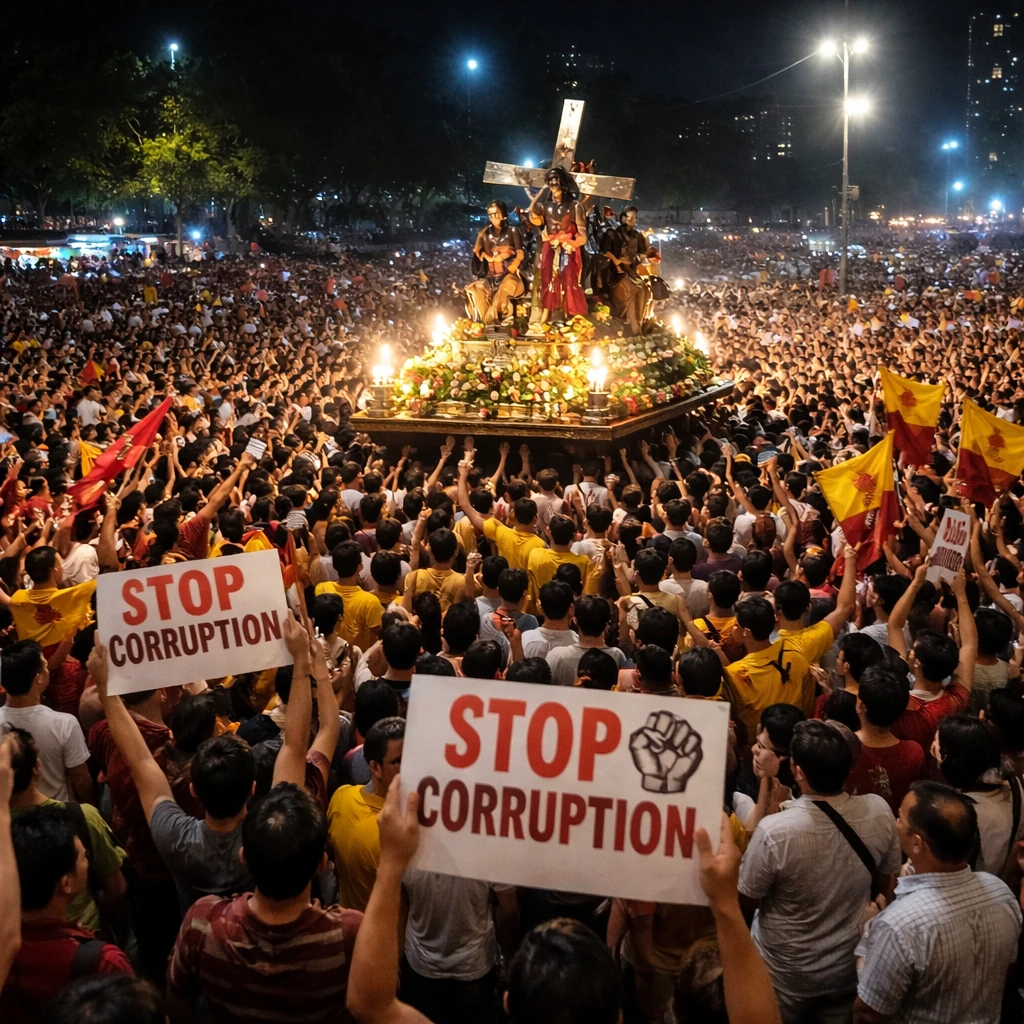

On a significant Friday in Manila, an immense gathering of Filipino Catholics, many barefooted as tradition dictates, took part in the annual procession honoring the centuries-old statue of Jesus the Nazarene. The event commenced early after a midnight mass held at a Manila seaside park, where tens of thousands worshipped. Prior to dawn, the revered wooden statue was placed upon a four-wheeled open carriage, initiating the procession that Manila's mayor, Isko Moreno, estimated would attract millions of believers from morning through the night.
Recognized as one of Asia's major religious spectacles, this vibrant and often boisterous ritual snakes through close to 6 kilometers (3.7 miles) of Manila's narrow and congested streets, passing by the heavily fortified presidential palace. The authorities face considerable challenges in managing security during the event, given the dense crowd and route complexity.
Approximately 15,000 police officers supported by intelligence operatives were deployed along the procession route to maintain order. In preparation, officials imposed a series of restrictions including bans on firearms and alcoholic beverages, prohibition of drones and backpacks, and the jamming of cellular signals on the procession path to hinder communications that might threaten safety.
Medical support was robust, with first-aid stations staffed by government and Red Cross personnel installed across the route. By midday, over 250 worshippers had received care for injuries such as bruises and sprains. Tragically, a Filipino photographer collapsed shortly before the procession began, reportedly experiencing breathing difficulties. Despite immediate medical assistance, he passed away en route to a hospital, as confirmed by officials and reporters who attempted to aid him.
Throughout the morning, masses of devotees donned maroon shirts adorned with images of the Nazarene, fervently jostling to draw near the statue's carriage. Many climbed the carriage or tossed small towels to volunteers assisting atop, hoping that contact with the revered figure or its cross might grant healing, improved health, employment opportunities, or enhanced livelihoods.
This year’s procession coincided with intensifying public ire over a major corruption scandal unveiled last year. The controversy encompasses dozens of members of both the House of Representatives and the Senate, accused of receiving significant kickbacks from construction firms. Central to the scandal are thousands of deficient or missing flood control projects in a country frequently struck by deadly flash floods.
Government engineers and executives from construction companies implicated in the scandal have been detained and face trials for corrupt practices. Many citizens express frustration over the delay in actions promised by President Ferdinand Marcos Jr., who had vowed to incarcerate culpable legislators by last Christmas. Chants of “jail them now” echoed repeatedly among marchers as they proceeded.
The corruption alleged predates the current administration, with roots extending to the term of former President Rodrigo Duterte. Numerous government officials and lawmakers are suspected of involvement, their extravagant displays of wealth—luxury vehicles, private jets, palatial homes—triggering widespread protests, some of which have been supported by the powerful Roman Catholic Church in the country.
During the mass preceding the procession at Rizal Park grandstand, Bishop Rufino Sescon openly condemned implicated officials. He criticized their refusal to resign, despite incrimination by witnesses during televised congressional hearings and mounting public dissatisfaction. “Enough is enough. Have mercy on the people. Have some shame. Step down voluntarily in the name of mercy and love,” he urged.
Among the devotees, 62-year-old Venus Lopez, who carried a replica of the Nazarene statue, echoed similar sentiments. She expressed her hope that corrupt officials would relinquish their power, calling them undeserving of their positions and pledging to pray for their removal through the intercession of the Nazarene.
The life-sized statue, distinguished by its thorn crown and cross, is believed to have been transported from Mexico to Manila in 1606 aboard a Spanish galleon. Despite a fire aboard the ship, the scorched statue endured. Its survival through natural calamities such as fires and earthquakes, as well as extensive bombings during World War II, has led devotees to attribute mystical powers to the figure.
This event exemplifies a distinctive expression of Catholicism in the Philippines, blending traditional religious faith with folk beliefs. Another related ritual marking Good Friday involves devotees undergoing crucifixion reenactments by being nailed to crosses, an act drawing substantial attendance each year and underscoring the country's unique spiritual customs.