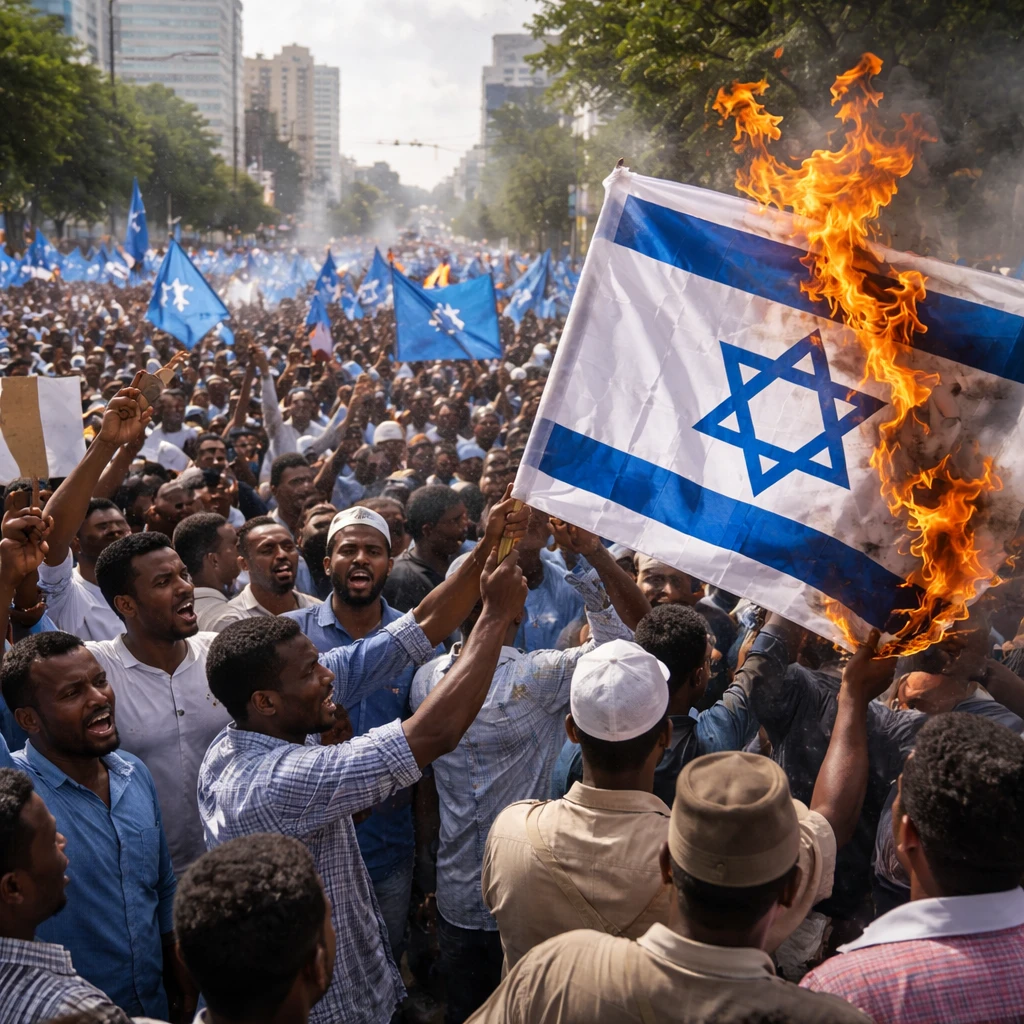

Across Somalia, tens of thousands of citizens mobilized on Tuesday to protest Israel’s groundbreaking decision to recognize Somaliland, a self-declared independent region that broke away from Somalia in the early 1990s. This recognition received harsh criticism from over twenty countries, which viewed it as an attack on Somalia’s sovereignty.
Simultaneously, Somalia’s President Hassan Sheikh Mohamud traveled to Turkey for strategic discussions with Turkish President Recep Tayyip Erdogan, following the strong reaction to Israel’s announcement.
At an emergency session of the United Nations Security Council held on Monday, Somalia officially objected to Israel’s recognition of Somaliland, cautioning that it threatens regional security. The Israeli delegate countered by highlighting what they perceived as a double standard, referring to recognition already extended to Palestine. Meanwhile, the spokesperson for the U.S. special representative maintained the United States' consistent position regarding Somalia.
Last week marked an unprecedented development when Israel became the first country to officially recognize Somaliland. This move elicited strong rebukes from Turkey, which is already at odds with Israel over the fighting in Gaza, as well as from Somalia and multiple other international actors.
Somaliland, home to over three million inhabitants in the Horn of Africa, declared independence from Somalia in 1991 amidst civil conflict that has since left Somalia in a fragile state. Despite operating its own government and currency, Somaliland had not been acknowledged by other nations until Israel’s recent declaration.
In Mogadishu, Somalia’s capital, large crowds convened at the principal stadium for a rally led by influential religious leaders, who vehemently denounced Israel’s recognition and rallied calls for unity in defending Somalia’s territorial wholeness.
Similar demonstrations unfolded in Baidoa in the southwest, Guriel and Dhusamareeb in central regions, as well as in Lasanod and Buhoodle in the northeast. Protesters in these locales chanted slogans rejecting the recognition and prominently displayed Somali national flags, as verified by local eyewitness accounts and communal video recordings disseminated online. Collectively, these protests represented the largest public dissent observed since Israel’s announcement.
During the main rally in Mogadishu, traditional leader Mohamed Hassan Haad urged all Somalis to resist the recognition and cautioned against any claims on Somali territory. He also appealed directly to Somaliland’s inhabitants to discount this external acknowledgement. Religious scholar Sheikh Mohamud Sheikh Abulbari voiced similar condemnation, labeling Israel’s decision as unacceptable and criticizing the welcome extended to Israel on Somali lands, especially in light of Israel’s actions concerning Palestinians and Muslim sites in Jerusalem.
At the U.N. Security Council meeting on Monday, Somalia’s permanent representative Abukar Dahir Osman emphasized that Israel’s recognition sets a perilous precedent and seriously endangers peace and security both regionally and internationally.
On Tuesday in Istanbul, President Mohamud publicly thanked regional and global bodies opposing Israel’s recognition of Somaliland, characterizing the act as a breach of international law, the United Nations Charter, the African Union’s governing principles, and diplomatic conventions.
He elaborated, “This sets a dangerous precedent contrary to fundamental principles of sovereignty, territorial integrity, and non-interference that underpin international order.” Standing alongside Erdogan, Mohamud stressed that such acts fuel conditions favorable to violent extremist groups that exploit narratives accusing foreign interference, thereby deepening insecurity across Somalia and the greater Horn of Africa region — an area already grappling with armed conflict, humanitarian crises, and political instability.
President Erdogan declared firm backing for Somalia’s unity and territorial integrity while condemning Israel’s recognition as “illegitimate and unacceptable.” He reiterated Turkey’s commitment to maintaining Somalia’s territorial unity and accused Israel of seeking to destabilize the Horn of Africa.
Turkey has emerged as a significant ally of Somalia over the past decade, providing military training and investing in infrastructure. Its military base in Mogadishu facilitates Somali forces’ training, and Turkey has deployed a seismic research vessel, escorted by naval vessels, to explore Somalia’s coastline for potential oil and gas deposits. Erdogan announced Turkey’s intention to commence drilling activities in Somalia by 2026.
Ankara has criticized Israel’s recognition as unlawful and warned that it risks upsetting the fragile regional equilibrium. The motivations underlying Israel’s recognition have not been publicly explained.
Earlier in 2025, Turkey convened talks between Ethiopia and Somalia aimed at resolving tensions resulting from Ethiopia’s agreement with Somaliland. In January 2024, Ethiopia signed a memorandum of understanding with Somaliland to lease coastal territory for a naval base, subsequently pledging to recognize Somaliland’s independence — a move Somalia disputes as infringing on its sovereignty and territorial integrity.