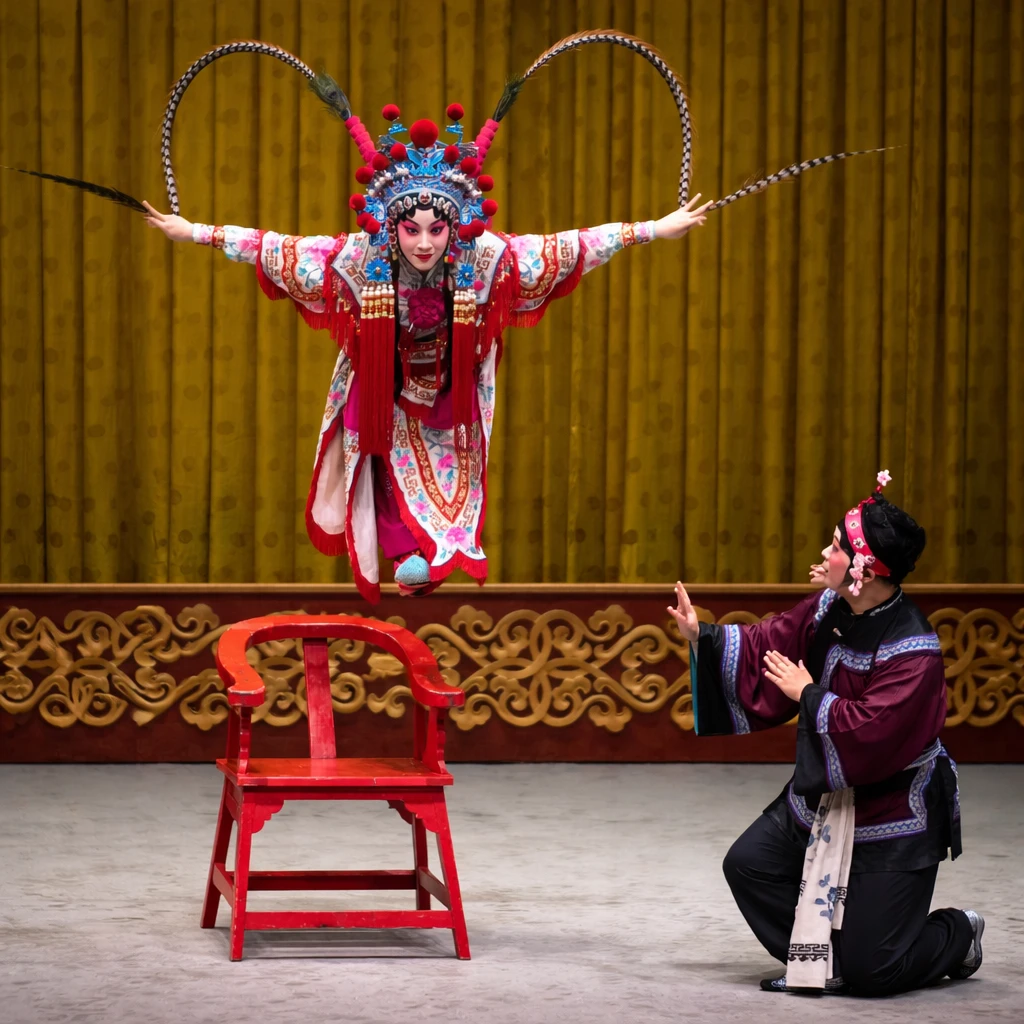

In a modern theater in Beijing, the spotlight centers on Zhang Wanting as she dons a distinctive red-and-white warrior costume, executing a precise balance on the narrow, rosewood chair handle. Perched upon one foot, Zhang arches her body forward, extends her other leg upward, and grasps the long pheasant feathers attached to her helmet, crafting a pose reminiscent of a swallow mid-flight. This compelling spectacle captivates an audience of over a hundred, who respond with enthusiastic applause.
The scene unfolds on a Sunday afternoon in early September when Zhang stars in "The Masked Heroine," an acclaimed performance from the Song School of Peking opera — a tradition stretching back centuries but formally established in the early 20th century. At just 30 years old, Zhang embraces her first full leading portrayal in this play, a milestone that emerges from more than a decade of continuous dedication that began in her childhood years. "Since my initial encounter with this play, I have aspired to perform it fully," Zhang shares.
Decade-Long Preparation for a Singular feat
Originally from Hebei province in northern China, Zhang’s immersion into Peking opera started at age seven after watching local children rehearsing at a cultural center. Captivated by the art, she joined their ranks and recognized her aptitude and determination to pursue it professionally. After completing primary education, she advanced to specialized theater schooling in Jiangsu province, located in eastern China.
Peking opera artists typically commence training early in childhood to develop the necessary physical strength and flexibility, foundational for mastering its intricate movements. This rigorous and repetitive process, often described as involving significant "sweat and tears," is essential for cultivating both skill and endurance.
The signature chair balancing pose performed by Zhang originates from the fundamental technique known in opera circles as tanhai, meaning "gazing over the sea." This stance, which demands exceptional balance and control, involves standing steadily on one leg while extending the arms forward and arching the body — a skill rooted in traditional Chinese martial arts.
At theater school, Zhang began daily practice sessions at 5 a.m., each so intense that exhaustion would leave her collapsed on the floor, overwhelmed with emotion. Throughout her education, Zhang deepened her exposure to the Song School repertoire and became intrigued by its distinctive style. In 2015, during her college years, she studied under Song Danju, daughter of the Song School’s founder.
Breaking from conventional Peking opera conventions, which often spotlight roles such as qingyi that feature refined female characters, the Song School introduced dynamic female martial roles. Their performances include innovative stunts and a fresh energy that invigorate the traditional art form.
The chair sequence is a hallmark of the Song family’s performance style. Zhang’s mentor preserved and revitalized this tradition by integrating martial arts and acrobatic moves learned from folk opera artists in northwest China. The routine is complex, including leaps through the chair frame, one-legged stands on the narrow chair handle, spinning the chair with a palm, and hopping forward while hooking the chair leg with an instep.
Although Zhang already possessed skills like the tanhai pose, translating that foundation into the multifaceted chair act presented a significant challenge. Overcoming the initial fear was paramount. She spent an entire academic term mastering balance by repeatedly standing on a chair handle approximately three inches wide and positioned over two feet off the ground. Her dedication was such that she transported a chair routinely to practice whenever possible.
Every movement within the chair sequence demands extended periods of practice. For example, Zhang sought to complete about 50 jumps daily into the narrow area of the chair’s backrest, resulting by day’s end in trembling muscles and bruised thighs. Despite the physical toll, these efforts persisted until she reached a breakthrough — the point at which standing on the chair became natural rather than taxing.
Emerging Generations Sustaining Peking Opera’s Legacy
Peking opera emerged as a popular urban entertainment in the 19th and early 20th centuries, though its origins trace back to the imperial courts of the Qing Dynasty in Beijing’s Forbidden City. Confronted by contemporary digital and theatrical forms, the genre faces concerns over waning public interest. Nonetheless, devoted young artists like Zhang invest considerable time honing the art’s demanding methods with the hope of engaging modern audiences.
Among those appreciating Zhang’s recent performance in September was Yang Hecheng, a 26-year-old instructor at the Beijing Film Academy. It was his first experience witnessing the full production and the signature chair routine. He expressed admiration for both the aesthetic qualities and the vibrant spirit conveyed by Zhang’s stage techniques.
In the narrative of "The Masked Heroine," Zhang portrays Wan Xiangyou, a gallant woman who combats injustice and defends the vulnerable by becoming a militia leader in ancient China. During a pivotal interrogation scene, she performs the tanhai posture atop the chair handle, effectively weaving the complex chair maneuver into the storyline. Zhang believes that merging the stunt coherently with the plot enhances audience engagement.
She recites a well-known saying underscoring the genre’s essence: "A play without skill is not amazing; a play without emotion is not moving." As a professional with Beijing’s prestigious Jingju Theatre Company, Zhang has appeared in over 150 performances across nearly a decade. Each production demands learning new movements or perfecting established ones.
Embracing a lifelong commitment to mastery, Zhang emphasizes incremental progress and delivering top-tier performances at each show. She notes, "The most gratifying moment is when the curtain falls and the audience applauds."