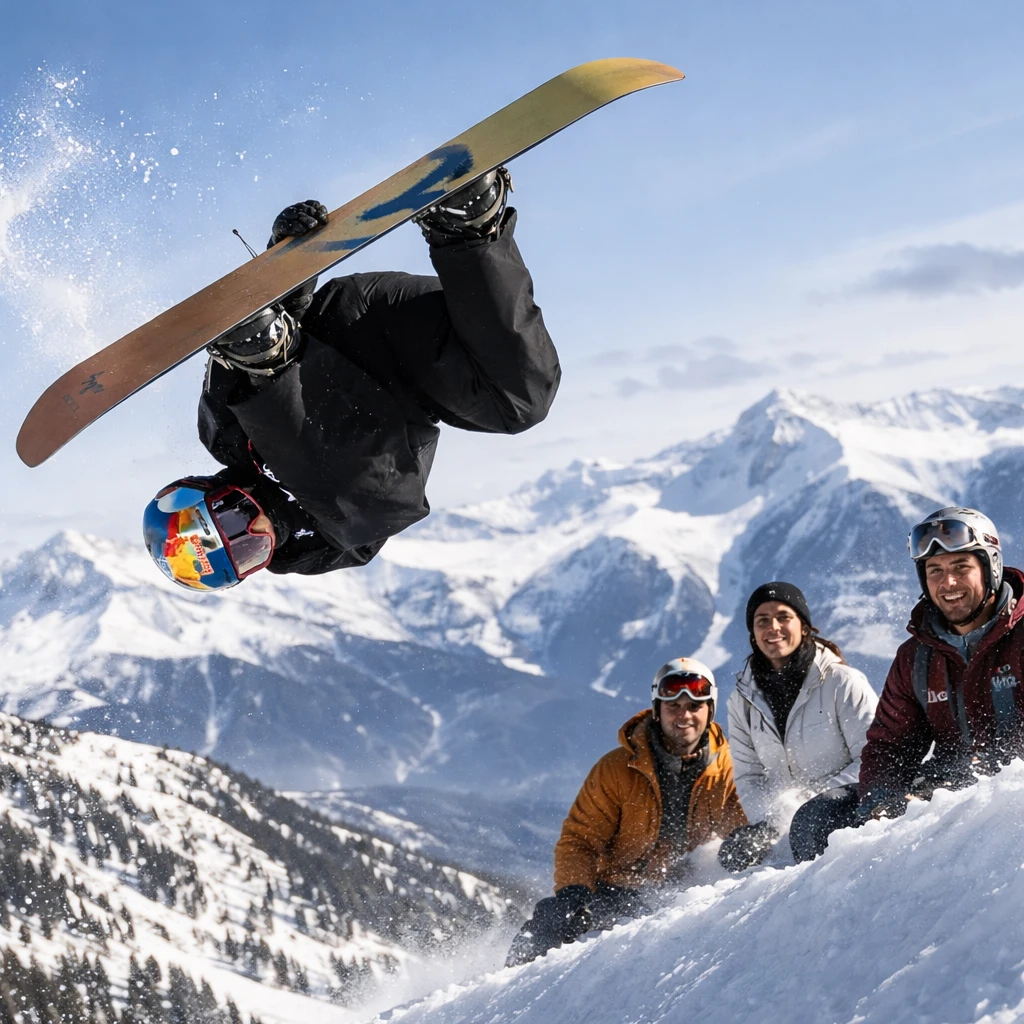
In the early stages of his snowboarding journey, Shaun White's family navigated the then-nascent sport in unique ways. His mother, Cathy White, a lifelong skier adapting to snowboarding, imposed a particular rule: for her to accompany Shaun and his siblings down the mountain, they had to practice riding "switch"—that is, backward—so she could maintain pace. This insistence led to rigorous sessions throughout winter, where riding switch was a constant challenge. White credits this experience for significantly enhancing his proficiency in this challenging style, calling it a "real gift" from his mother.
Despite snowboarding’s public image revolving around large jumps and daring acrobatics, the capacity to navigate the board in four ways—riding forward and backward, then spinning either clockwise or counterclockwise from either stance—is considered a pinnacle of technical skill. Success in high-profile competitions such as the upcoming Milan Cortina Games often hinges on athletes’ abilities to execute these complex rotations smoothly.
Chloe Kim epitomizes mastery of this demanding skill set. Leading up to the Beijing Olympics, she dedicated about four years to perfecting riding switch and spinning from multiple orientations under intense competitive pressure, which contributed significantly to her second Olympic gold medal.
Another athlete embracing the technical challenges is Scotty James, who has earned Olympic silver and bronze medals and recently made history at the X Games by landing consecutive backside 1440-degree jumps—one while riding forward and the other switch. This maneuver involves initiating the spin with the rider’s back facing downhill, heightening the complexity. James, now 31, is pushing his limits preparing for Milan Cortina, focusing on expanding the array of spins and tricks, including "switch McTwists" and various backside riding variations. For him, experimenting with such intricate techniques is a vital source of motivation.
Describing the difficulty of riding switch and performing spins from this position, elite snowboarders draw analogies to tasks that require rewiring familiar motor skills, such as a right-handed pitcher throwing left-handed or signing one’s name with the non-dominant hand. Kelly Clark, a decorated Olympic halfpipe champion, frames it as the equivalent of writing an essay with your non-dominant hand and convincing others it was done with your dominant hand—an effort requiring extraordinary control and adaptability.
While snowboard experts find it challenging to explain precisely how difficult switch riding and backside spins are to outsiders, White expressed appreciation for the topic being discussed, noting it as an underrecognized facet of the sport. He explained that casual observers often cannot tell when a rider performs a switch maneuver because snowboards look similar from front or back, unlike skis. Freeskiing, which involves comparable difficulties with backward motion, offers clearer visual cues, enabling more straightforward identification of these maneuvers.
Acknowledging parallel feats in freeskiing, David Wise, a two-time Olympic gold medalist, made history in 2018 by landing double corks—two head-over-heels flips—while spinning in all four directions within a single halfpipe run. Jonny Moseley, an influential figure in freestyle skiing, characterized Wise’s achievement as akin to mastering two distinct sports simultaneously.
Eileen Gu, aiming to augment her tally of Olympic medals at the forthcoming Italy Games, demonstrates proficiency spinning both directions across halfpipe, slopestyle courses, and big air events. She describes riding switch as "unnatural," noting that the two sides never feel symmetrical and that one side becomes notably more challenging after breaks from skiing.
Although triple corks and double corks in competitions capture significant attention for their aerial difficulty and spectacle, integrating riding switch and spinning in less natural directions forms a fundamental part of constructing a competitive run. Rick Bower, director of the U.S. snowboard program and coach to Kim, predicts that future competitions will feature consecutive triple corks within runs. Athletes will rely heavily on these complex technical components to claim victory.
Canadian snowboarder Mark McMorris, a multiple X Games winner and three-time Olympic bronze medalist in slopestyle, concurs on the importance of switch riding. He highlights how this skill adds variety and impressiveness to routines, reinforcing its role in elevating the sport’s technical and artistic dimensions.
In summary, while the larger jumps and flips continue to draw audience enthusiasm, the nuanced mastery of riding backward and executing backside spins remains a crucial and demanding skill intrinsic to snowboarding’s highest competitive levels.
January 29, 2026
News & Politics
Mastering the Art of Switch Riding and Backside Spins in Snowboarding
Exploring the Technical Challenges Behind Snowboarding's Most Complex Maneuvers

Derek Hwang
Materials & Mining Analyst
Summary
Switch riding—riding backward on a snowboard—and executing backside spins in multiple directions represent some of the most challenging and underappreciated elements of snowboarding. Although the sport often highlights high-flying tricks and flips, these technical skills are crucial for competitive success and require years of dedication to master. Elite athletes like Shaun White, Chloe Kim, and Scotty James emphasize the difficulty and significance of these maneuvers, which demand an exceptional level of skill and practice.
Key Points
Switch riding and backside spins are among snowboarding's most technically difficult skills, requiring riding both forwards and backwards and spinning in multiple directions, which demand extensive practice and coordination.
Top-level athletes like Shaun White, Chloe Kim, and Scotty James emphasize the centrality of these skills for success in major competitions, including the Winter Olympics and X Games.
Incorporating switch riding into performance routines adds complexity and impressiveness, enhancing the competitive potential and overall artistry of snowboarding runs.
Risks
- Mastering switch riding and backside spins presents significant difficulty, which may act as a barrier to entry or advancement for athletes, potentially limiting the talent pool in elite snowboarding competitions.
- The high degree of technical challenge and physical demand in executing these maneuvers carries increased risk of injury during practice and competition, impacting athlete health and career longevity.
- The nuanced nature of these tricks might limit casual audience appreciation or understanding, potentially affecting viewer engagement and sponsorship interest, especially in markets less familiar with snowboarding's technical intricacies.
Disclosure
This article is based entirely on provided information regarding snowboarding techniques and athlete perspectives. It contains no speculative content or external data beyond the original coverage.