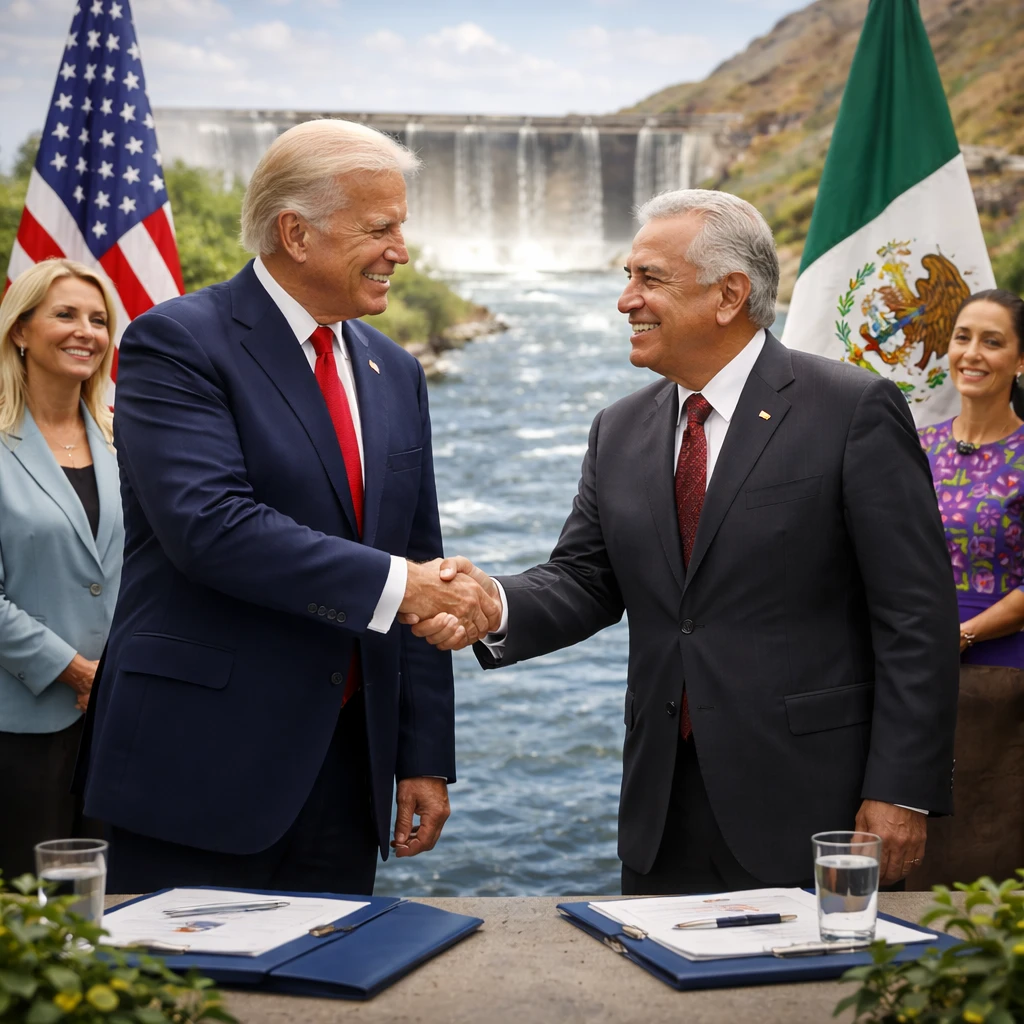

Mexico and U.S. Agree on Steady Annual Water Deliveries Amid Cross-Border Drought Concerns
February 3, 2026
News & Politics

Mexico and U.S. Agree on Steady Annual Water Deliveries Amid Cross-Border Drought Concerns

New Pact Aims to Ensure Minimum Water Supply from Mexico to U.S. in Five-Year Cycle

Summary

Mexico and the United States have finalized a new agreement that obligates Mexico to deliver a fixed minimum amount of water annually to the United States over the current five-year period. This arrangement alters previous requirements under the 1944 Water Treaty, seeking to provide a more consistent water flow to U.S. states reliant on cross-border water sources. The deal comes after several months of negotiation and amid concerns about drought conditions affecting northern Mexican farmers.

Key Points

Mexico has agreed to supply a fixed minimum of 350,000 acre-feet of water annually to the United States for the current five-year cycle, ensuring a more predictable water delivery schedule.
This agreement modifies the 1944 Water Treaty, which required a total delivery of 1.75 million acre-feet over five years but did not guarantee fixed annual amounts, leading to periods of water debt affecting U.S. farmers.
The United States will compensate Mexico with additional water from western sources along their shared border, balancing the cross-border resource exchange.

On Tuesday, officials from Mexico and the United States announced that they reached an accord mandating Mexico to supply a designated minimum volume of water each year to the United States throughout the ongoing five-year cycle. The impetus for this agreement included persistent negotiations and pressure, including threats by then President Donald Trump to impose a 5% tariff on Mexican imports should Mexico fail to increase its water deliveries.

According to the new terms, Mexico will provide no less than 350,000 acre-feet of water annually to the U.S. during the current five-year treaty span. For context, an acre-foot of water is the amount necessary to cover one acre of land with one foot of water.

This commitment to a guaranteed annual minimum marks a notable adjustment from Mexico’s obligations under the 1944 Water Treaty. Previously, the treaty required Mexico to deliver a total of 1.75 million acre-feet of water over every five years, averaging 350,000 acre-feet annually. However, the U.S. had expressed concerns that Mexico's water deliveries were uneven within the cycle, often accumulating a debt in the early years that adversely affected Texas farmers before the total quota was fulfilled later.

As part of the updated arrangement, the United States will reciprocate by providing Mexico with increased water supplies from sources located further west along the shared border, thus rebalancing the allocation between the countries.

Mexican government entities including the Ministries of Foreign Affairs, Environment, and Agriculture issued a joint statement confirming the agreement with the United States. The statement emphasized Mexico's readiness to assure the delivery of an agreed-upon annual minimum quantity but notably did not specify the exact amount. The statement read, “Mexico confirmed its willingness to guarantee the delivery of an annual minimum quantity agreed to by both countries.”

U.S. officials hailed the agreement as a significant achievement, underscoring its importance to water security and agriculture. However, within Mexico, the pact remains a sensitive topic, particularly among farmers in northern states who are currently enduring drought conditions. In the state of Tamaulipas, located along the border with Texas, local farmers have recently reported that insufficient water has forced them to abandon planting crops during this season.

The finalization of this new water delivery commitment followed a phone discussion between President Trump and Mexican President Claudia Sheinbaum. In December prior, President Sheinbaum had indicated that Mexico would increase water deliveries to address the accumulated water debt under the existing treaty obligations.

Risks
  • Drought conditions in northern Mexican states pose challenges to Mexico's ability to meet the minimum annual water deliveries without negatively impacting local agriculture.
  • The sensitivity of water resource management in the border region could lead to political or diplomatic tensions if either party perceives the agreement as unfavorable or if deliveries fall short.
  • Farmers on both sides of the border are vulnerable to fluctuations in water availability, impacting agricultural output and regional economies dependent on consistent water supply.
Disclosure
This article is based solely on reported information about the Mexico-U.S. water delivery agreement and does not include additional analysis beyond the details provided by official statements and government communications.
Search Articles
Category
News & Politics

News & Politics

Related Articles
Moderna and Mexican Government Collaborate to Expand Local mRNA Vaccine Production

Moderna Inc. has entered into a long-term strategic partnership with the Mexican government to devel...

FDA Initiates Review of BHA Food Additive Safety

The U.S. Food and Drug Administration (FDA) has announced plans to conduct a comprehensive reassessm...

Partisan Divide Deepens as White House Excludes Democratic Governors from NGA Meeting

The longstanding bipartisan forum of the National Governors Association (NGA) is facing disruption a...

Using Fireplace Ashes in Your Garden: Benefits and Considerations

Amidst a notably cold winter leading to increased fireplace use, many homeowners are seeking sustain...