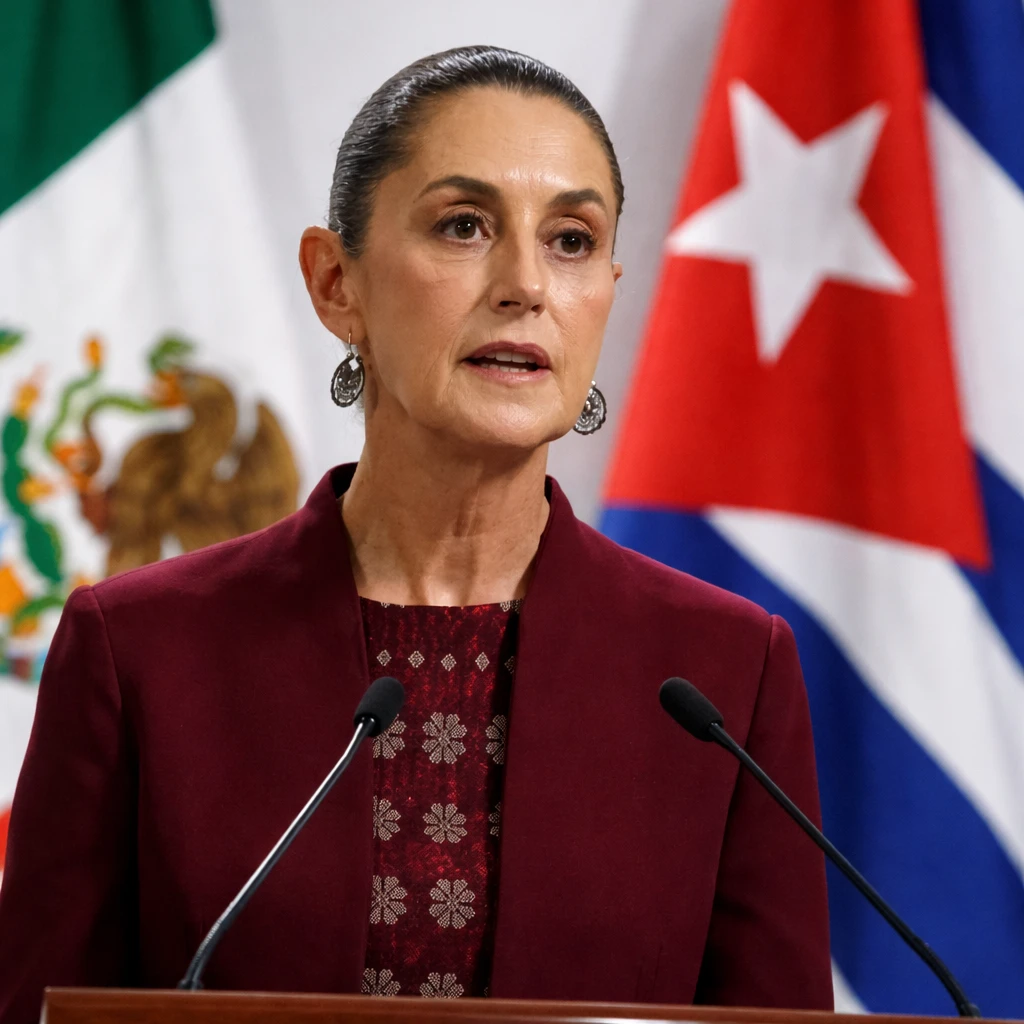

Mexico City – On Sunday, Mexican President Claudia Sheinbaum announced intentions to send food and other humanitarian supplies to Cuba within the upcoming week. This declaration surfaced amidst reports that U.S. President Donald Trump requested the Mexican administration to halt oil deliveries to the Caribbean nation.
During a public engagement in the northern state of Sonora, Sheinbaum clarified that Cuban issues were not addressed during a recent telephone conversation with President Trump on Thursday. She emphasized that the Mexican government aims to resolve concerns regarding oil shipments to Cuba through diplomatic means, underscoring humanitarian considerations as a priority.
Earlier comments from the U.S. President indicated he had instructed Mexico to stop sending oil to Cuba, a directive linked to broader U.S. efforts to exert pressure on the Caribbean island.
The context for this development traces back to early January when a U.S.-backed military operation in Venezuela resulted in the ousting of President Nicolás Maduro. Following these events, Venezuela suspended its oil shipments to Cuba—a supply that had already been dwindling over recent years.
Consequently, Mexico assumed the role of Cuba’s primary oil supplier. Mexican crude and refined petroleum products have served as a crucial support for Havana’s energy needs. Mexican state oil company Pemex reported that from January through September 30, 2025, it exported nearly 20,000 barrels of oil daily to Cuba.
However, this figure has seen notable reduction. In September, U.S. Secretary of State Marco Rubio's visit to Mexico City prefaced estimates by Jorge Piñon, a University of Texas Energy Institute specialist who utilizes satellite technology to monitor oil shipments, indicating a decline in deliveries to roughly 7,000 barrels per day.
This shifting dynamic signals significant implications for the energy supply chain in the region as Mexico navigates between international diplomacy and humanitarian aid commitments.
It remains to be seen how Mexico’s planned humanitarian aid shipments will intersect with ongoing discussions about energy exports, especially under the scrutiny of U.S. influence and regional geopolitical developments.