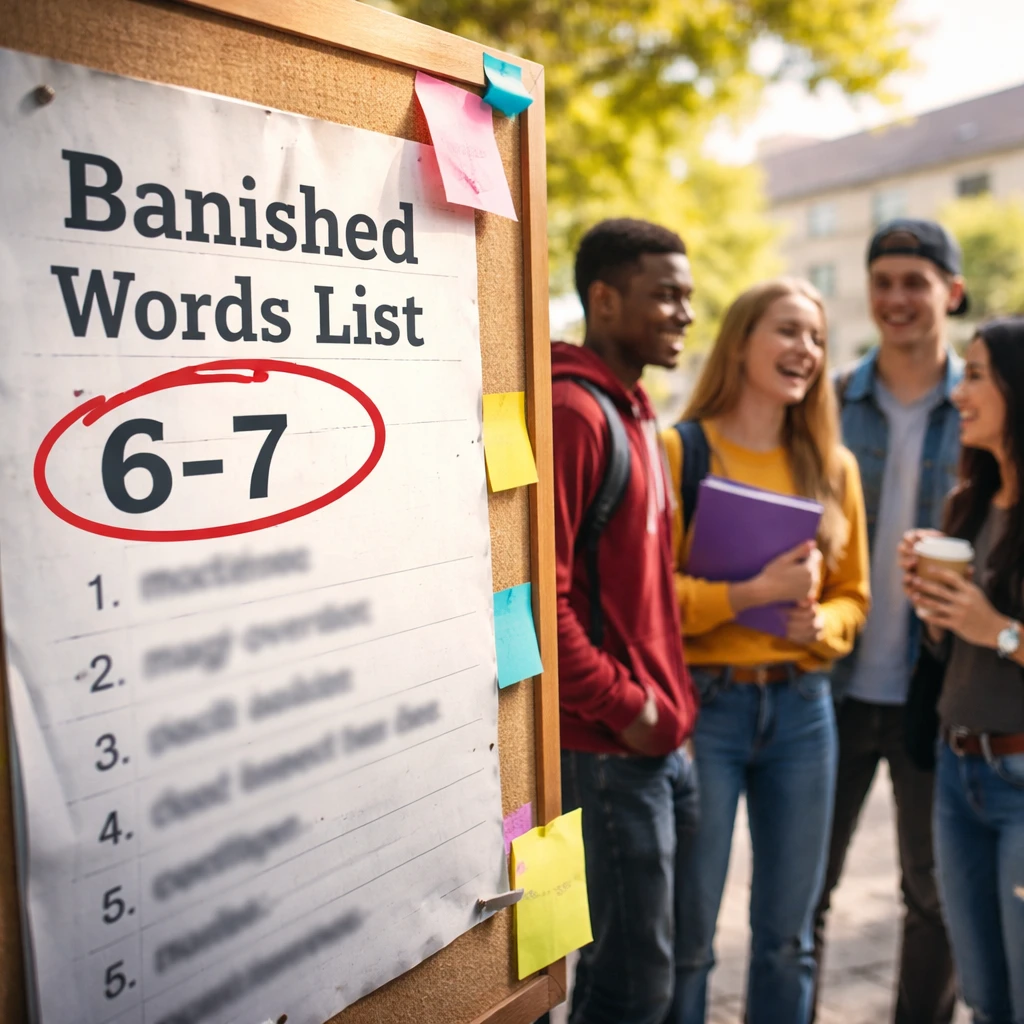

Lake Superior State University recently unveiled the 50th annual "Banished Words List," highlighting words and phrases considered overused, misapplied, or rendered meaningless in contemporary discourse. At the forefront of this year's list is "6-7," a phrase that has surged in popularity among Gen Z, especially on social media platforms, yet remains largely enigmatic in its meaning.
The Banished Words List, affectionately termed the "Queen's English for Mis-use, Over-use and General Uselessness," began in 1976 as a playful tradition during New Year's Eve celebrations. This iteration gathered approximately 1,400 submissions from all 50 U.S. states and various international locations including Uzbekistan, Brazil, and Japan, reflecting wide engagement with language trends.
Alongside "6-7," other entries in the top 10 include "demure," "incentivize," "perfect," "gift/gifted," "my bad," and "reach out." Interestingly, "my bad" and "reach out" have appeared on prior lists, in 1998 and 1994 respectively, indicating their sustained presence yet potential overuse in everyday conversation.
David Travis, president of Lake Superior State University, commented on the influence of social media on language. He explained that digital communication channels—primarily texting and social posts lacking non-verbal cues—facilitate the misunderstanding and misapplication of terms. According to him, this environment fosters the rapid adoption of slang that may lack clarity outside certain groups.
The phrase "6-7" generated particular attention in 2025, causing confusion among older demographics including parents and educators. Dictionary.com named "6-7" its Word of the Year for 2025, while other lexicons highlighted alternatives such as "slop" and "rage bait." The origins of "6-7" lie in social media inside jokes, with the numbers spoken separately as "six, seven" or collectively as "sixty-seven," recalling moments of excitement like a college basketball team reaching 67 points.
This placement as the leading banished term situates "6-7" among previously notable entries. For example, "quid pro quo," a longstanding Latin expression, topped the 2019 list, while "fake news" garnered most votes in 2017. These patterns suggest the list captures evolving cultural and communicative concerns.
Voices among the younger generation reflect differing attitudes toward "6-7." Alana Bobbitt, a 19-year-old sophomore at the University of Michigan in Ann Arbor, embraces the phrase for its playful nature, despite its ambiguous meaning. Conversely, Jalen Brezzell, also 19 and a sophomore at the University of Michigan-Dearborn, refrains from using it, citing a lack of understanding or humor in the term. However, he supports the colloquial use of "cooked," another phrase on the list, which implies conceding or dismissing a subject.
President Travis suggested that some expressions enjoy lasting usage, citing "at the end of the day" and "my bad" as examples still commonly used across generations. He anticipates that while certain phrases will endure indefinitely, transient slang like "6-7" may fade from popular lexicons quickly, possibly disappearing within the following year.