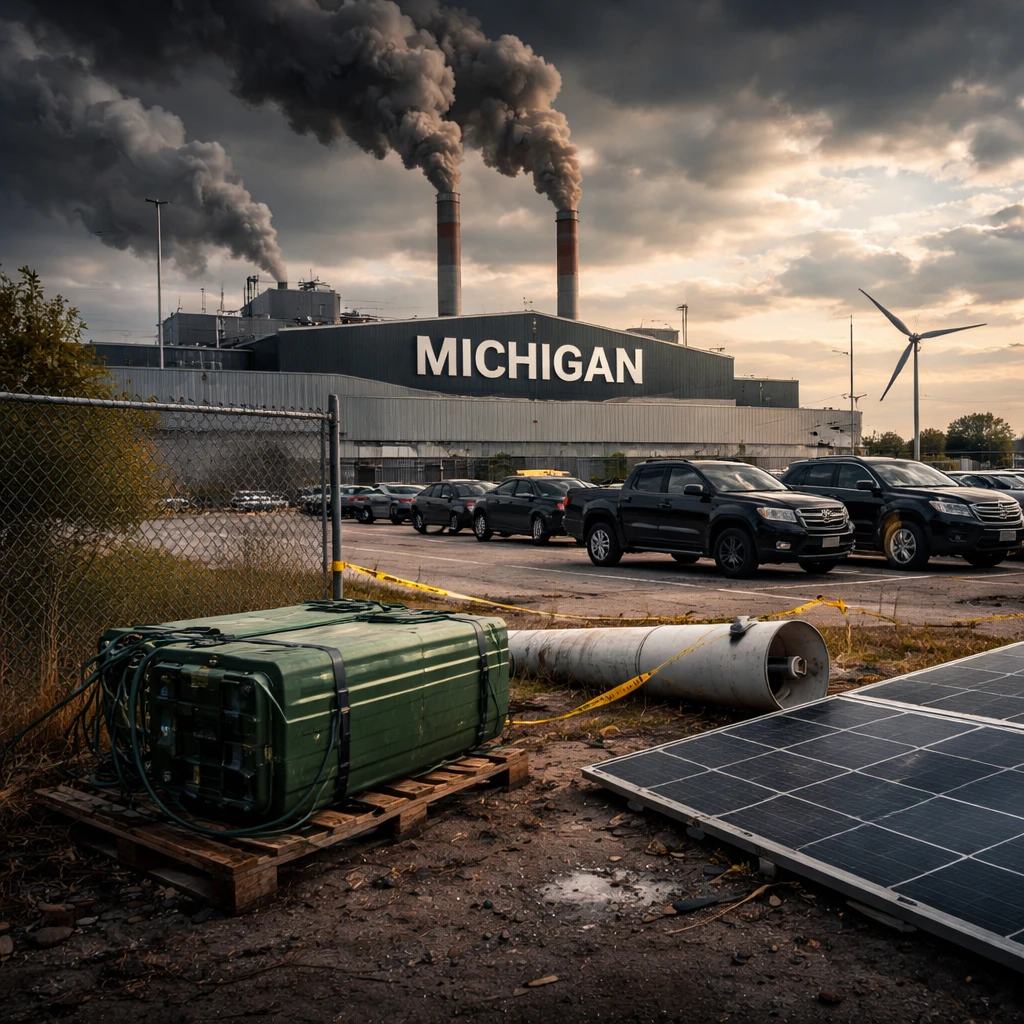

In a stark reversal of fortunes compared to the previous year, Michigan’s anticipated influx of federal money aimed at facilitating a shift towards clean energy and supporting green manufacturing projects has largely been curtailed. Following the inauguration of President Donald Trump in January 2024 and subsequent review and cancellation of numerous federal climate programs formerly championed as central to the energy transition, Michigan has faced a wave of aborted projects and withheld grants. Concurrently, investments in fossil fuel-based manufacturing and energy production have resurfaced.
Data compiled by Atlas Public Policy reveals that approximately $540 million in climate-oriented federal grants to Michigan have been rescinded or delayed since the change in administration. This financial contraction coincides with a decline in clean manufacturing investments in the state, which plummeted this year by $3 billion due to shifting market circumstances and the expiration of federal electric vehicle tax credits. Previously, Michigan had seen robust annual investments into clean and green technology sectors.
Annabelle Rosser, a research analyst at Atlas, notes that Michigan's experience reflects a broader national pattern. At the heart of the state’s industrial shift, automotive manufacturers such as Ford and General Motors have abandoned or restructured plans for electric vehicle production facilities in favor of gas and hybrid vehicle manufacturing within Michigan. Glenn Stevens, executive director of MichAuto, an affiliate of the Detroit Regional Chamber, observes that current market dynamics are driving this realignment.
This evolving situation is set to persist into 2026, as federal authorities under the Trump administration continue to downplay climate change concerns and renew their emphasis on fossil fuel industries, reducing attention to renewable energy initiatives. As 2024 concludes, Michigan’s landscape with regard to climate funding and green energy projects is shaped by several developments:
$540 Million in Funding Canceled
A major component of the funding loss stems from cancellations related to the Solar for All Program, a $7 billion Environmental Protection Agency initiative designed to expand solar access in underserved communities. Michigan was expecting a $156 million allotment through this program, while Native American tribes in the region awaited a share of a $62 million grant targeting Great Lakes tribal areas. Attorney General Dana Nessel has legally challenged these cancellations, joining other states in arguing that halting congressionally approved funding exceeds executive authority.
Besides the solar grant cancellations, over 20 additional grants in Michigan have been scrapped or proposed for cancellation. These vary widely in scale and scope, from a $31.7 million grant intended to support LuxWall Inc.'s construction of an energy-efficient window factory in Detroit, to a $14,000 allocation for a West Michigan climate resilience project. Other notable rescinded grants include:
- $28.2 million to TS Conductor for a high-capacity power line manufacturing facility in Erie
- $20.4 million to Ecoworks, a Detroit nonprofit aiming to convert houses of worship into climate resilience centers
- $20 million to the Inter-Tribal Council of Michigan for energy efficiency improvements in tribal homes
- $20 million to the Southwestern Michigan Planning Commission for creating resilience hubs in Benton Harbor, upgrading low-income housing, and fostering workforce development
Smaller funding packages targeted energy-efficient housing in Kalamazoo, climate resilience planning in Flint, and restoration projects for wild rice beds in local waterways. Additionally, a halted $20 billion federal green bank network had promised substantial financial support for housing retrofits, insulation upgrades, and energy efficiency in factories statewide.
Federal officials have indicated further grant cancellations may be forthcoming as they continue reassessing billions of dollars in clean energy funds distributed during the previous administration. For instance, Michigan utility providers await clarification on $15 billion in clean energy loan programs announced shortly before the transition of presidential power. Moreover, the federal review encompasses a $500 million grant aimed at converting a Lansing GM factory to electric vehicle production.
An exemption to the overall reduction in clean energy funding has been the Trump administration’s ongoing support for nuclear energy. Disbursements continue for a $1.5 billion loan approved in 2024 to resume operations at the Palisades nuclear power plant. In December, a further $400 million was allocated to develop two new reactors at the site. US Energy Secretary Chris Wright emphasized that expanding energy production, with nuclear as a cornerstone, remains a priority for the current administration.
$3 Billion in Manufacturing Investments Canceled
Between 2022 and 2024, influenced by subsidies and regulations promoting electric vehicles, Michigan manufacturers had declared approximately $23.8 billion in new investments related to the energy transition, primarily involving battery and EV plant development. However, in 2025 this trajectory reversed sharply, with $3 billion in announced projects canceled amid a shift in policies and market sentiment.
Requests for comment from the US Department of Energy regarding changes in federal resource allocation and vehicle emissions regulations were not fulfilled. Notably, the Trump administration has publicly criticized electric vehicles, describing them as an expensive “scam” and minimizing the role of fossil fuels in climate change. A policy change announced in December included loosening fuel economy standards for new vehicles, which the administration framed as a consumer and job-protection measure, promising savings on car prices.
The largest single project cancellation involved a $2.4 billion electric vehicle battery factory planned near Big Rapids by Gotion, which had faced controversy for years before state officials declared the project defunct recently. Analyst Rosser points out that factors extending beyond policy, such as EUA tax credit reductions, softened EV demand, and concerns about foreign ownership, contributed to the derailment.
Battery manufacturer XALT Energy recently announced the closure of its Midland headquarters and Auburn Hills facility just two years after expansion plans. Similarly, automotive supplier Dana Inc. canceled a $54.2 million investment at an Auburn Hills EV battery plant, citing sudden drops in customer orders linked to diminished EV demand. Fortescue scrapped a $210 million EV charger, battery, and hydrogen generator plant under construction in Detroit, attributing the decision to market changes and loss of key tax credits.
Additional closures include an Akasol electric vehicle battery factory in Warren, and the abandonment of a TS Conductor high-voltage direct current conductor plant project in Erie, which initially possessed a $28 million federal grant later revoked. TS Conductor relocated plans to South Carolina after securing a substantial incentives package there.
Delays and cutbacks have affected numerous other Michigan EV and battery projects. General Motors sold its interest in a Lansing EV battery factory to LG Energy Solution, with the planned opening pushed from 2025 to 2026. Ford also downsized its EV battery plant project near Marshall, now expected to open in 2026. Stevens anticipates growth in the EV market in 2026 but expects it to be more gradual than previously forecasted, contrasting with the pace encouraged by prior administration policies.
As the state contends with shrinking federal support and shifting industry priorities, the impacts resonate through Michigan’s energy, manufacturing, and automotive sectors, underscoring ongoing uncertainty in the state’s clean energy transition landscape.