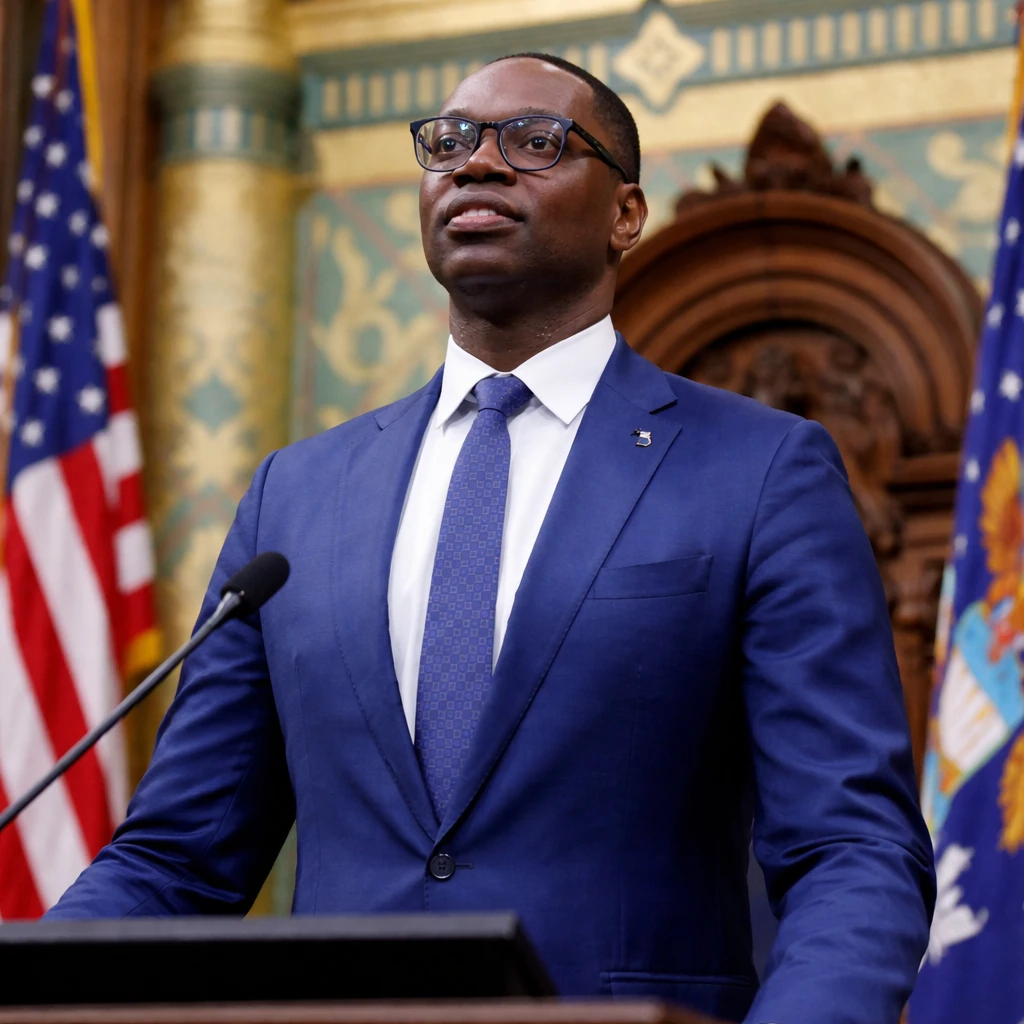

In a strategic pivot announced on Monday, Michigan Lieutenant Governor Garlin Gilchrist II declared the suspension of his campaign for governor, opting instead to contend for the office of secretary of state in the crucial battleground state of Michigan. Gilchrist, a progressive Democrat hailing from Detroit, shared this development via a video message but did not elaborate on specific motives behind this shift, emphasizing his ongoing commitment to public service.
This decision influences the Democratic primary landscape significantly, potentially benefiting the current secretary of state, Jocelyn Benson, who is regarded as the frontrunner. Benson is campaigning to succeed term-limited Governor Gretchen Whitmer. The secretary of state post in Michigan is especially significant because it entails oversight of elections, a role that has grown increasingly politicized and scrutinized since the 2020 presidential election cycle.
In his announcement, Gilchrist underscored Michigan’s historical and continuing importance in election integrity battles, stating, "Michigan has been ground zero in the battle for free and fair elections before, and it will be again."
As the incumbent Lieutenant Governor and Whitmer’s running mate in previous elections, Gilchrist faced challenges in matching Benson's prominence and fundraising capabilities. Financial disclosures as of October reveal he held approximately $378,000 in cash reserves whereas Benson’s fundraising efforts resulted in a substantial $2.98 million.
Benson’s primary competition has narrowed, with Genesee County Sheriff Chris Swanson remaining as her sole challenger for the Democratic nomination in the August primary.
Adding complexity to the electoral environment is former Detroit Mayor Mike Duggan’s independent candidacy. By entering as an independent, Duggan circumvents potentially costly primaries. This move has drawn criticism from the Michigan Democratic Party, which reproached Duggan for not opposing the policies associated with President Donald Trump’s prospective second term.
On the Republican side, the primary battle for various leadership roles, including secretary of state, features U.S. Representative John James, ex-Michigan Attorney General Mike Cox, State Senate Leader Aaric Nesbitt, and former Michigan House Speaker Tom Leonard, among others.
As Gilchrist seeks the secretary of state position, he will contend against four other Democratic hopefuls: Barb Byrum, Ingham County clerk; Aghogho Edevbie, deputy secretary of state; Suzanna Shkreli, a former aide to Whitmer and previous commissioner of the Michigan State Lottery; and Adam Hollier, a former state senator based in Detroit.
It's important to note Michigan’s process for selecting nominees to this office bypasses direct primary elections. Instead, precinct delegates at party conventions determine the nominees, with the Michigan Democratic Party’s convention set for April 19. Correspondingly, the Michigan Republican Party plans a nominating convention on March 28, where candidates like Macomb County Clerk Anthony Forlini and Oakland County executive Monica Yatooma seek the party’s endorsement for the secretary of state designation.
In addition to the contests for governor and secretary of state, Michigan voters will also have decisions to make in the upcoming November elections, including the selection of a state attorney general and a U.S. senator.