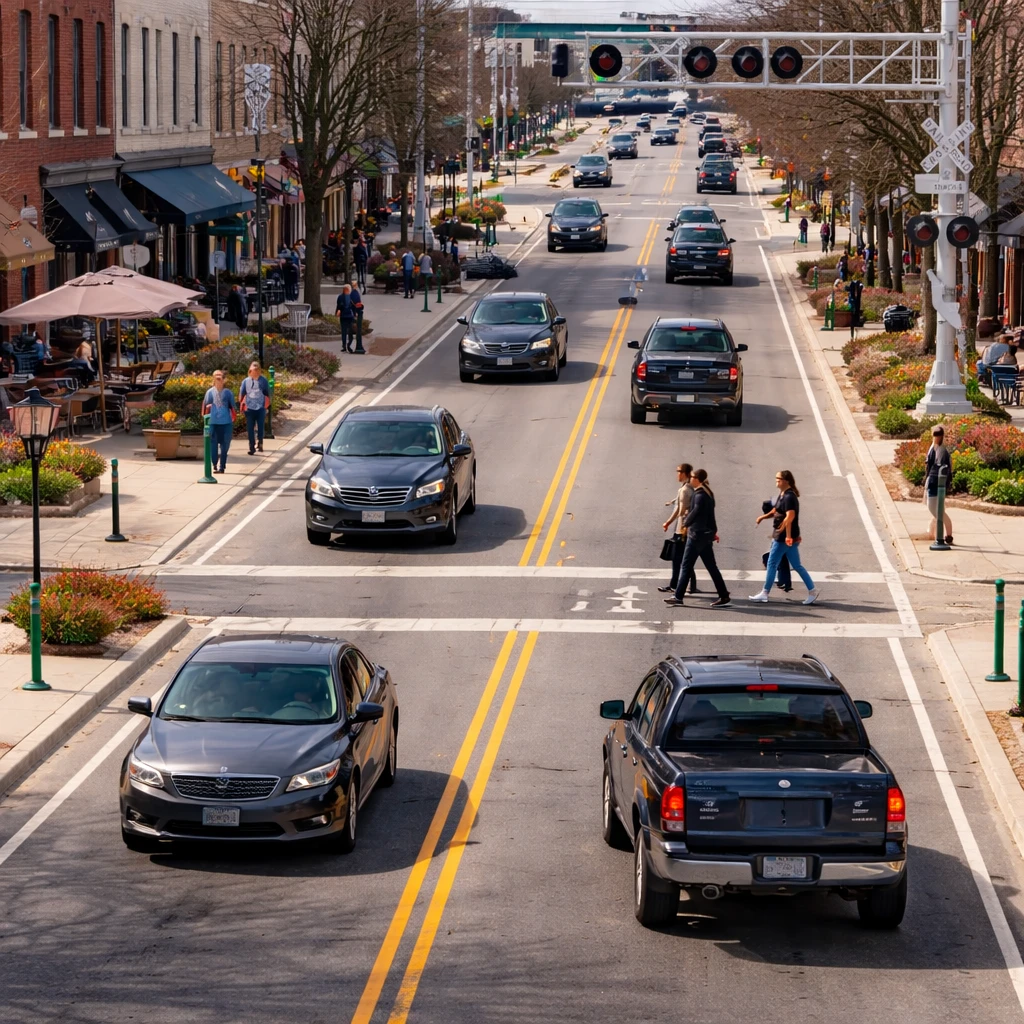
For decades, parallel one-way streets near a once-bustling electronics manufacturing plant in Indianapolis were notorious among locals for aggressive speeding, earning them the nickname "racetrack" reminiscent of the nearby Indianapolis Motor Speedway. Originally configured as two-way streets, Michigan and New York streets were converted in the 1970s to opposing one-way routes. This adjustment facilitated rapid commutes for numerous workers at the RCA plant who produced televisions and vinyl records.
When the RCA plant ceased operations in 1995, these streets experienced a decline in traffic volume which paradoxically encouraged even more reckless driving behaviors. It was not until the previous year that city authorities decided to revert these corridors back to their original two-way traffic scheme.
James Taylor, who oversees a community center located close to the former RCA factory, observed that the reopening and the return to two-way traffic significantly transformed public perception and use of the corridor. This local example aligns with a broader national trend wherein transportation planners, especially in midsize urban centers, are re-examining the widespread adoption of one-way street systems.
The oft-repeated maxim "paint is cheap" underlines the relative ease and cost-effectiveness of such street conversions. By moving back to two-way streets, cities aim to enhance public safety and make their downtown districts more attractive for consumers, diners, and residents alike.
Dave Amos, an assistant professor specializing in city and regional planning, notes that one-way streets are rarely original constructs in the U.S.; historically, two-way streets predominated before suburban sprawl redirected priorities toward faster commuter traffic at the expense of walkability in urban cores. Since one-way streets prioritize rapid vehicle movement, this design inherently sidelines the needs of pedestrians and cyclists, increasing their vulnerability.
Further complicating safety considerations, Wade Walker, an engineer who has participated in multiple street conversion projects across several states, highlights that the popular belief in one-way streets simplifying pedestrian crossings is a misconception. When one-way and two-way streets intersect to form urban grids, pedestrian crossing patterns become more complex, resulting in numerous possible vehicular movement sequences that pedestrians must navigate. This complexity can lead to confusion and elevated risk, not merely from the number but also from the nature of traffic conflicts.
The city of Louisville, Kentucky, has undertaken extensive efforts to restore historic two-way traffic flows along major corridors including stretches housing cultural and sports landmarks. A particularly notable project is occurring in Louisville's western neighborhoods, predominantly inhabited by Black residents, where earlier one-way conversions designed to accommodate a new interstate bridge over the Ohio River disrupted local commerce and severed community connectivity. Transportation officials there lament that local businesses faded as these neighborhoods became thoroughfares prioritized for quick vehicle passage rather than community engagement.
Chattanooga, Tennessee, presents another illustrative case. After some downtown streets were converted to one-way configurations, vacancy rates among businesses surged and the University of Tennessee at Chattanooga struggled with pedestrian safety concerns that effectively isolated its campus. Subsequent restoration of two-way streets catalyzed renewed development and expansion across previously divided areas within the city.
In Lynchburg, Virginia, initial apprehension from business owners about the potential negative impact of restoring two-way traffic proved unwarranted once the transformation was completed. One local restaurateur candidly admitted to misjudging the outcome, highlighting a pattern of initial skepticism followed by acceptance and approval witnessed in multiple municipalities.
Similarly, in Austin, Texas, the reconversion of one-way streets in the urban core was met with growing support and calls to eliminate remaining one-way segments entirely, underscoring a trend toward favoring more traditional, pedestrian-friendly street designs.
Conversely, Chicago recently implemented changes converting some two-way streets into one-way routes within a busy restaurant district, which sparked complaints from local residents. This highlights that such street design changes can provoke community concern if not adequately consulted.
Following the Indianapolis example, the city’s Department of Public Works plans to undertake numerous additional two-way street conversions, financed partly through a substantial federal grant allocation. While conclusive effects are still emerging, early indicators include plans for new business developments along the reconstructed streets, reflecting renewed interest sparked by the altered traffic patterns.
James Taylor reflects on the evolving urban landscape in his neighborhood, noting the familiar streets now being experienced from an entirely new perspective after several decades. The changes represent a significant recalibration in urban design philosophy, privileging safety, connectivity, and community vitality over merely vehicular throughput.
January 17, 2026
News & Politics
Midsize Cities Shift Back to Two-Way Streets to Enhance Safety and Revitalize Downtowns
A growing trend sees urban planners revisiting one-way street designs to curb speeding and boost local business activity

Hana Yamamoto
Consumer Staples Analyst
Summary
Numerous midsize cities across the United States are reversing earlier decisions to implement one-way street systems, opting instead to restore two-way traffic patterns. This shift aims to reduce the dangers posed by high vehicular speeds on one-way roads and to rejuvenate downtown areas by improving accessibility and safety for pedestrians, cyclists, and businesses. The change reflects a reassessment of urban traffic planning priorities, balancing vehicle flow with community connectivity and street vitality.
Key Points
Midsize U.S. cities are increasingly reversing one-way street systems to improve traffic safety and urban livability.
One-way streets encourage speeding and complicate pedestrian crossing patterns, increasing risks for non-motorists.
Restoring two-way traffic has demonstrated positive effects on business vitality and neighborhood connectivity in multiple cities.
Risks
- Potential confusion and disruption during street conversion projects may affect traffic flow and local businesses temporarily.
- Community resistance can arise if residents and business owners are not sufficiently engaged before changes are implemented.
- Large-scale street reconfigurations require significant public investment, and the return on this investment may vary depending on local conditions.
Disclosure
This article is intended for informational purposes and does not constitute investment advice. Readers should consider their own circumstances and seek professional guidance before making financial decisions related to municipal infrastructure projects.