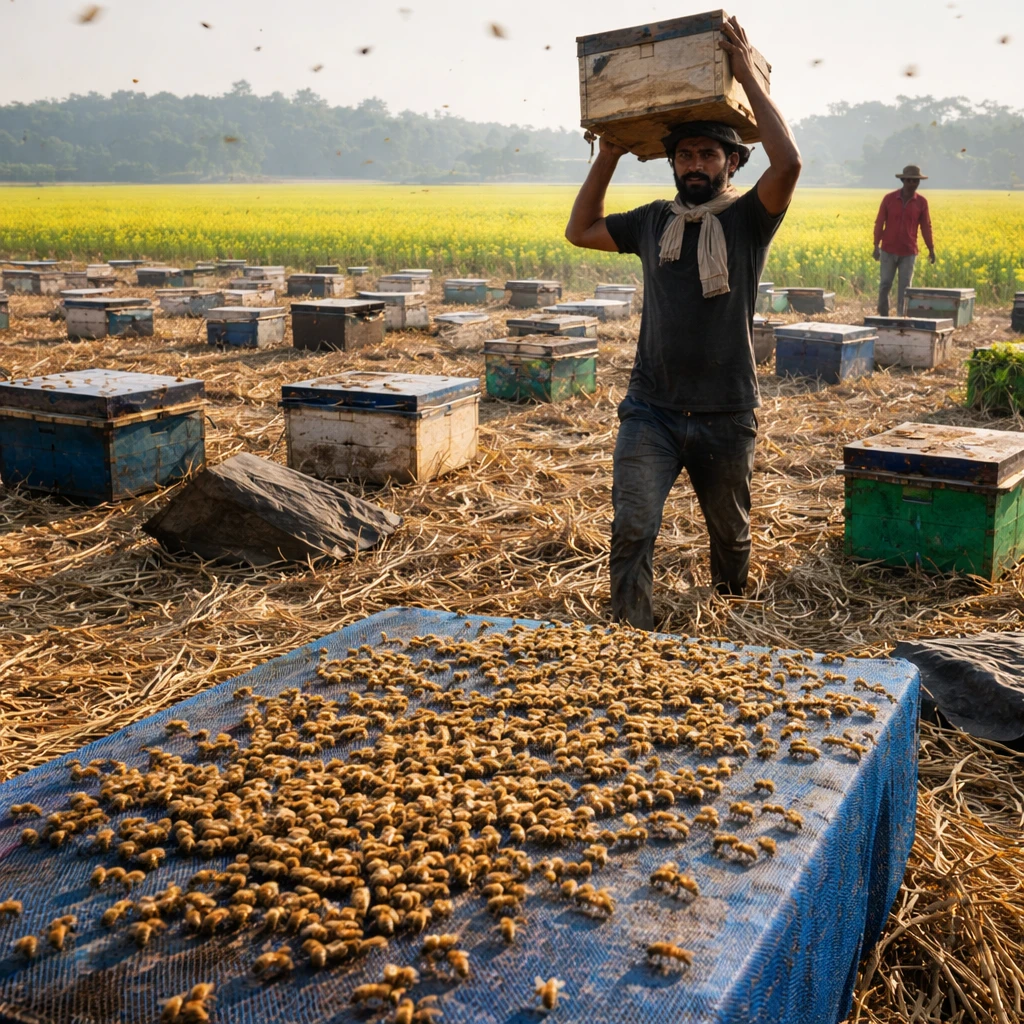
In the verdant mustard fields of Assam in northeastern India, migratory beekeepers rise before dawn to undertake a demanding routine. Originating from various regions, including Bihar, they journey considerable distances to spend winter months attending to their wooden bee boxes among the vibrant yellow blooms. Their day begins with a simple breakfast at dawn and stretches until dusk without further nourishment as they monitor hives, cautiously use smoke to calm the bees, and extract dense, golden honeycombs destined for international markets. This laborious work involves enduring frequent bee stings and nights sheltered under blue tarpaulins, far from families often left behind for prolonged periods. As Karan Raj, a beekeeper from Bihar, notes, "I earn an income, that’s why I do business."
This tradition of migratory beekeeping, while relatively new in Assam, is expanding as local and visiting apiarists recognize the region's favorable conditions and rising demand for honey. The practice not only supports direct honey production but also enhances agricultural productivity through pollination services. However, climate change poses escalating threats to these endeavors. Beekeepers report that intensified monsoons, flooding, and unseasonable heatwaves disrupt flowering cycles and bee activity. Ranjeet Kumar, another apiarist, emphasizes the dependence of production on weather stability: "If the weather is fine, the production will be fine. If the weather spoils, then there is no production. Weather has an effect. The weather needs to be good."
Assam, located south of the Himalayas and east of Bangladesh, has already experienced severe climate-related impacts. In 2024, floods and landslides resulted in over 100 fatalities, extensive crop damage, and repeated evacuations among farming communities. According to Mukul Kumar Deka of Assam Agricultural University, prolonged dry periods diminish nectar availability, while excessive heat or precipitation keep bees confined to their hives, reducing foraging time and honey yields.
Research from Madhya Kamrup College in 2025 indicates that Assam has encountered an increase of more than 20 heat-wave days compared to a decade earlier, with average maximum and nighttime temperatures rising by approximately 2 degrees Celsius (3.6 Fahrenheit). Such temperature shifts correlate with decreased honey productivity reported by many farmers.
The beekeeping community distinguishes between Western honeybees, commonly managed by migratory beekeepers, and indigenous bee species maintained by traditional apiarists. Indigenous species face significant pressures from habitat loss due to development projects, such as highways that fragment forests, and climate stressors. Karan Raj remarks on the decline of wild forest bees: "The bees that are in the trees, the ones that are in the forest, those bees have reduced drastically. For the Western ones, we feed them sugar and raise them, and this is why they survive, as long as we care for them."
This influx of commercial Western honeybees has the potential to compete with native bee populations and small-scale farmers who increasingly rely on beekeeping for supplemental income. Deka cautions that expanding Western honeybee rearing could threaten indigenous species.
Nevertheless, some initiatives promote rearing local bees, recognizing their critical role for smallholder farmers below the poverty line. These programs emphasize the dual benefits of honey sales and improved crop yields from robust pollination. Sujana Krishnamoorthy, executive director of the Under the Mango Tree Society, highlights training efforts to help farmers adapt to climate variability and manage their bees effectively, ultimately building resilience against climate change through diversified income and enhanced agricultural productivity.
Despite mounting environmental pressures, experts suggest that beekeeping will continue in Assam. Government subsidies for beekeeping equipment are supporting the industry’s sustainability. "There may be ups and downs, but ultimately beekeeping will be sustained here," states Deka.
Daily life for migratory beekeepers consists of long hours in the fields caring for hives, extracting honey, and managing bee health amid unpredictable weather patterns. Their dedication reflects the intricate balance between traditional livelihoods, commercial opportunities, and ecological stewardship in a changing climate.
February 9, 2026
News & Politics
Migratory Beekeeping in Assam: Navigating Climate Challenges to Harvest Honey
Seasonal beekeepers traverse India’s northeastern mustard fields, confronting weather extremes to sustain honey production and support pollination

Derek Hwang
Materials & Mining Analyst
Summary
Migratory beekeepers in Assam, India, dedicate their winters to harvesting honey from mustard fields, a practice growing in response to increasing global honey demand. While providing vital income and aiding crop pollination, these beekeepers confront significant climate-related threats including erratic rainfall, floods, and rising temperatures that impact bee behavior and productivity. Conflicts between introduced Western honeybees and indigenous species also present ecological concerns amid expanding commercial activity.
Key Points
Migratory beekeeping in Assam has expanded due to growing international demand for honey and the region’s mustard fields that provide forage during winter months.
Climate change impacts, including erratic rainfall patterns, flooding, and rising temperatures, significantly affect bee behavior and honey production in Assam.
There is increasing attention to the competition between introduced Western honeybees and indigenous species, raising ecological and livelihood considerations for smallholder farmers.
Risks
- Intensified climate variability threatens the stability of honey production due to adverse impacts on nectar availability and bee activity, affecting agricultural output and income sources associated with pollination and apiculture sectors.
- Habitat loss from infrastructural development may exacerbate declines in indigenous bee populations, risking biodiversity and the sustainability of traditional beekeeping practices.
- Expansion of commercial Western honeybee populations could compete with native bees, potentially disrupting ecological balance and affecting small-scale farmers reliant on indigenous bees for both income and crop pollination.
Disclosure
This article is informed entirely by observed reporting and expert commentary within the region, with no additional speculation or external information beyond the provided facts.