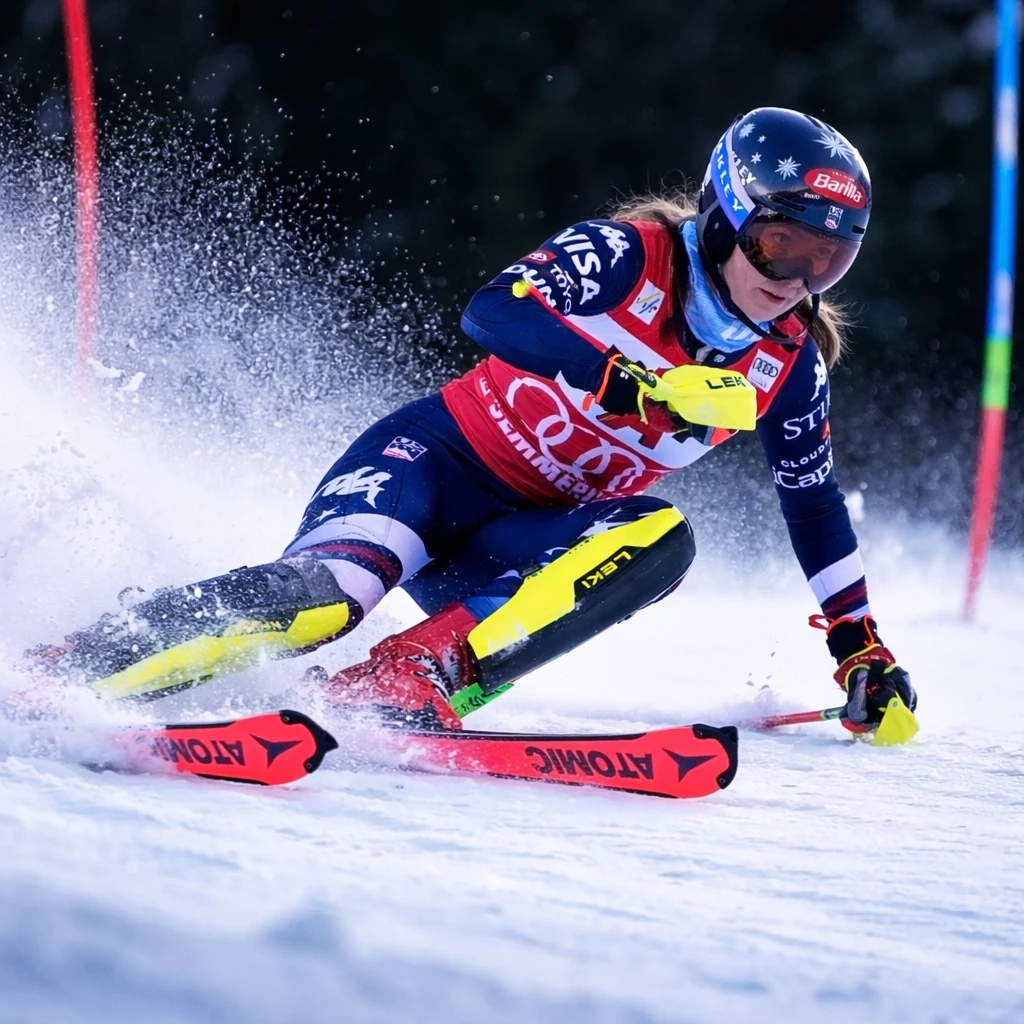

In Semmering, Austria, Mikaela Shiffrin narrowly preserved her unbeaten run in this season's World Cup slalom competitions as the final event of the year unfolded on Sunday night. The American skiing ace faced challenging conditions on the Panorama course that did not elicit much satisfaction, even as she outpaced the reigning world champion, Camille Rast of Switzerland.
Shiffrin rallied from a half-second deficit after the first run to edge Rast, but she did not hold back in expressing her frustrations with the course setup. Speaking to Austrian television, she emphasized concerns about the safety of the course for competitors with later bib numbers. "It was not safe to ski for the girls," Shiffrin remarked, pointing out that while her early start at bib 4 afforded better conditions, the increasingly deteriorated surface was particularly dangerous for women with start numbers extending into the teens and sixties.
The course's state was negatively impacted by recent mild weather, prompting organizers to attempt to harden the snow surface using water and salt treatments prior to the race. Despite these efforts, the course broke down in numerous spots as the afternoon session progressed, which began at 2:15 p.m. Conditions saw some improvement during the evening run, held approximately three and a half hours later, as temperatures fell.
Shiffrin described the day as "very challenging and distracting," acknowledging the precarious state of the course, but noted that no major injuries were reported. She expressed particular frustration for the competitors navigating the compromised surface, stating the second run was somewhat better, but still fell short of ideal standards.
Only 40 of the 77 racers finished the initial session, and a substantial time disadvantage of 5.94 seconds remained sufficient for qualification into the final run. Shiffrin advocated for improvements, underscoring the necessity for races to be both engaging and safe, without athletes fearing hazardous features like the large holes encountered in the first turns.
Despite the difficulties, Shiffrin delivered a stellar second run performance. After posting the fourth-fastest time in challenging conditions during the first session, she clocked the fastest time in the evening, allowing her to surpass Rast by a margin of 0.09 seconds. Eighteen-year-old Italian-born Lara Colturi, racing for Albania, secured third place, trailing by 0.57 seconds.
Following her victory, Shiffrin reflected on the day's intense mental and physical demands, acknowledging the pressure and the necessity to refocus after a run that, by her own admission, did not feel optimal. The win marked her 106th career victory, further extending her personal record in World Cup competition.
Shiffrin's achievement matches her personal best in beginning a season with five consecutive slalom wins, a feat she previously reached in 2018-19. Her dominance in the current Olympic campaign includes sweeping the first four slaloms by an average margin of 1.5 seconds, capped by this latest narrow triumph.
During the opening run, Shiffrin held a slender lead over Rast halfway down the course but lost considerable time in the latter sections. She attributed this to potentially overskiing and not taking the most efficient line. She remains the 2014 Olympic champion and holds the women's World Cup record for slalom victories with 69 wins.
In the slalom standings, Shiffrin now leads by 220 points ahead of Colturi. The World Cup tour includes three more slalom events in January prior to the Milan Cortina Winter Olympics, followed by two more in March. Each race win offers 100 points in the competition.
Other notable competitors included Croatia’s Zrinka Ljutic, the previous season's slalom winner and globe holder, who finished in eighth place, trailing by 3.75 seconds. Shiffrin's teammate Paula Moltzan was positioned seventh after the first run but missed a gate in the second attempt. This occurred after Moltzan sustained a fall impacting her back and head in a giant slalom event on the same slope the day before. Austria's Julia Scheib, who claimed victory in that giant slalom and does not contest slalom events, remains a distinguished competitor within the circuit.
The women's World Cup will next visit Kranjska Gora, Slovenia, for giant slalom and slalom races scheduled for the upcoming weekend.