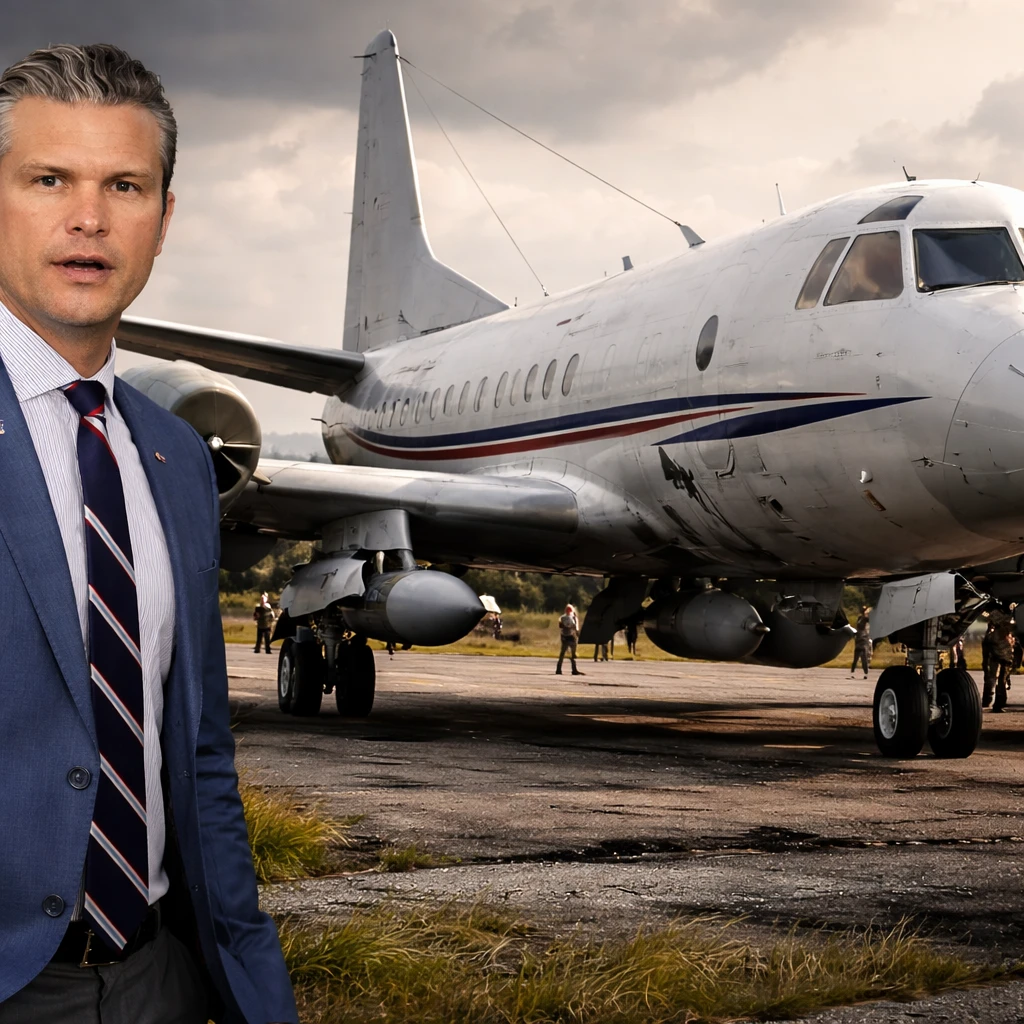

WASHINGTON — An aircraft employed by the United States military in a mission targeting a vessel suspected of drug trafficking near Venezuela last September was painted to mimic a civilian airplane. This approach seemingly conflicts with the Pentagon's own legal instructions on combat conduct.
The aircraft, part of a covert U.S. surveillance fleet, was additionally armed with munitions internally within the fuselage as opposed to external mounts, prompting scrutiny over the degree to which the mission was disguised in ways inconsistent with standard military procedures.
Details regarding the plane's civilian-like appearance, initially disclosed by The New York Times, were corroborated by two individuals familiar with the matter who requested anonymity owing to the operation's sensitivity. Pentagon spokesperson Kingsley Wilson stated that the military employs an assortment of standard and nonstandard aircraft tailored to mission demands.
This revelation follows a sequence of aggressive actions by the Trump administration against Venezuela, beginning with the deployment of significant military assets in the region and encompassing a series of attacks on purported narcotics trafficking boats, resulting in at least 115 fatalities. These events culminated this month in a high-profile raid capturing Venezuelan President Nicolás Maduro, who, along with his spouse, was transported to the U.S. to face federal drug charges.
The U.S. Senate is responding to these developments by preparing to vote on a war powers resolution aimed at restricting further military interventions in Venezuela without explicit legislative consent.
President Donald Trump has reacted strongly against this congressional measure, reportedly contacting multiple Republican senators who sided with Democrats in advancing the resolution for a final vote potentially scheduled soon. Senate Majority Leader John Thune described the President as highly animated over the issue.
To justify the September boat strikes, the administration has framed its actions within the context of an "armed conflict" against drug cartels in the region, labeling personnel aboard the targeted vessels as unlawful combatants.
However, military doctrines prohibit engaging in combat while impersonating civilians—a practice known as perfidy—which carries significant legal and ethical prohibitions. The Department of Defense manual expressly identifies feigning civilian status prior to attacking as perfidious. Furthermore, the Air Force underscores that such deception causes adversaries to neglect necessary precautions. Navy guidelines emphasize that attacks carried out under a civilian guise endanger all non-combatants and mandate adherence to military honor without resorting to such acts.
Wilson affirmed that each aircraft is subjected to comprehensive procurement scrutiny to ensure compliance with domestic laws, departmental policies, and international legal standards governing armed conflict.
The plane involved in the September 2 attack marked the opening salvo of a prolonged campaign featuring lethal strikes against suspected narcotics ships, with significant political and policy implications for the administration.
Defense Secretary Pete Hegseth and other senior officials have been summoned by Congress to provide explanations about these operations, particularly the initial strike, which included a controversial secondary attack killing survivors clinging to debris. Legal analysts suggest the follow-up strike might breach laws pertaining to combatant treatment since targeting shipwrecked personnel violates war conduct standards.
Some legislators advocate for the public release of the unedited footage from the mission, which Hegseth has declined to authorize. At a December cabinet meeting, Hegseth recounted observing the initial strike live but leaving prior to the subsequent attack.
In a classified congressional briefing, senators reviewed an undisclosed legal memorandum detailing the administration's justification for using military force to depose Maduro. Senator Rand Paul criticized the secrecy surrounding these legal rationales, advocating for transparency.
Senator Peter Welch expressed reservations regarding the operation's legality and skepticism about President Trump's intentions to exert extended control over Venezuela. Secretary of State Marco Rubio indicated that this control would involve enforcing sanctions-related oil quarantines as part of U.S. assertions over Venezuelan energy resources.
Welch further questioned the legitimacy of prolonged military involvement aimed at securing a single individual's prosecution, acknowledging Maduro's notoriety but highlighting legal uncertainties regarding sustained U.S. presence and governance ambitions in Venezuela.