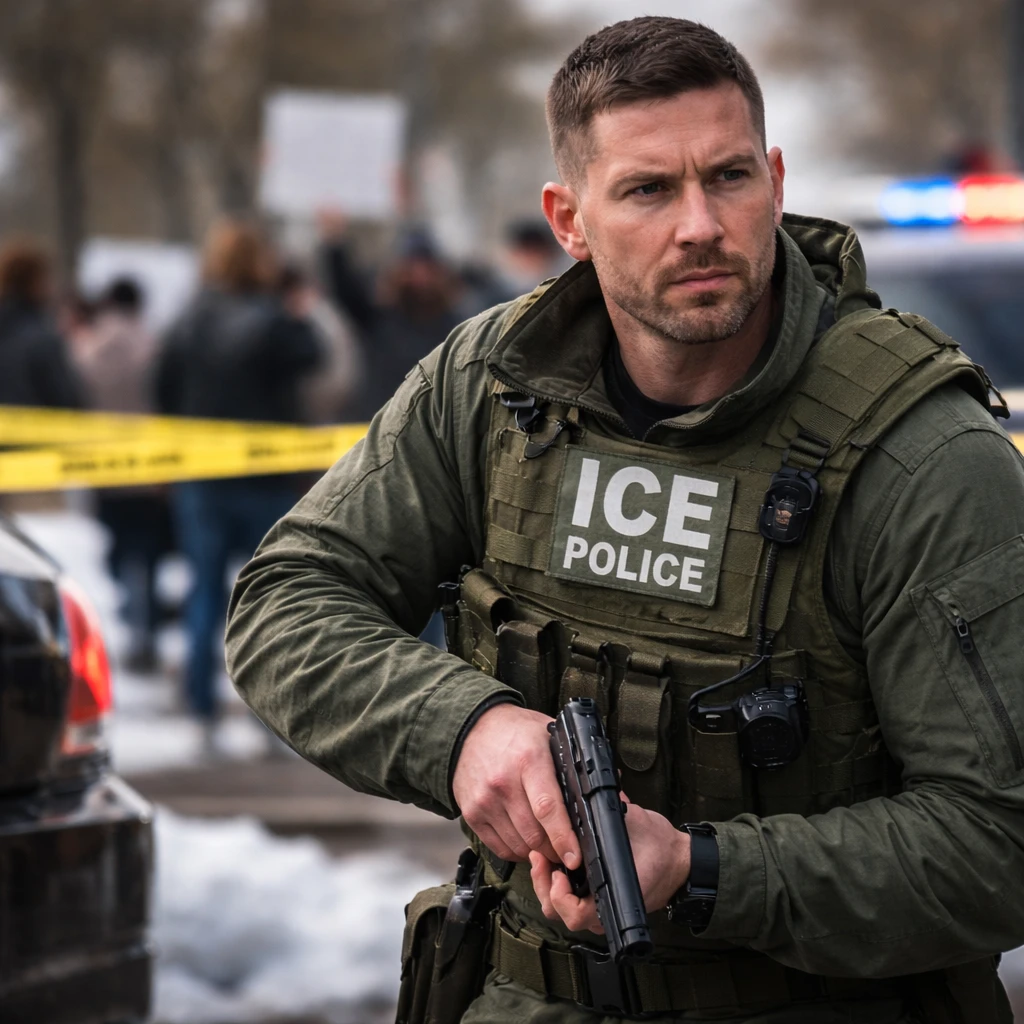

The individual who fatally shot Renee Good, a 37-year-old woman, in Minneapolis is Jonathan Ross, an Iraq War veteran and long-serving law enforcement officer, according to records released Thursday. Ross has been with U.S. Immigration and Customs Enforcement (ICE) as a deportation officer since 2015 and previously spent time in the Border Patrol. Over nearly two decades, he accumulated extensive experience in various law enforcement roles including field intelligence and fugitive operations.
Ross was seriously injured in an incident last June when a suspect, whom Ross attempted to apprehend outside the suspect’s Bloomington, Minnesota residence, dragged him with a vehicle following an attempted stun gun deployment. Federal documentation and statements from Department of Homeland Security Secretary Kristi Noem confirm that Ross was the officer involved in that event. Although federal authorities have withheld the officer’s name in the recent shooting, this prior injury aligns with descriptions provided by Noem.
The shooting of Renee Good has ignited widespread debate. Officials in the Trump administration emphasize Ross's seasoned background, citing his nearly two decades of service and asserting that he acted appropriately in self-defense when he believed Good was attempting to run down agents with her vehicle. Meanwhile, video footage related to the shooting has raised questions regarding the necessity and proportionality of the use of force. The FBI has launched an investigation into the incident, and local Minnesota authorities are engaging in their own inquiry. Protesters have called for criminal charges to be filed against Ross.
Efforts to contact Ross directly via known phone numbers and email addresses were unsuccessful. Below is a detailed account of his background and the previous incident that left him seriously injured.
Professional background and service details
Jonathan Ross served in the Indiana National Guard and was deployed to Iraq from 2004 to 2005, where he fulfilled a combat role as a machine gunner on a gun truck within a patrol team. After returning from military service, he pursued higher education before joining the United States Border Patrol in 2007 near El Paso, Texas. His tenure there lasted until 2015, during which he functioned as a field intelligence agent focusing on collecting and analyzing information related to drug cartels and human trafficking networks.
Since 2015, Ross has been a deportation officer with ICE, assigned to fugitive operations targeting higher-profile individuals within the region encompassing Minneapolis. Additionally, he has operated as a team leader within the FBI’s Joint Terrorism Task Force. Ross testified in court that his responsibilities span developing arrest targets, compiling packages on those targets, conducting surveillance, and orchestrating strategies for executing arrest warrants.
His skills extend to serving as a firearms and active shooter instructor, a field intelligence officer, and a member of the Special Weapons and Tactics (SWAT) team. He attended the Border Patrol Academy in New Mexico, where he acquired Spanish language skills as part of his training.
Incident in June 2023 resulting in serious injury
On June 17, 2023, Ross spearheaded an operation to arrest Roberto Munoz-Guatemala, an individual residing illegally in the U.S., in Bloomington, Minnesota. Agents assembled outside Munoz-Guatemala’s residence as he departed in his automobile. While FBI agents employed emergency sirens and lights to signal the suspect to stop, he failed to comply. Ross maneuvered his vehicle into the suspect’s path at an angle to induce a stop. After officers identified themselves and pointed firearms at Munoz-Guatemala, he raised his hands but was ordered to place his vehicle in park. When Munoz-Guatemala did not lower his window sufficiently, Ross used a spring-loaded window punch to break the rear driver’s side window, then reached inside to unlock the door.
As Ross engaged the suspect, Munoz-Guatemala accelerated, dragging Ross, whose arm was caught in the vehicle, down the street over approximately the length of a football field during 12 seconds. During this, Ross deployed his Taser, with prongs delivering electric shocks to Munoz-Guatemala’s head, face, and shoulder; however, the device failed to incapacitate him. Eventually, as Munoz-Guatemala drove onto the curb twice, Ross was freed from the vehicle but sustained multiple wounds, including large cuts and abrasions to his knee, elbow, face, and a bleeding right arm requiring a tourniquet. He received dozens of stitches following hospitalization and described the pain as excruciating.
Munoz-Guatemala sustained injuries and was noted to have called 911 via a female acquaintance, reporting assault and uncertainty about whether his assailant was a law enforcement officer. Subsequently, Munoz-Guatemala was arrested and charged with assaulting a federal officer with a dangerous or deadly weapon. Last month, a jury convicted him, determining that he reasonably should have known Ross was a law enforcement officer rather than a private citizen.
Federal and political responses to the recent shooting
Vice President J.D. Vance publicly commended the ICE officer involved in the shooting, labeling him a vital asset to the nation. Vance stressed the officer’s injuries and service, asserting that he merits gratitude. Meanwhile, Tricia McLaughlin, a Department of Homeland Security assistant, refrained from disclosing the agent’s identity due to safety concerns for the officer and his family. She affirmed that the agent was chosen for ICE's special response team, a unit requiring rigorous selection, including a demanding 30-hour trial and advanced training in techniques such as breaching, perimeter control, hostage rescue, and specialized firearms training.
McLaughlin stated, "He acted according to his training. This officer is a longtime ICE officer who has been serving his country his entire life." These assertions underscore federal authorities’ defense of the agent’s conduct amid ongoing investigations and public scrutiny.
The sequence of events has sparked significant community unrest, highlighting tensions between federal immigration enforcement policies and public safety considerations. The investigations underway by the FBI and local Minnesota law enforcement aim to determine the factual circumstances surrounding the shooting and whether the use of deadly force was justified in this case.
Ross was seriously injured in an incident last June when a suspect, whom Ross attempted to apprehend outside the suspect’s Bloomington, Minnesota residence, dragged him with a vehicle following an attempted stun gun deployment. Federal documentation and statements from Department of Homeland Security Secretary Kristi Noem confirm that Ross was the officer involved in that event. Although federal authorities have withheld the officer’s name in the recent shooting, this prior injury aligns with descriptions provided by Noem.
The shooting of Renee Good has ignited widespread debate. Officials in the Trump administration emphasize Ross's seasoned background, citing his nearly two decades of service and asserting that he acted appropriately in self-defense when he believed Good was attempting to run down agents with her vehicle. Meanwhile, video footage related to the shooting has raised questions regarding the necessity and proportionality of the use of force. The FBI has launched an investigation into the incident, and local Minnesota authorities are engaging in their own inquiry. Protesters have called for criminal charges to be filed against Ross.
Efforts to contact Ross directly via known phone numbers and email addresses were unsuccessful. Below is a detailed account of his background and the previous incident that left him seriously injured.
Professional background and service details
Jonathan Ross served in the Indiana National Guard and was deployed to Iraq from 2004 to 2005, where he fulfilled a combat role as a machine gunner on a gun truck within a patrol team. After returning from military service, he pursued higher education before joining the United States Border Patrol in 2007 near El Paso, Texas. His tenure there lasted until 2015, during which he functioned as a field intelligence agent focusing on collecting and analyzing information related to drug cartels and human trafficking networks.
Since 2015, Ross has been a deportation officer with ICE, assigned to fugitive operations targeting higher-profile individuals within the region encompassing Minneapolis. Additionally, he has operated as a team leader within the FBI’s Joint Terrorism Task Force. Ross testified in court that his responsibilities span developing arrest targets, compiling packages on those targets, conducting surveillance, and orchestrating strategies for executing arrest warrants.
His skills extend to serving as a firearms and active shooter instructor, a field intelligence officer, and a member of the Special Weapons and Tactics (SWAT) team. He attended the Border Patrol Academy in New Mexico, where he acquired Spanish language skills as part of his training.
Incident in June 2023 resulting in serious injury
On June 17, 2023, Ross spearheaded an operation to arrest Roberto Munoz-Guatemala, an individual residing illegally in the U.S., in Bloomington, Minnesota. Agents assembled outside Munoz-Guatemala’s residence as he departed in his automobile. While FBI agents employed emergency sirens and lights to signal the suspect to stop, he failed to comply. Ross maneuvered his vehicle into the suspect’s path at an angle to induce a stop. After officers identified themselves and pointed firearms at Munoz-Guatemala, he raised his hands but was ordered to place his vehicle in park. When Munoz-Guatemala did not lower his window sufficiently, Ross used a spring-loaded window punch to break the rear driver’s side window, then reached inside to unlock the door.
As Ross engaged the suspect, Munoz-Guatemala accelerated, dragging Ross, whose arm was caught in the vehicle, down the street over approximately the length of a football field during 12 seconds. During this, Ross deployed his Taser, with prongs delivering electric shocks to Munoz-Guatemala’s head, face, and shoulder; however, the device failed to incapacitate him. Eventually, as Munoz-Guatemala drove onto the curb twice, Ross was freed from the vehicle but sustained multiple wounds, including large cuts and abrasions to his knee, elbow, face, and a bleeding right arm requiring a tourniquet. He received dozens of stitches following hospitalization and described the pain as excruciating.
Munoz-Guatemala sustained injuries and was noted to have called 911 via a female acquaintance, reporting assault and uncertainty about whether his assailant was a law enforcement officer. Subsequently, Munoz-Guatemala was arrested and charged with assaulting a federal officer with a dangerous or deadly weapon. Last month, a jury convicted him, determining that he reasonably should have known Ross was a law enforcement officer rather than a private citizen.
Federal and political responses to the recent shooting
Vice President J.D. Vance publicly commended the ICE officer involved in the shooting, labeling him a vital asset to the nation. Vance stressed the officer’s injuries and service, asserting that he merits gratitude. Meanwhile, Tricia McLaughlin, a Department of Homeland Security assistant, refrained from disclosing the agent’s identity due to safety concerns for the officer and his family. She affirmed that the agent was chosen for ICE's special response team, a unit requiring rigorous selection, including a demanding 30-hour trial and advanced training in techniques such as breaching, perimeter control, hostage rescue, and specialized firearms training.
McLaughlin stated, "He acted according to his training. This officer is a longtime ICE officer who has been serving his country his entire life." These assertions underscore federal authorities’ defense of the agent’s conduct amid ongoing investigations and public scrutiny.
The sequence of events has sparked significant community unrest, highlighting tensions between federal immigration enforcement policies and public safety considerations. The investigations underway by the FBI and local Minnesota law enforcement aim to determine the factual circumstances surrounding the shooting and whether the use of deadly force was justified in this case.