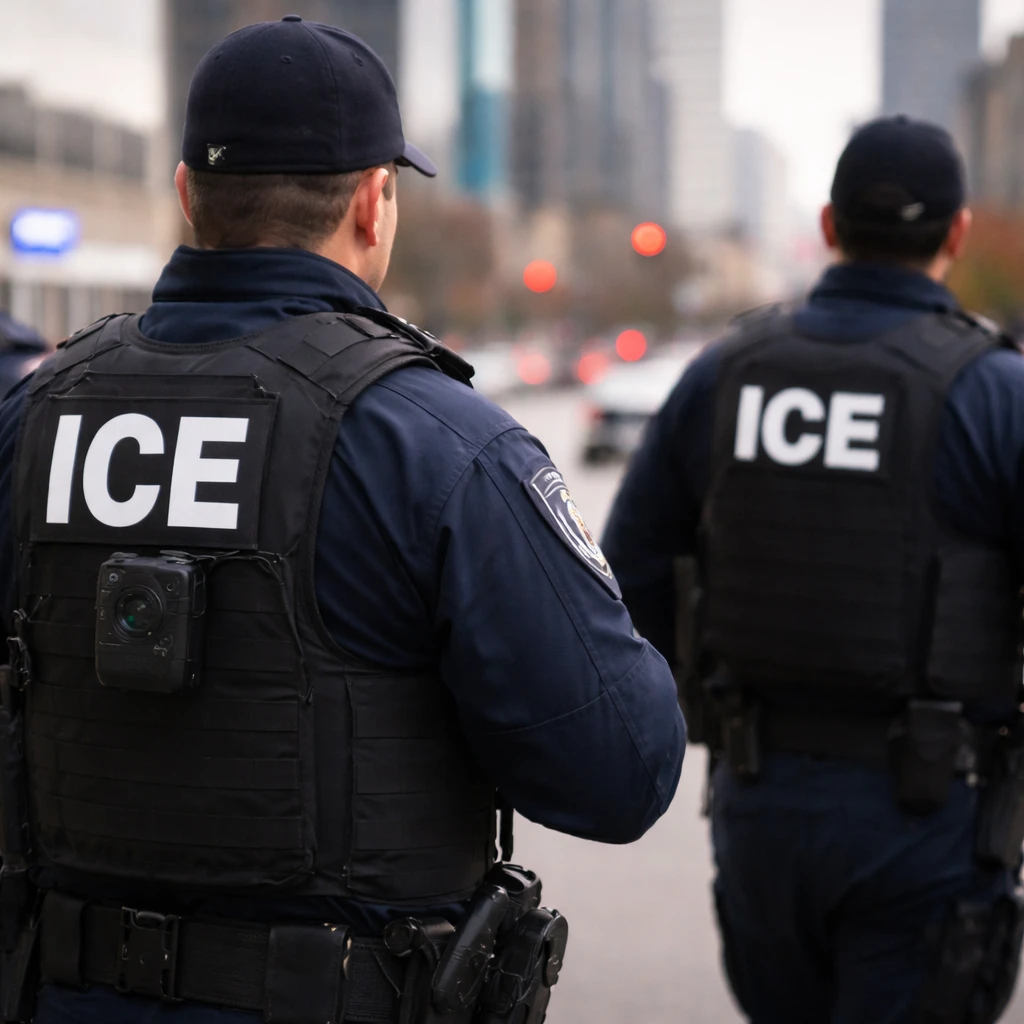

The Department of Homeland Security (DHS) has instructed that every law enforcement officer deployed in Minneapolis, including those from Immigration and Customs Enforcement (ICE), will be provided with body-worn cameras without delay, announced Secretary Kristi Noem on Monday. This step is part of a broader effort to address public concerns after two U.S. citizens fatally shot during immigration enforcement actions in Minneapolis sparked widespread criticism.
In a social media statement on the platform X, Secretary Noem affirmed the department’s commitment to “rapidly acquire and deploy body cameras to DHS law enforcement across the country,” indicating a planned nationwide expansion of the program as budget allocations permit.
Minneapolis has recently become a focal point of intense public examination concerning federal officers' conduct following these two fatal shootings. These incidents have ignited protests and sharp debate about immigration enforcement practices and federal law enforcement transparency.
In the immediate aftermath of the shootings, Secretary Noem defended the actions of the officers involved in the death of ICU nurse Alex Pretti, describing Pretti as armed and aggressive. She stated that Pretti "came with a weapon and dozens of rounds of ammunition and attacked" the agents who responded to protect themselves. Other officials within the administration echoed similar accounts.
Contrary to these official statements, multiple videos that surfaced later depicted Pretti holding only a mobile phone as he was apprehended, during which an officer drew a handgun from Pretti's waistband prior to shots being fired into his back.
DHS has confirmed that at least four Customs and Border Protection agents at the scene where Pretti was killed were equipped with body cameras, although no footage has been released to the public. Regarding the January shooting of 37-year-old mother Renee Good, the department has remained silent on whether ICE personnel involved were wearing body cameras at the time.
The fatal incidents and the surrounding official narratives have amplified calls for accountability, including from some members of the Republican Party. In response, President Donald Trump dispatched border official Tom Homan to oversee Minneapolis operations, replacing Border Patrol Commander Gregory Bovino, who has faced criticism in other major city enforcement efforts.
Additionally, the Justice Department initiated a federal civil rights probe into Pretti's death, a step not taken in Good's case.
Public demands for mandatory body cameras on Homeland Security immigration officers have intensified following these events. Minnesota Governor Tim Walz criticized the delayed implementation of camera use in an X post, asserting cameras should have been standard "long before (officers) killed two Americans."
This announcement coincides with ongoing legislative negotiations between the Trump administration and congressional Democrats over Homeland Security funding. Democrats are pushing for provisions that limit aggressive immigration enforcement, including a $20 million allocation for body-worn cameras included in a bipartisan funding package recently passed by the Senate to avoid a government shutdown.
However, the House has yet to ratify this package, resulting in a partial shutdown affecting several agencies, including Homeland Security. Despite funding gaps, many of DHS’s essential operations continue.
The use of body cameras has been a contentious topic during immigration enforcement operations under the Trump administration’s mass deportation policies, highlighted by a significant operation in Chicago last fall where a U.S. district judge mandated camera use when available by uniformed agents during arrests and other enforcement actions.
Previously, President Joe Biden had issued an executive order in 2022 directing federal law enforcement to adopt body cameras, a directive rescinded by Trump in his second term.
Recently, President Trump expressed support for body-camera use among immigration officers, stating that it generally benefits law enforcement by providing an objective record of incidents. Following Noem’s announcement, he commented that the decision ultimately rests with the DHS Secretary, but he personally approves the initiative.
Aaron Reichlin-Melnick, senior fellow at the American Immigration Council, observed that the department should have the resources to implement the protocol immediately, citing a recent congressional appropriations measure that allocated nearly $30 billion to ICE for enforcement and removal operations, including information technology expenditures. He remarked, "That buys a lot of body cameras."