As Minneapolis grapples with unrest tied to immigration enforcement, the local journalistic community has risen to the challenge without being overwhelmed. Over recent weeks, the Minnesota Star Tribune has notably uncovered key information, such as the identity of the immigration enforcement officer responsible for the shooting of Renee Good, supplemented by a range of insightful reports to inform and educate readers.
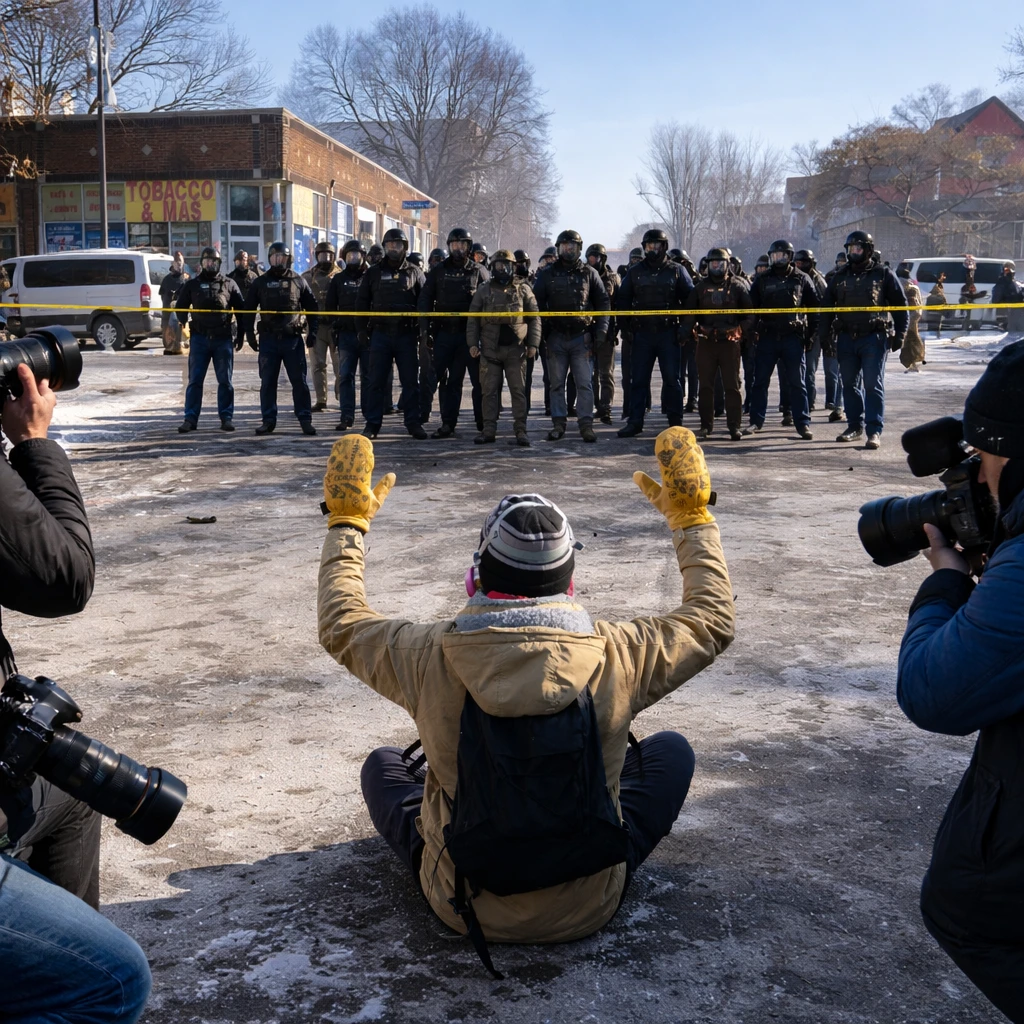
A striking photograph captured by Richard Tsong-Taatarii, showing a demonstrator subdued on the ground as a chemical irritant was sprayed directly at him, quickly became emblematic of the unfolding events. This and other ICE-related developments have prompted the Star Tribune to rethink its approach to news coverage, intensifying its focus on the topic.
Contrasting with the decline of many regional newspapers, the Star Tribune has maintained a relatively stable newsroom, supported since 2014 by owner billionaire Glen Taylor. The publication rebranded to the Minnesota Star Tribune and embarked on a digital-first transformation prior to the recent unrest, positioning it advantageously to cover breaking developments effectively.
“Without prior investment in the newsroom, we wouldn’t have been able to respond as swiftly and comprehensively,” said Steve Grove, the publisher and chief executive officer of the paper.
The Star Tribune operates within a rich local journalism landscape. Minneapolis benefits from strong public radio and television news services, complemented by digital outlets like Sahan Journal, which has made a name for itself covering immigrant communities and regional reactions to federal immigration policies under President Donald Trump.
“The local media ecosystem is remarkably robust,” noted Kathleen Hennessey, senior vice president and editor of the Star Tribune. “I believe the public is now recognizing the strength of these various outlets.”
While national media have had visibility in the region, local journalists possess distinct advantages, including deep neighborhood knowledge and community contacts. For example, Josie Albertson-Grove of the Star Tribune was among the first reporters at the scene after ICU nurse Alex Pretti was fatally shot on January 24. Residing close by, her familiarity with the area and its residents helped piece together the sequence of events.
Journalists with school-age children gleaned insights about ICE’s tactics targeting zones near schools from personal networks, highlighting how local immersion supports reporting efforts. Coverage of public safety matters brings challenges, but reporters like Liz Sawyer have cultivated sources that, together with colleagues Andy Mannix and Sarah Nelson, enabled detailed reporting on the shooting involving Good.
“Our staff’s profound understanding of Minnesota complements these relationships,” Hennessey added. “This state has a deep-rooted activism tradition with tightly woven social and neighborhood networks. People mobilize swiftly, often vocally, and that dynamic shapes the story.”
An instance illustrating this responsiveness occurred on January 21 when Tsong-Taatarii received a tip via a Signal group about escalating demonstrations. Arriving promptly, he documented a powerful scene: a protester pinned face-down, restrained by two officers while a third deployed a chemical agent mere inches from his face, the liquid vividly flooding his cheek and the pavement below. The image sparked outrage amid those who perceived the act as cruel.
“My goal was to document and let the public interpret the incident,” Tsong-Taatarii explained.
In thorough investigative reporting, the Star Tribune’s Christopher Magan and Jeff Hargarten mapped out 240 of approximately 3,000 immigrants detained in Minnesota, revealing that 80% had felony convictions but nearly all had faced judicial processes, been sanctioned, and were no longer fugitives. Additional collaborations examined the federal immigration force’s size relative to local law enforcement numbers.
Columnist Laura Yuen explored the prevailing atmosphere of fear, detailing how even elderly residents now carry passports to assert their belonging. Yuen recounted downloading her passport onto her phone, transforming it from a symbol of global travel pride to a “badge to prove I belong.”
Kim Hyatt and Louis Krauss contributed detailed analysis examining the health repercussions associated with chemical irritants reportedly used by law enforcement – an area complicated by lingering questions about the exact substances involved.
Scott Libin, a seasoned broadcast journalist and professor at the University of Minnesota, commended the Star Tribune’s dispassionate and comprehensive coverage of immigrants’ criminal histories.
Since Kathleen Hennessey’s appointment as editor last May, the paper has consistently broken major stories, including incidents involving shootings of state legislators and gun violence at a Minneapolis Catholic school. The staff also retains collective memory and expertise from covering the groundbreaking events following George Floyd’s death in 2020, according to Grove.
The evolving news environment has prompted substantial operational changes at the Star Tribune. The newsroom reorganized to support an intensive, real-time live blog on immigration issues, freely accessible online, and embraced video journalism with forensic analysis of footage related to the Pretti and Good incidents – capabilities uncommon among local competitors.
These enhancements have resulted in a 50% uptick in website traffic, increased paid subscriptions, and donor support amounting to thousands of dollars from across the country, reflected Grove.
“Audiences have shifted their consumption habits,” Hennessey remarked. “We notice readers returning multiple times daily to stay current, rather than a single daily visit.”
Journalists across the newsroom contribute to the immigration story, with even food, culture, and outdoor reporters adapting to the absence of typical beat boundaries, Albertson-Grove noted.
Under Grove’s leadership, who brings experience from Google, the Star Tribune has pursued a digital-first strategy, replacing around 20% of staff over two years, closing its Minneapolis print facility in December, and relocating printing to Iowa—a move reflecting broader challenges facing local news media.
“Like all local news organizations, we face constant headwinds,” Grove acknowledged. “Yet, being the Midwest’s largest newsroom helps us maintain our capacity during critical times.”
From a reporter’s perspective, Sawyer values the community’s acknowledgment of the newsroom’s public service role, expressed through sharing content. Nevertheless, balancing intense workload with family life poses challenges, especially for her and husband Aaron Lavinsky, a Star Tribune photographer. Coordinating coverage ensures they are not simultaneously exposed to hazardous situations or unavailable for childcare.
“Both journalists and residents here are exhausted by the persistent national spotlight, which rarely focuses on positive aspects,” Sawyer said. “Everyone strives to navigate this period with composure.”