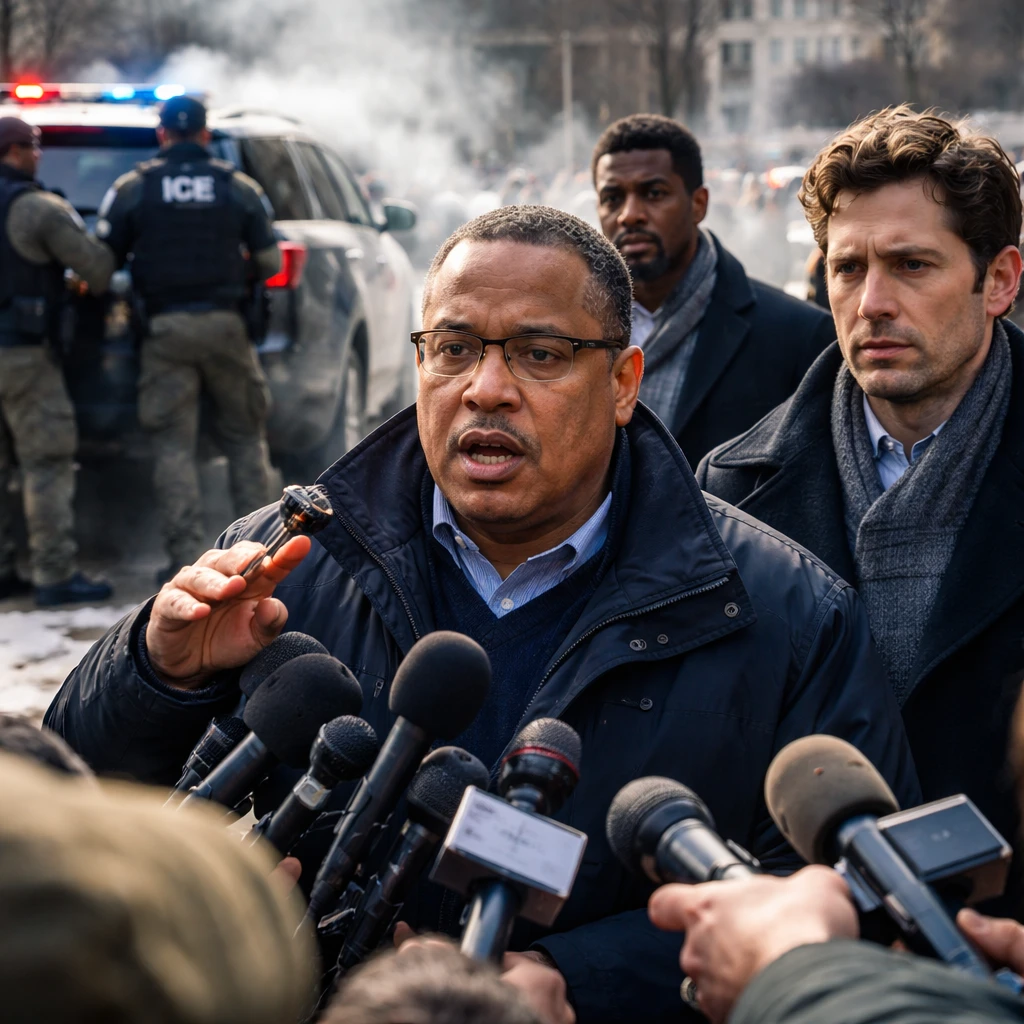

MINNEAPOLIS - On Monday, Minnesota, accompanied by the state's two largest municipalities, Minneapolis and St. Paul, commenced legal proceedings against the Department of Homeland Security (DHS) under the Trump administration. The lawsuit aims to impede a significant enforcement initiative that federal authorities launched, which has been linked to a fatal incident involving a Minneapolis woman shot by a federal officer. This enforcement surge has ignited widespread protests and criticism nationwide.
The lawsuit asserts that DHS's recent actions infringe upon constitutional protections, particularly those enshrined in the First Amendment. It seeks not only to halt the ongoing immigration enforcement activities but also to impose restrictions on the scale and conduct of such operations within Minnesota.
State Attorney General Keith Ellison described the federal presence as an invasion, highlighting concerns about the conduct of immigration enforcement agents. "Essentially, this is a federal incursion into the Twin Cities, and it must be stopped," he stated during a press briefing. Ellison criticized these agents as inadequately trained yet heavily armed, accusing them of inducing fear among Minnesotans due to widespread unlawful behaviors.
Supporting Ellison's assertions, the Department of Homeland Security has indicated plans to deploy over 2,000 immigration enforcement officers in Minnesota, reporting more than 2,000 arrests since December. Immigration and Customs Enforcement (ICE) characterized this escalation as its largest enforcement campaign to date.
Central to the lawsuit's claims is the allegation that the Trump administration has targeted Minnesota, a state with a progressive stance favoring Democratic policies and welcoming immigrants, based on demographics such as appearance and accent. St. Paul Mayor Kaohly Her, a native of Laos, voiced the apprehensions of local residents, many of whom reportedly feel intimidated by the federal presence. She emphasized local government responsibilities, stating, "Our residents are scared, and as local officials, we have a duty to intervene."
In response, DHS representative Tricia McLaughlin countered these claims by accusing Minnesota officials of neglecting public safety priorities. She underscored the federal mandate to uphold law enforcement irrespective of differing political leadership, asserting, "President Trump's role involves safeguarding Americans and enforcing the law regardless of any mayor, governor, or attorney general. The administration operates with constitutional backing and is prepared to defend its position in court."
Parallel to Minnesota's legal challenge, the federal government is also confronting a similar lawsuit related to enforcement efforts in Illinois. Last year, "Operation Midway Blitz" resulted in over 4,300 arrests across the Chicago metropolitan area. Plaintiffs in Illinois argue that the aggressive crackdown has deterred residents from leaving their homes or utilizing public services, further escalating community tensions.
Since the intensified federal deployment in the Twin Cities area, grassroots activists have frequently voiced alarms about the heavy presence of agents. Numerous eyewitness accounts have surfaced, including videos displaying federal officers deploying tear gas to prevent followers from tracking their movements.
Earlier on Monday, federal agents utilized tear gas to disperse a crowd that gathered shortly after a vehicle accident took place in Minneapolis, a mere few blocks from the location where Renee Good was fatally shot. Agents were seen engaging with a man whose vehicle had been rear-ended by law enforcement. In an attempt to disband the onlookers, tear gas was deployed before agents retreated amidst public outcry labeling them "cowards." Christian Molina, standing near his damaged car, voiced frustration and concern, questioning who would bear responsibility for his vehicle's damage.
This incident follows sustained public unrest after Renee Good's death on January 7. The 37-year-old mother of three has been commemorated through numerous protests and vigils nationwide, with many strongly criticizing the enforcement approach under the Trump administration. Although officials have defended the immigration officer involved, citing threats posed by Good and her vehicle, these justifications have faced skepticism from Minnesota Governor Tim Walz and others who have reviewed the video footage of the encounter.
Amid this volatile environment, hundreds of students participated in a walkout from Minneapolis's Roosevelt High School last week, prompted by federal agents' deployment of tear gas towards students and faculty. The demonstration was supported by adult volunteers managing traffic safety and was notable for the presence of alumni parents, some donning the school's apparel. Protesters bore signs with slogans such as "ICE out" and references to the dystopian "Hunger Games" society, symbolizing their opposition to federal enforcement actions.
Elsewhere, in Portland, Oregon, federal authorities have pressed charges against a Venezuelan national following an incident involving U.S. Border Patrol agents. The individual, along with a female companion, was injured but survived after shots were fired when the male allegedly used a pickup truck to ram a Border Patrol vehicle and attempted to flee. The FBI has noted a lack of video evidence for this event, contrasting it with available footage from the Good shooting.