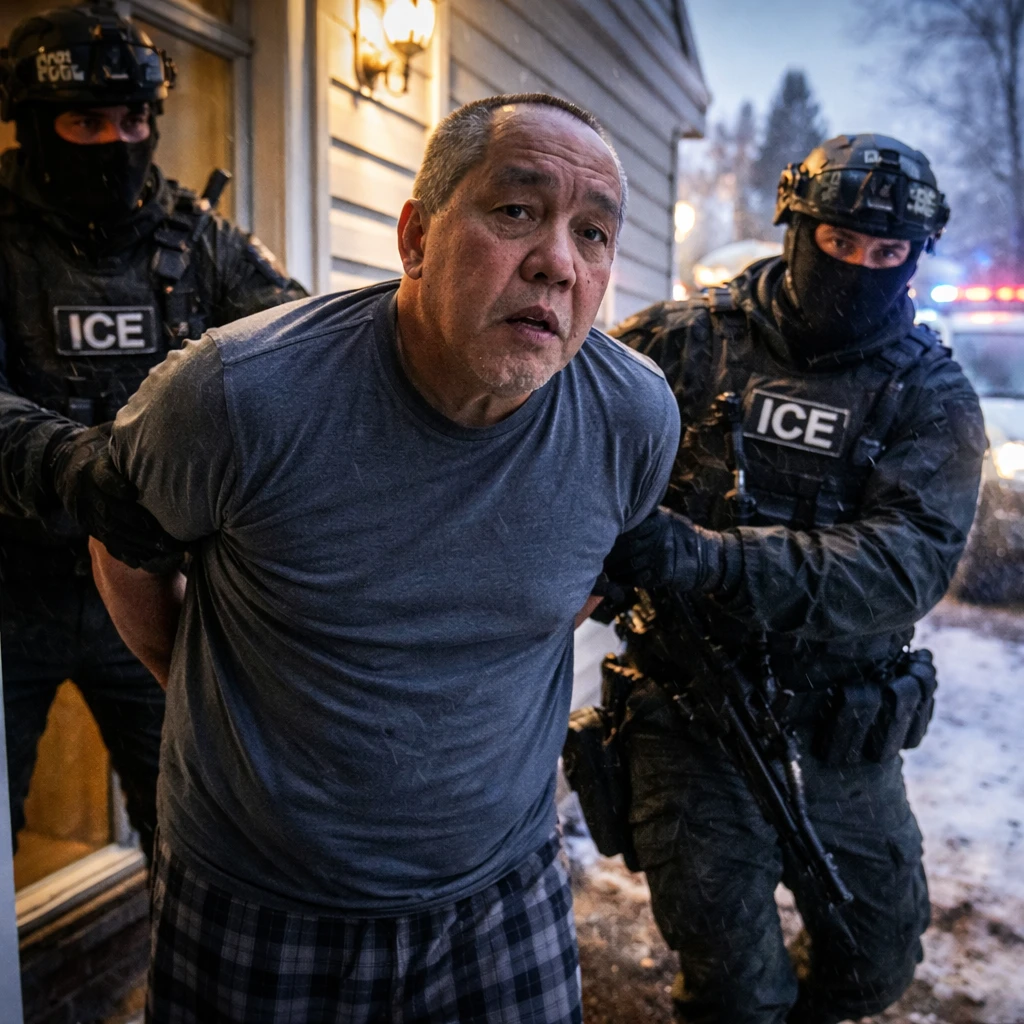

In St. Paul, Minnesota, a U.S. citizen named ChongLy "Scott" Thao was forcibly detained by Immigration and Customs Enforcement (ICE) agents who entered his residence without a warrant, according to accounts from his family and video footage acquired by this publication. The incident occurred on a cold Sunday afternoon when masked officials forcibly broke open the door to Thao's home and held him at gunpoint.
Thao recounted that his daughter-in-law alerted him to the presence of ICE officials knocking persistently at their door during his nap. Following his instruction to avoid opening the door, agents breached the entry and confronted the family aggressively, brandishing firearms and issuing commands.
"I was shaking," Thao stated. "They didn’t present any warrant; they simply broke down the door." This episode has unfolded in the context of a significant deployment of federal agents in the Twin Cities, which has stirred concerns among residents and city officials over warrantless arrests and confrontations with protesters. Moreover, the recent fatal shooting of Renee Good, a mother of three, has intensified criticism of ICE's approach.
St. Paul Mayor Kaohly Her, who is of Hmong descent, publicly criticized the ICE practices, emphasizing the flawed targeting rationale. "They are not pursuing hardened criminals," she commented. "They are indiscriminately targeting people, which is unacceptable and contradicts American principles."
During the detention process, Thao said he requested his identification through his daughter-in-law, but agents declined to see it initially. During this ordeal, with his 4-year-old grandson observing and crying, Thao was handcuffed and led outside wearing only underwear and sandals, wrapped only in a blanket despite the subfreezing temperatures.
Neighbors gathered, expressing their displeasure vocally through whistles and shouts, demanding that the armed officials cease their actions against the family. Video evidence depicts this tense moment involving over a dozen agents.
Thao explained that following his removal, agents transported him to a remote location where they compelled him to exit the vehicle for photographic identification, despite his prior offer to show ID. He expressed fear of physical assault during this time. Only after some time did the agents confirm his status as a U.S. citizen with no criminal record and subsequently returned him to his residence.
Upon returning, officials requested Thao to provide identification, which he complied with. He reported that despite the intrusive entry and unwarranted detention, neither an apology nor explanation for the incident was offered by the officers before they left the premises.
The Department of Homeland Security (DHS) has defended the operation, characterizing it as "targeted," aiming to apprehend two convicted sex offenders believed to be residing at the location. The DHS indicated that Thao lived with these individuals, and that he refused biometric identification methods. The agency claimed he matched the description of these targets.
However, Thao’s family has strongly denied these assertions, releasing a statement asserting that these claims are false and misleading. According to Thao, only he, his son, daughter-in-law, and grandson live at the rented property, none of whom appear in the state's sex offender registry. The closest registered sex offender is reportedly over two blocks away from their address.
Requests for the identities of the purported sex offenders and further explanation from DHS have gone unanswered. Thao's son, Chris Thao, reported being stopped by ICE while en route to work in a vehicle borrowed from a cousin’s boyfriend, whose name coincides with an unrelated individual convicted of a sex offense. Chris clarified that these parties are distinct individuals.
The family also emphasized the historical context and emotional impact of this incident, noting that ChongLy Thao’s mother fled Laos in the 1970s due to her support of U.S. covert operations and the ensuing communist takeover. She served as a nurse assisting CIA-backed Hmong soldiers during the U.S.’s “Secret War.” Choua Thao, who passed away recently, had close ties to U.S. government efforts and cared for both civilians and American soldiers, as recognized by the Hmong Nurses Association.
In light of these events, ChongLy Thao has expressed intentions to pursue legal action for civil rights violations against DHS, voicing a profound sense of insecurity and distress over his treatment.
"I don’t feel safe at all," Thao stated. "What did I do wrong? I didn’t do anything."