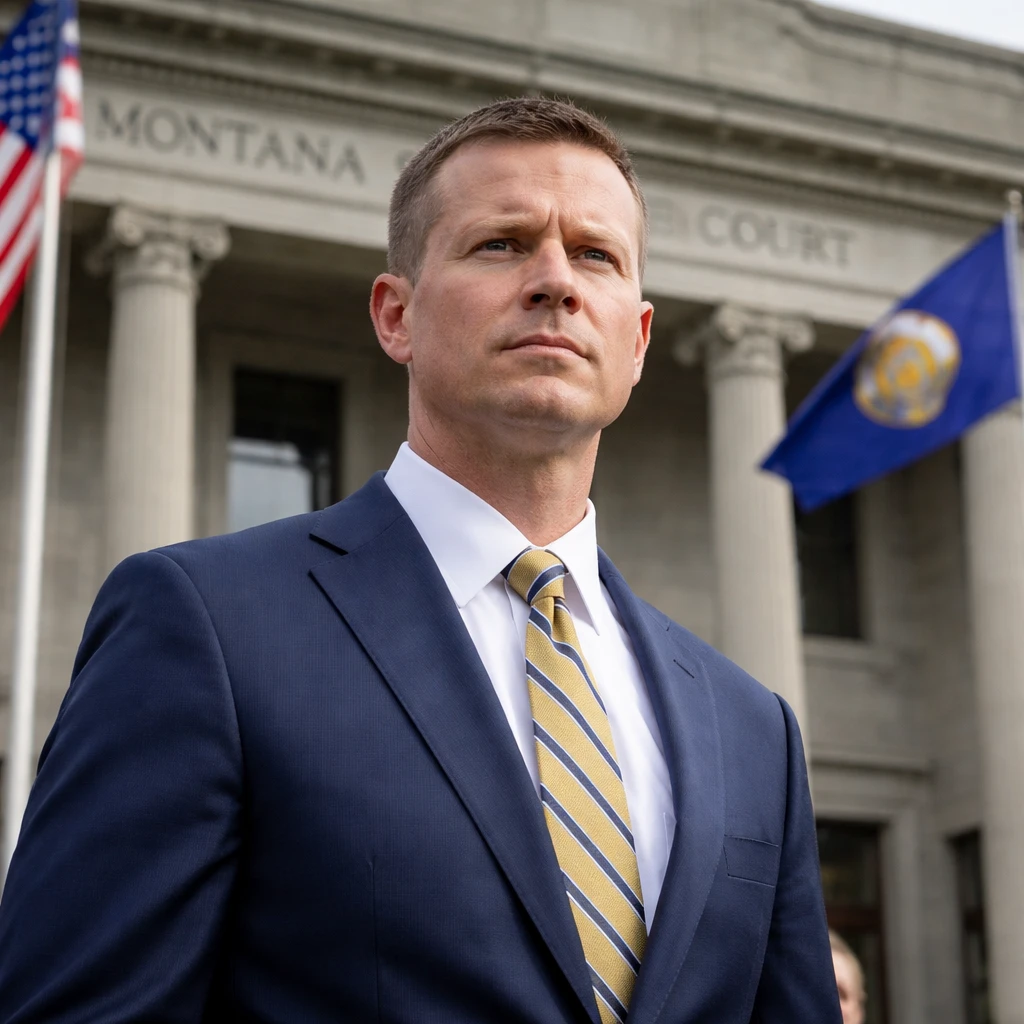

In Billings, Montana, the state's Supreme Court announced on Wednesday the dismissal of a misconduct complaint filed against Attorney General Austin Knudsen. The case arose from Knudsen's defense of a controversial 2021 law that empowered the Republican governor to directly appoint judicial officials, a move that sparked conflict between Montana's executive and judicial branches.
A panel of court-appointed reviewers had earlier determined that Knudsen repeatedly impugned the integrity of Montana Supreme Court justices in his legal arguments supporting the legislation. Acting on these findings, the panel recommended a 90-day suspension of Knudsen's license to practice law. However, in its ruling, the Supreme Court acknowledged Knudsen's violations of professional standards but ultimately dismissed the case due to procedural failings by the panel overseeing the investigation.
Specifically, the Supreme Court found that the panel compromised Knudsen's due process rights by excluding his expert witness testimony and by failing to thoroughly explain its ruling against him. Chief Justice Cory Swanson stated that the decision amounted to a "public admonition" aimed at addressing Knudsen's misconduct.
Knudsen welcomed the court's ruling, dismissing the complaint as a "frivolous" political maneuver. In a statement, he expressed appreciation for the case being brought to a conclusion and characterized the proceedings as a distraction from his official duties.
The legal conflict centers on a statute that was part of a broader Republican effort to steer the judiciary towards conservatism. This law, affirmed by Montana's Supreme Court, allows the governor to fill judicial vacancies directly—a provision that triggered considerable opposition from the state's highest court.
During legal challenges, Knudsen's office accused the justices of various forms of judicial impropriety, including misconduct, corruption, conflicts of interest, and self-serving behavior. Following these allegations, a thirteen-member commission, known as the Commission on Practice of the Montana Supreme Court, investigated and concluded that Knudsen's office had consistently breached professional codes of conduct.
Knudsen contended that any disciplinary measures should have remained confidential, but the court determined that the case's extensive public litigation was far more severe than a private reprimand would have been. In an unusual procedural step, all but two justices recused themselves from the case due to prior involvement in opposing Knudsen, prompting their replacement by district court judges and recently elected justices.
Of the justices who ruled on the case, six opposed the suspension recommendation, with only Justice Katherine Bidegaray dissenting. Bidegaray advocated for a public censure alongside a 30-day suspension, emphasizing that disciplinary actions serve to protect public confidence in the judiciary and legal profession rather than to punish.
The court unanimously rejected Knudsen's argument that his role as attorney general exempted him from disciplinary action, with Chief Justice Swanson underscoring the necessity for the state's top law enforcement official to adhere to ethical standards. During a prior hearing, Knudsen acknowledged that his approach in representing the legislature's interests included overly sharp language, which he would avoid if given the opportunity to revise his tactics.