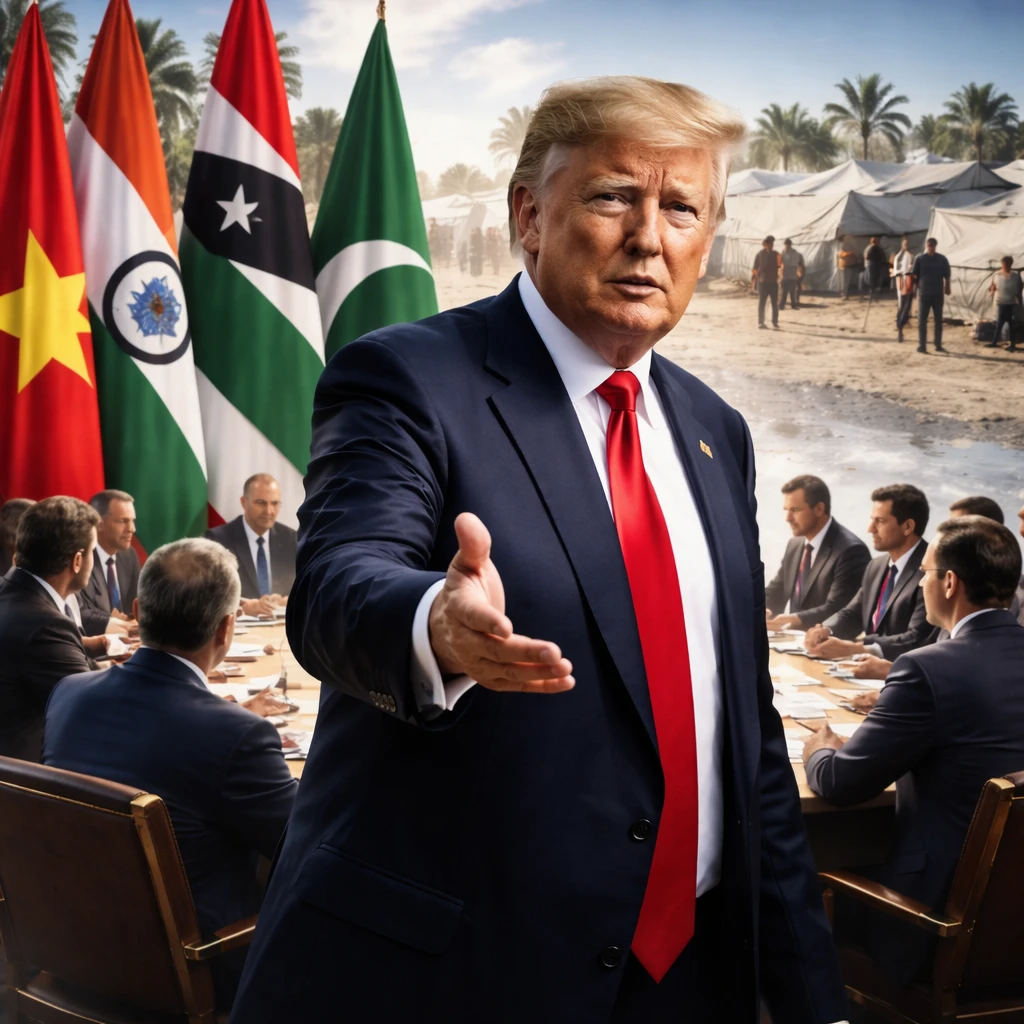

On Sunday, at least seven additional countries announced that they had been invited by the United States to join President Donald Trump's newly established 'Board of Peace.' This group of world leaders is tasked with guiding the subsequent phases of governance and recovery in Gaza, indicating an ambition for broader influence in managing international affairs. Among these, Hungary and Vietnam have publicly accepted the invitations.
According to a U.S. official who requested anonymity due to the confidentiality of the charter—yet to be officially disclosed—a permanent seat on the Trump-led board requires a $1 billion financial contribution. This distinguishes it from a temporary three-year membership, which entails no mandatory contribution. The funds collected through these contributions are intended to support the rebuilding efforts in Gaza.
Hungarian Prime Minister Viktor Orbán, recognized as a fervent supporter of Trump within Europe, has accepted the invitation, as confirmed by Hungary's Foreign Minister Péter Szijjártó via state radio on Sunday. Similarly, Vietnam's Communist Party chief, To Lam, has accepted the invitation, according to a statement from Vietnam's foreign ministry.
India has reportedly received an invitation as well; this was disclosed by a senior Indian government official who chose to remain anonymous since the information has not been publicized by the authorities.
Additional countries confirming receipt of invitations include Jordan, Greece, Cyprus, and Pakistan. Meanwhile, Canada, Turkey, Egypt, Paraguay, Argentina, and Albania have already acknowledged their invitations. The total number of countries invited remains unclear.
The United States is expected to officially announce the list of the Board of Peace members in the near future, potentially coinciding with the World Economic Forum meeting in Davos, Switzerland.
The board’s responsibilities will encompass overseeing the continuing phases of the Gaza ceasefire agreement, implemented on October 10, which now enters a more complex second stage. This includes establishing a new Palestinian governing committee within Gaza, deploying an international security force, disarming Hamas, and facilitating the reconstruction of this conflict-damaged region.
In invitations dispatched last Friday designating recipients as “founding members,” President Trump expressed that the Board of Peace would pursue a novel approach to resolving conflicts worldwide.
This initiative may be viewed as a potential alternative to the United Nations Security Council (UNSC). The UNSC, consisting of fifteen seats, has been obstructed from taking effective action to halt the Gaza conflict, primarily due to U.S. vetoes. Furthermore, its authority has been weakened by significant funding reductions imposed by the Trump administration alongside other donors.
Trump’s invitations to join the Board of Peace referenced the Security Council’s endorsement of the U.S.-proposed 20-point Gaza ceasefire plan, which incorporates the establishment of this board. Transparency around these letters increased as some invitees shared them via social media platforms.
In tandem, the White House announced an executive committee comprising several distinguished leaders to advance the board’s objectives. Nonetheless, this announcement prompted objections from Israel on Saturday, which criticized the formation of the committee for lack of prior coordination and for conflicting with Israeli policy. The statement issued by Prime Minister Benjamin Netanyahu’s office represents a rare critique directed toward the administration in Washington.
The executive committee is composed of U.S. Secretary of State Marco Rubio, Trump envoy Steve Witkoff, Trump's son-in-law Jared Kushner, the former British Prime Minister Tony Blair, World Bank President Ajay Banga, Deputy National Security Adviser Robert Gabriel, as well as Yakir Gabay, an Israeli businessman and billionaire.
Members also include officials from Qatar, Egypt, and Turkey, who serve as representatives of ceasefire monitoring efforts. Despite strained relations between Turkey and Israel, Turkey maintains a robust connection with Hamas, potentially positioning it as a critical mediator to encourage Hamas’s relinquishment of power in Gaza and its disarmament.