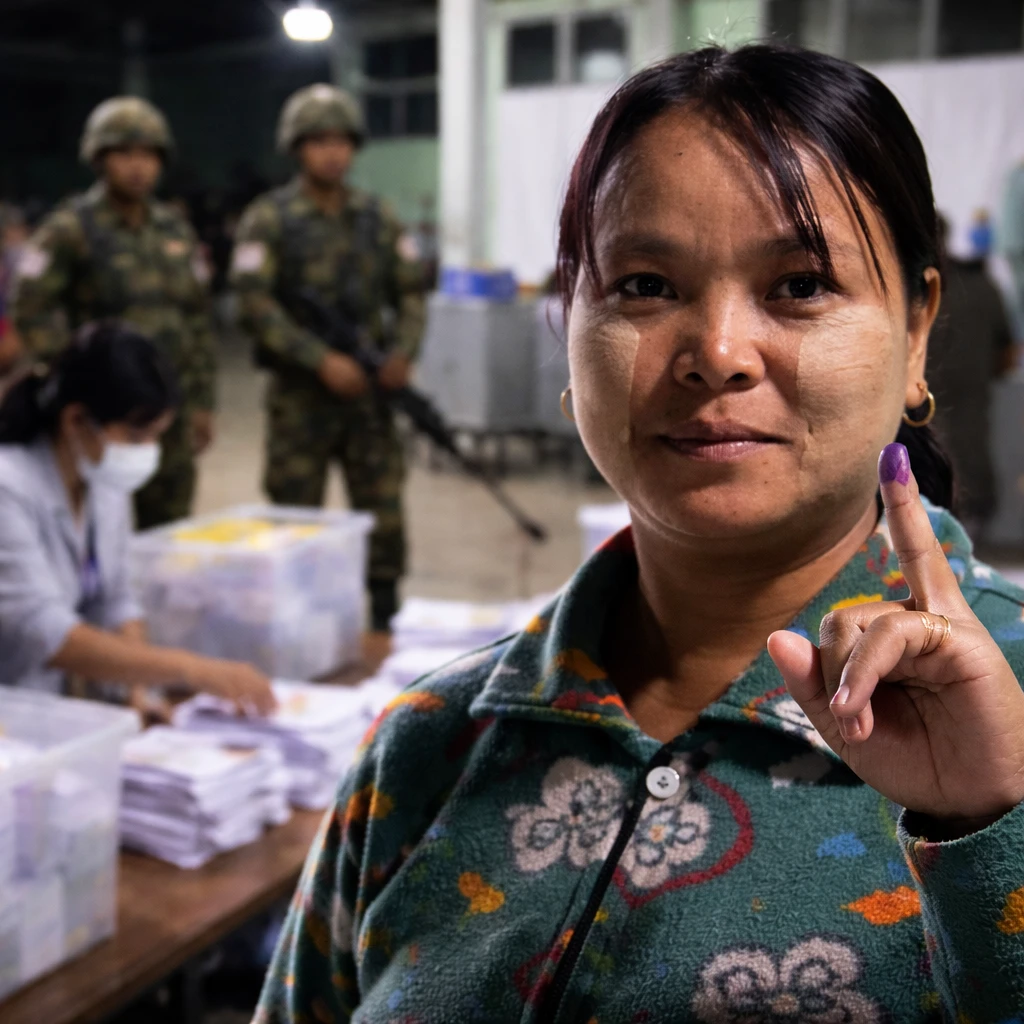

Myanmar reached the conclusion of its three-phase general elections on Sunday, wrapping up a nearly one-month-long electoral process that has ensured a parliamentary majority for the nation's ruling military and their allied parties. The staggered voting rounds, commencing in late December and culminating in late January, have been characterized by widespread allegations that the elections lack the attributes of a free and fair democratic process, effectively providing a veneer of legitimacy to military dominance following the February 2021 coup that ousted the civilian government led by Aung San Suu Kyi.
The military-supported Union Solidarity and Development Party (USDP) secured the majority of contested seats in the first two voting rounds. It is important to note that the Myanmar constitution allocates a quarter of the seats in both parliamentary chambers, the Pyithu Hluttaw and Amyotha Hluttaw, directly to the military, thereby guaranteeing legislative control and the ability to influence government formation decisions.
Observers and political participants widely anticipate that General Min Aung Hlaing, the senior military officer leading the present junta, will ascend to the presidency when the newly elected parliament convenes.
Conflict-Related Voting Restrictions
The military takeover in 2021 ignited significant opposition from various groups, propelling Myanmar into an ongoing civil war context. Due to security concerns arising from armed clashes, voting was suspended in over 20% of the country’s 330 municipalities. This significant reduction in voter participation areas contributes to critiques regarding the electoral process's validity and transparency.
Additionally, the Association of Southeast Asian Nations (ASEAN), which includes Myanmar as a member, explicitly declined to send observer missions and refrained from endorsing the election results, citing concerns about a lack of inclusiveness and freedom in voter participation, as stated by Malaysia’s Foreign Minister, Mohamad Hasan.
In response, General Min Aung Hlaing dismissed external criticism on election legitimacy, emphasizing that the ballots cast by Myanmar’s residents are the only valid indicator of the vote’s authenticity. Speaking at a polling station in Mandalay, the country’s second-largest city, he stressed, "We do not concern ourselves with recognition from foreign nations. We recognize the people's vote. That is the appropriate approach." However, he refrained from confirming whether he intends to assume a role within the new government, indicating that the president will be appointed upon parliamentary assembly.
Opposition Absence and New Restrictions
Notably absent from these elections was Aung San Suu Kyi, Myanmar’s former leader aged 80, and her National League for Democracy (NLD), which boycotted the process. Suu Kyi is incarcerated on multiple charges widely presumed to be politically motivated, resulting in a 27-year prison sentence. After securing sweeping victories in the 2015 and 2020 elections, the NLD was forced to disband in 2023 following refusal to comply with military-imposed registration rules.
Other opposition parties either declined to register or choose not to compete, citing unfair electoral conditions. Calls for boycotts were prominent among resistance groups. The introduction of a new Electoral Protection Law further constrained public discourse critical of the elections, imposing harsh penalties on dissenting voices. Authorities have arrested over 400 individuals recently for activities including leaflet distribution and social media postings deemed subversive.
Security Challenges During the Election Cycle
The first two voting rounds were disrupted by attacks from armed factions opposed to the military government, targeting polling stations and government structures across several municipalities. These incidents resulted in the deaths of at least two administrative officials, as reported by the ruling authorities.
On the final voting day, polls opened at 6 a.m. across 61 municipalities spanning six regions and three states, including areas that had experienced recent armed confrontations. Voters at a polling center in Dagon township, Yangon, reflected diverse sentiments; Soe Tint, 86, expressed hope for peace and development across various sectors such as education, whereas Lae Lae Yi, 62, conveyed skepticism about the electoral process, stating a lack of expectations.
Voting Limitations in Conflict Zones
The division of elections into three stages was a measure to contend with ongoing armed conflicts. The initial rounds occurred on December 28 and January 11, covering 202 of Myanmar’s 330 townships. Voting did not take place in 67 municipalities, predominantly controlled by insurgent groups, reducing the total parliamentary seats from the original 664 to 586.
Final comprehensive results are anticipated later in the week. The military government has announced plans to convene parliament in March, with the new administration expecting to begin operations in April.
According to the country’s legal framework, the party holding a majority in both parliamentary chambers selects the president, who subsequently appoints the cabinet and forms the new government. Election participation statistics released by the military indicate over 24 million eligible voters, reflecting a roughly 35% decrease from 2020 numbers. Reported voter turnout in the first two rounds hovered between 50% and 60%.
The election saw more than 4,800 candidates vying across 57 political parties for seats in national and regional legislatures, though only six parties competed on a national scale. Apart from the USDP, 17 additional parties secured between one and ten seats each in the legislative body.