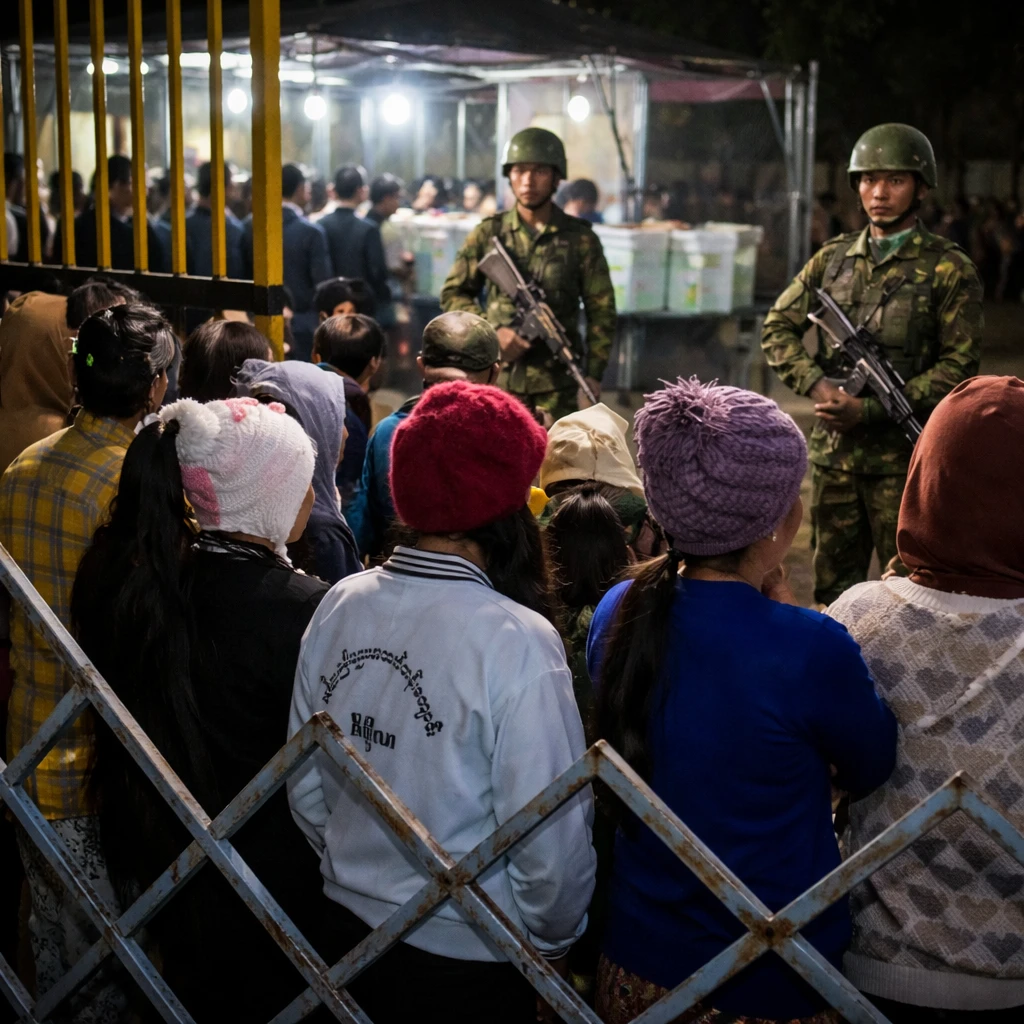

On Sunday, Myanmar began the initial stage of its first general election in half a decade, conducted under the supervision of the military government amid ongoing civil unrest across large areas of the country. This electoral process is set to span three separate voting phases, with the first round involving 102 out of the 330 townships nationwide. Subsequent voting will occur on January 11 and January 25. However, 65 townships are excluded from participation due to active armed conflict in those regions.
Complete results will only be available following the conclusion of all rounds, with announcements expected by February. It remains unclear whether the authorities will aggregate and release overall voter turnout figures from Sunday's voting event, although local polling stations have been publicly declaring individual counts.
The military government presents the election as a restoration of democratic governance. Senior General Min Aung Hlaing, the military leader who seized control in 2021, is widely anticipated to assume the presidency once the parliamentary results are finalized. However, this portrayal is undermined by key opposition parties' absence and multiple accounts of military intimidation aimed at compelling voter participation.
Over 4,800 candidates from 57 political parties are competing for seats in national and regional assemblies, yet only six nationwide parties have a realistic prospect of influencing parliamentary power. Among these, the Union Solidarity and Development Party, supported by the military, stands out as the dominant force.
The military's grip on power began with its February 2021 ousting of the elected government led by Aung San Suu Kyi’s National League for Democracy (NLD). Despite the NLD’s decisive victory in the 2020 elections, the military blocked the party from taking office for a second term, dissolving it in 2023 after it refused to register under new military-imposed regulations.
Criticism from independent observers and political adversaries points to the election as a mechanism designed to legitimize the existing military regime. These critics emphasize that excluding major opposition parties and suppressing dissenting voices during an ongoing civil war undermine the electoral process's credibility.
Tom Andrews, the United Nations-appointed human rights expert on Myanmar, condemned the election on social media as a “theater of the absurd performed at gunpoint,” highlighting ongoing bombings of civilians, imprisonment of political figures, and criminalization of dissent.
Conversely, some neighboring nations such as China, India, and Thailand may interpret the election as progress toward political stability, despite Western countries maintaining sanctions on Myanmar’s military leadership in response to anti-democratic actions and violent suppression.
Preliminary counts from one Yangon polling station revealed voter turnout at just under 37%, with 311 votes cast for the pro-military party out of 524 total ballots, suggesting that calls for a boycott by opposition groups may have influenced participation levels.
Among voters, some, like Khin Marlar, a 51-year-old from Yangon’s Kyauktada township, expressed a reluctant hope that participating in the election might lead to peace, noting her displacement from her home village due to conflict. Conversely, others, such as a Mon state resident identified only as Khin for safety reasons, reported feeling coerced to vote amid military threats and the presence of armed soldiers in their communities.
The political environment surrounding the election remains tense. More than 22,000 individuals are detained on political charges, and over 7,600 civilians have been killed by security forces since 2021, according to the Assistance Association for Political Prisoners. Armed resistance emerged following the military’s violent crackdown on peaceful protests after the 2021 takeover, leading to a humanitarian crisis with over 3.6 million people displaced.
A recently enacted Election Protection Law further restricts criticism of the electoral process, penalizing dissent. Despite this, opposition factions and armed groups have vowed to disrupt the elections, though no significant interference has been reported so far.
While Min Aung Hlaing has maintained that he is a civil servant and not a political party leader, he is widely expected to retain control, reflecting the military’s enduring dominance. He commented after voting, noting that the presidential selection is a parliamentary procedure to be addressed at the appropriate time.